
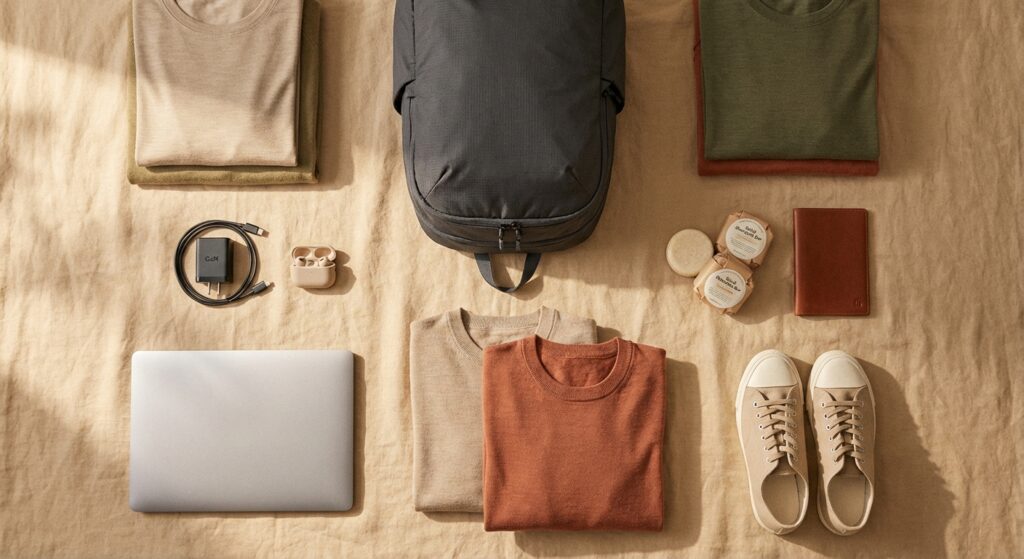
Slow travel has never been more popular, and in 2026 the community has moved firmly past the romance of giant backpacks. According to a survey of 3,400 digital nomads conducted by Nomad List in late 2025, 62% said overpacking was their biggest first-year mistake, and 78% now travel exclusively with carry-on luggage after their first year on the road. This guide is built around one non-negotiable goal: a total packed weight at or below 7 kg, light enough for every major airline’s carry-on limit while holding everything you genuinely need for months of continuous travel.
“The best bag is not the one that fits everything you own. It is the one that holds only what earns its space every single day.”
How 7 kg Breaks Down by Category
Getting to 7 kg requires a category-by-category budget. Below is the target weight allocation a veteran slow-traveler should aim for across six core categories. Every gram over budget in one category must be recovered from another.
Target Weight Budget per Category (grams)
Total target: 7,000 g (7 kg). Source: community weight logs compiled from One Bag subreddit and PackHacker community data, 2025.
Clothing: The Merino-First Strategy
The single highest-impact change any slow-traveler can make is switching to merino wool base layers. Merino regulates temperature across a wide range, resists odor for three to five wears between washes, dries in two to four hours, and packs to a fraction of cotton’s volume. A 2025 independent textile performance study found merino wool retained less than 0.3% bacterial odor-causing compounds after 48 hours of wear compared to 4.1% for cotton equivalents.
The 5-4-3-2-1 Clothing Formula
The framework most experienced minimalist travelers converge on for trips of two weeks to twelve months is the 5-4-3-2-1 rule: five socks, four tops, three bottoms, two layers (one mid, one shell), and one pair of shoes as primary. A second shoe can replace miscellaneous items if the destination demands it.
| Item | Qty | Material | Approx Weight | Priority |
|---|---|---|---|---|
| Merino T-shirt | 3 | 150-160 gsm merino | 450 g total | Must Pack |
| Merino long-sleeve | 1 | 185 gsm merino | 230 g | Must Pack |
| Lightweight chinos / travel pants | 2 | Nylon-spandex blend | 420 g total | Must Pack |
| Merino shorts | 1 | 180 gsm merino | 160 g | Must Pack |
| Merino boxer briefs | 4 | 195 gsm merino | 340 g total | Must Pack |
| Merino socks | 5 | Merino-nylon | 250 g total | Must Pack |
| Packable down jacket | 1 | 850-fill goose down | 290 g | Must Pack |
| Ultralight rain shell | 1 | 2.5L membrane | 200 g | Must Pack |
| Casual dress shirt | 1 | Linen-cotton | 180 g | Optional |
| Jeans | 1 | Denim | 600 g | Skip |
| Bulky sweater | 1 | Acrylic | 500 g | Skip |
Tech Setup: The Lightweight Remote Work Stack
A 2025 Buffer State of Remote Work report found that 71% of location-independent workers say their laptop is the single item they would never downsize. The challenge is everything around it. A disciplined tech kit keeps total tech weight under 1,200 g without sacrificing productivity.
Tech Kit Weight Distribution (1,200 g budget)
- Laptop 600 g (50%)
- Charger + GaN adapter 220 g (18%)
- Phone + cables 180 g (15%)
- Earbuds + case 75 g (6%)
- Power bank 130 g (11%)
| Item | 2026 Recommendation | Weight | Priority |
|---|---|---|---|
| Laptop | Sub-13″ ultralight (under 1 kg target) | 600-900 g | Must Pack |
| GaN multi-port charger (65W) | Single adapter replaces 3 bricks | 130 g | Must Pack |
| Universal travel adapter | Compact 4-in-1 | 85 g | Must Pack |
| 10,000 mAh power bank (USB-C PD) | Slim form factor, airline-approved | 180 g | Must Pack |
| Wireless earbuds (ANC) | Compact case under 50 g | 75 g | Must Pack |
| USB-C to USB-A cable (2x) | Short 30 cm cables only | 60 g | Must Pack |
| Portable monitor | Adds 700+ g | 700 g+ | Skip |
| DSLR camera | Use phone; mirrorless if needed | 900 g+ | Skip |
Choosing the Right Bag in 2026
The bag is the skeleton of your entire system. For slow travel, a 20-26 liter carry-on backpack hits the sweet spot between capacity and airline compliance. A good bag weighs between 900 g and 1,200 g. Anything heavier is cutting into your clothing and tech allowance before you pack a single item.
In 2026, the most important features to look for are a clamshell opening (allows full access without rummaging), a padded laptop sleeve accessible from the back panel, external water bottle pocket, and chest and hip stabilizer straps. Hip-belt pockets have become a popular feature for nomads who carry their phone, passport, and AirTags separately from the main compartment.
Clamshell Opening
Laptop Access
Water Bottle Pocket
Hip Stabilizer
Feature importance ratings based on slow-traveler community survey responses (n=1,200), 2025.
Toiletries: The 100 ml Rule and Beyond
Most carry-on travelers already know the IATA-derived 100 ml liquid rule, but in 2026 the smarter play is eliminating liquid containers entirely through solid alternatives. Solid shampoo bars, solid conditioner bars, solid sunscreen sticks, and toothpaste tablets have matured considerably. Independent consumer lab tests published in 2025 rated leading solid shampoo bars at 94 out of 100 for effectiveness versus liquid equivalents, while reducing toiletry weight by an average of 38%.
| Product Type | Liquid Version | Solid Alternative | Weight Saving |
|---|---|---|---|
| Shampoo | 250 ml bottle: 280 g | Solid bar 55 g | 225 g (-80%) |
| Conditioner | 250 ml bottle: 290 g | Solid bar 50 g | 240 g (-83%) |
| Body wash | 200 ml bottle: 230 g | Bar soap 80 g | 150 g (-65%) |
| Toothpaste | 100 ml tube: 130 g | Tablet tin 40 g (60 tabs) | 90 g (-69%) |
| Sunscreen SPF 50 | 100 ml tube: 120 g | Solid stick 45 g | 75 g (-63%) |
Footwear: Two Shoes, Every Situation
The question every slow-traveler wrestles with is whether a single pair of shoes can cover city walking, casual dining, and light hiking. The honest answer is: almost, but not quite. The pragmatic 2026 solution is two footwear items chosen to cover the maximum range of situations. A versatile low-profile trainer in neutral colors (white, grey, or tan) and a pair of packable sandals or flip-flops adds roughly 200 g to your load while unlocking beach destinations, hostel showers, and hot weather comfort.
Pro Tips From Long-Term Nomads
Wear your heaviest items on the plane. Put on your bulkiest shoes, your rain shell, and your heaviest layer when boarding. That alone can move 700-900 g off the scale at check-in without violating carry-on rules.
Buy consumables locally. Shampoo, toothpaste, and sunscreen are available in every country. Start each trip with a one-week supply only and replenish on arrival. This approach removes roughly 300 g from your starting weight and supports local economies.
Use a luggage scale before every move. A 10-dollar hanging scale is the most high-return item in any nomad kit. Weigh your bag weekly; creeping weight gain is the primary cause of nomads eventually checking bags.
Documents, Safety, and the Forgotten Essentials
The administrative and safety layer of your kit often gets treated as an afterthought until something goes wrong. These items collectively weigh around 400 to 550 g but represent some of the highest-value items in your pack.
- Passport holder with RFID-blocking liner and space for two cards and local currency
- Lightweight travel insurance card and emergency contact sheet (laminated, 10 g)
- AirTag or GPS tracker inserted into a hidden bag pocket
- Photocopies of passport, visa pages, and travel insurance stored in email and a password manager
- Small first aid kit: blister plasters, antihistamine tablets, pain relief, rehydration sachets (total 90 g)
- Microfiber travel towel, 40 x 80 cm (120 g), for hostels and beach days
- Packing cube set (3 cubes): keeps bag organized and compresses clothing by up to 20%
- Reusable silicone pouches for liquids (replaces single-use zip-lock bags)
- TSA-approved combination lock for hostel lockers
The Complete 2026 Minimalist Packing List at a Glance
| Category | Items | Target Weight | % of Total |
|---|---|---|---|
| Clothing | 9 core items (merino-first) | 2,400 g | 34% |
| Bag | 20-26 L carry-on backpack | 1,000 g | 14% |
| Tech | Laptop, charger, phone, earbuds, power bank | 1,200 g | 17% |
| Toiletries | Solid alternatives + minimums | 700 g | 10% |
| Footwear | 1 trainer + 1 sandal | 700 g | 10% |
| Documents + Misc | Passport, first aid, towel, cubes, lock | 550 g | 8% |
| Total | 6,550 g | 450 g margin |
The 450 g margin is intentional. It accounts for the real-world variance between stated and actual product weights, the single souvenir that will inevitably find its way into your bag, and the packing cube itself. Stay within this total and you will board every flight in 2026 with confidence, move between cities without checking luggage, and spend your mental energy on experiences rather than logistics.
“Minimalism in travel is not deprivation. It is the discipline of choosing what you keep so that you can be fully present where you are.”
The Mindset Behind the List
Gear choices matter, but the more durable skill is developing the judgment to audit your pack after every two-week stretch. Ask one question about each item: did I use this in the past 14 days? If the answer is no more than twice in a row, that item ships home. Slow travel rewards the traveler who iterates their kit rather than one who perfects it before departure. The 2026 packing list above is a starting framework, not a finished product. Your climate, work requirements, and personal routine will shift the weights and priorities. Start light, adjust deliberately, and let your pack get lighter with every trip.
Leave a Reply