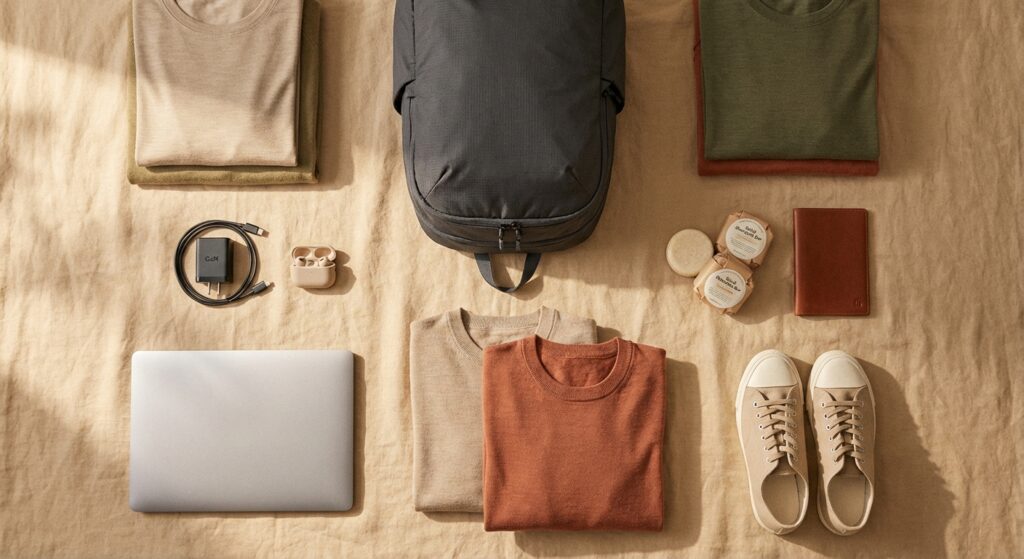
After three years of slow travel across 24 countries with a single 26-litre backpack, I’ve learned that the best gear setup is the one you can forget about and that every gram you eliminate creates space for the experiences that actually matter.
The global digital nomad population reached an estimated 35 million people in 2023, according to MBO Partners research, and projections suggest that number will approach 60 million by 2030. As remote work normalises and visa frameworks expand, the one-bag philosophy has shifted from countercultural quirk to a quietly dominant travel strategy particularly among slow travellers who stay in each destination for weeks or months rather than hopping between cities every other day.
This post isn’t a gear haul video. It’s a deliberately curated, weight-audited system. Every item earns its place by serving multiple functions, lasting under demanding conditions, and fitting comfortably into carry-on limits enforced by budget carriers from Kuala Lumpur to Lisbon.
Why One Bag Changes Everything
Traditional travel logic says pack for every scenario. One-bag philosophy inverts that: pack for your most common scenario and solve edge cases cheaply on the road. The cognitive and physical dividends are enormous. You never check luggage, never wait at carousels, never pay overweight fees. You move with the fluidity of a local rather than the lumbering gait of someone with a 65-litre expedition pack.
For slow travellers in particular, the benefits compound. When you stay somewhere for three weeks, you do laundry. You don’t need seven changes of clothes. You don’t need a separate “going out” bag. Your laptop bag is your day bag, your weekend bag, and your primary luggage.
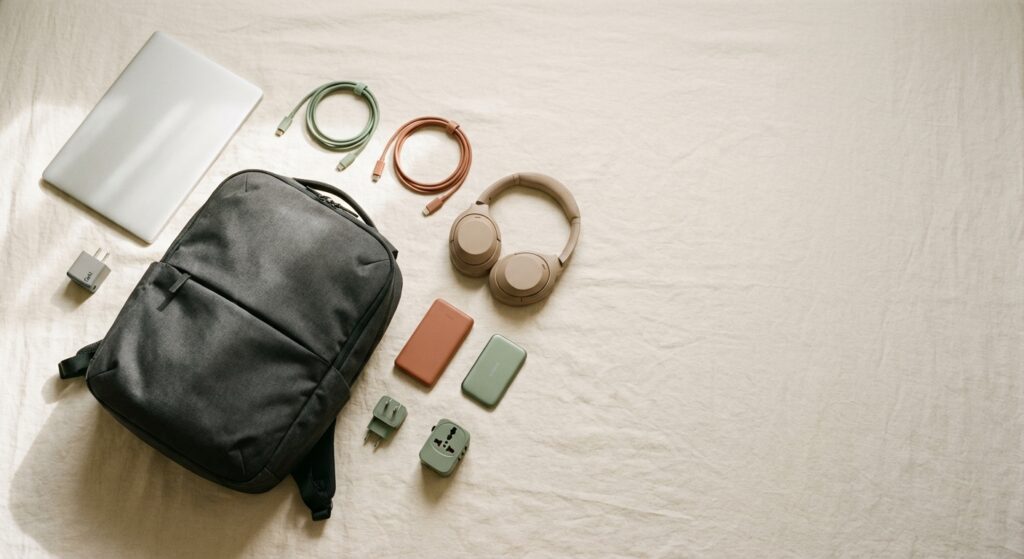
The Complete Gear List & Weight Audit
Below is my current setup as of early 2026, with honest weights measured on a postal scale. The goal is staying under 7.5 kg total the strictest cabin baggage weight limit you’ll encounter on European and Southeast Asian budget carriers.
| Category | Item | Weight | Why It Made the Cut |
|---|---|---|---|
| Bag | 26L daypack with laptop sleeve | 920g | Meets IATA carry-on specs, clamshell opening |
| Computing | 14″ Ultrabook (1.4 kg class) | 1,400g | Core workhorse video calls, writing, light dev |
| Computing | USB-C 65W GaN charger (2-port) | 118g | Charges laptop + phone simultaneously |
| Computing | Travel dock (2× USB-A, HDMI, SD) | 72g | Turns any monitor or TV into a workstation |
| Audio/Video | Over-ear ANC headphones | 253g | Flights, coworking noise, call quality |
| Audio/Video | Compact USB-C webcam (1080p) | 88g | Laptop cameras look unprofessional on calls |
| Connectivity | Unlocked dual-SIM travel phone | 195g | Local SIM + eSIM fallback in every country |
| Connectivity | Pocket WiFi / travel router | 98g | Essential when hostel WiFi is shared or filtered |
| Power | 10,000 mAh power bank (PD 20W) | 218g | One charge cycle for phone + earbuds + watch |
| Power | Universal travel adapter (compact) | 64g | Covers EU, UK, US, AU all in one unit |
| Storage | 1TB portable SSD | 46g | Offline media, backups, large file transfers |
| Cables | 3× USB-C (0.5m, 1m, 2m) + 1 Lightning | 110g | Every scenario covered; braided for durability |
| Organisation | Cable/accessory packing cube | 38g | TSA loves it; so do I at 2 AM in a dark hostel |
Total tech kit weight: approx. 3.72 kg. Combined with a minimal clothing layer (typically 2.8 kg), the complete pack sits at roughly 7.1 to 7.3 kg depending on the day and what I’ve consumed.
Weight Distribution: Visualised
What Share of My Pack is Tech?
- Laptop & computing 28%
- Accessories & cables 24%
- Clothing 16%
- Bag & organisation 14%
- Toiletries & misc 18%
One-Bag vs Traditional Pack: A Practical Comparison
This comparison is based on a typical 30-day slow travel trip. The “traditional” approach assumes a 70L checked bag.
| Factor | 1-Bag (26L) | Traditional (70L) |
|---|---|---|
| Average checked bag fees (EU budget, 4 flights) | €0 | €120 to 180 |
| Time lost at baggage carousels | 0 min | ~90 min/trip |
| Fits under airplane seat | ✓ | ✗ |
| Can hop on any transport spontaneously | ✓ | ✗ |
| Lost luggage risk | Zero | ~1% per flight (SITA data) |
| Physical strain (average daily carry) | Low (~7 kg) | High (15 to 20 kg) |
| Encourages deliberate packing | ✓ | ✗ |
Connectivity: The Real Work-from-Anywhere Infrastructure
Tech nomads often obsess over hardware and underestimate connectivity. A 2023 survey of remote workers by NordLayer found that 67% had experienced a work disruption caused by poor internet while travelling. My connectivity stack addresses this at every layer.
First, a dual-SIM phone that accepts both a physical SIM and an eSIM means I can buy a cheap local data SIM the moment I land while maintaining a backup eSIM data plan as a safety net. In most of Southeast Asia, Europe, and Latin America, a 30-day local SIM with 20 to 50 GB of data costs between $3 and $15 USD dramatically cheaper than roaming.
Second, a pocket travel router solves a problem that power users encounter constantly: hotel and Airbnb networks that limit connections per device, require per-device registration, or have mediocre range. The router connects to the local network once and rebroadcasts a private, password-protected network for all your devices.
The 3-2-1 Backup Rule Nomad Edition
Maintain 3 copies of critical work: 1 on your local SSD, 1 on cloud storage (synced automatically), and 1 on your portable SSD stored separately from your laptop. A stolen laptop recovers in hours. Lost unreplicated work doesn’t.
The 5 Things I Removed (And Don’t Miss)
- DSLR camera Modern ultrawide phone cameras cover 95% of travel photography needs. The 5% I miss isn’t worth 800 grams.
- Tablet Redundant if you have a laptop and a phone. I use my laptop for reading in bed; a cheap e-reader is lighter than any tablet and battery lasts weeks.
- Separate laptop bag My main backpack has a dedicated padded sleeve. Two bags defeats the whole purpose.
- Full-size keyboard & mouse A coworking space trip once a week is cheaper than carrying 400g of peripherals everywhere. Use their equipment.
- Third monitor I used a portable USB-C monitor for 6 months. Removed it. The discipline of a single screen is a surprising productivity gain for focused work.
Choosing Your Bag: What the Numbers Say
The 26-litre sweet spot is not arbitrary. Bag volume research and community data from nomad forums consistently show that 20 to 30 litres is the range that satisfies both the strictest cabin restrictions (Ryanair, AirAsia, IndiGo) and provides enough volume for a realistic week-to-ten-day packing list that assumes access to laundry.
Bags below 20 litres force extreme minimalism that becomes impractical for working nomads with tech equipment. Bags above 35 litres inevitably get over-packed the extra space is a psychological invitation to add “just in case” items. At 26 litres, you are forced to make deliberate decisions, and deliberate decisions consistently outperform intuitive ones when it comes to long-term satisfaction with your kit.
Look for: a clamshell or panel-loading design (easier packing than top-load), a dedicated padded laptop sleeve accessible from the back panel, external water bottle pockets, and critically a weight under 1 kg for the bag itself. Your bag should be infrastructure, not the main attraction.
Software Is Part of Your Setup Too
The physical kit is only half the system. A lean software stack reduces cognitive overhead and compensates for hardware limitations. Key pillars: a cloud document platform that works offline and syncs on reconnection, a password manager with biometric unlock, a lightweight VPN (especially important for banking on unfamiliar networks), and a local-first task management system that doesn’t require connectivity to function.
Nomads who rely heavily on browser tabs and bookmarks suffer most when WiFi is unreliable. Download what you need, work offline where possible, sync opportunistically. This is the digital equivalent of not checking luggage: it requires planning upfront, but eliminates friction everywhere else.
Final Thought: The Pack Reflects the Philosophy
Slow travel rewards depth over breadth. Spending three weeks in Tbilisi or Medellín instead of three days means you cook sometimes, you find the neighbourhood café, you stop being a tourist and start being a temporary resident. That rhythm is incompatible with heavy luggage, complicated tech setups, and gear that demands attention.
The 1-bag system isn’t about asceticism. It’s about choosing what serves you so thoroughly that nothing else earns a spot. When your pack weighs 7 kilograms and fits under the seat in front of you, travel stops being logistical and starts being experiential. That’s the whole point.