
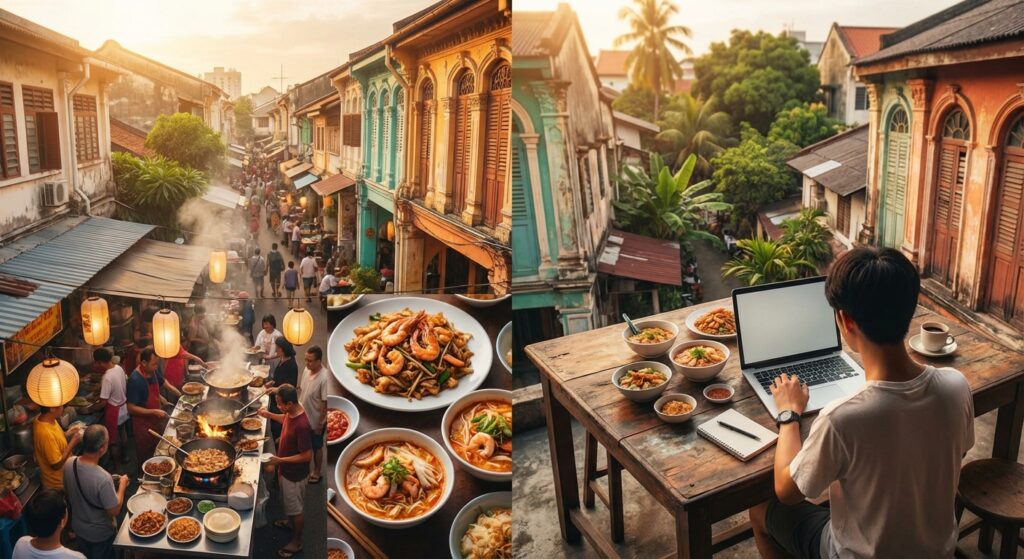
Why Penang in 2026?
Penang has quietly earned its reputation as the foodie capital of Southeast Asia, and in 2026 it is also becoming one of the continent’s top digital nomad hubs. The state government recently upgraded George Town’s fiber backbone, co-working spaces multiplied across Gurney Drive and Jalan Burmah, and Penang International Airport now sees direct routes from Kuala Lumpur, Singapore, Bangkok, and Taipei.
Yet the food remains the headline act. Char kway teow sizzled in century-old woks, Hokkien mee with shrimp-based broth, nasi kandar piled high with curries, assam laksa so bracing it rewires your palate. You can eat brilliantly here for under RM 20 a day if you know where to go, and that is before we even discuss the durian season surplus.
The Malaysian ringgit (MYR / RM) traded at approximately 3.90 to the US dollar as of February 2026, which means a USD 1,000 budget translates to roughly RM 3,900 in monthly purchasing power.
All figures in this guide are in Malaysian Ringgit (MYR). Approximate USD conversions use the current February 2026 rate of RM 3.90 = USD 1. Prices reflect early 2026 market rates verified through local property portals, community boards, and on-the-ground reporting.
The Full Monthly Budget Breakdown
Accommodation Costs in Penang
Penang’s rental market splits neatly between George Town (the UNESCO heritage core), Gurney Drive and Pulau Tikus (the upscale district), and Batu Ferringhi (the beachside strip). For nomads staying one to three months, furnished apartments and serviced rooms represent the best value.
| Accommodation Type | Location | Monthly Cost (RM) | Approx. USD | Best For |
|---|---|---|---|---|
| Hostel private room | George Town | RM 600 to 900 | USD 154 to 231 | Ultra-budget nomads |
| Co-living room (shared) | George Town / Pulau Tikus | RM 900 to 1,400 | USD 231 to 359 | Community seekers |
| Studio apartment (unfurnished) | Gurney Drive | RM 1,200 to 1,800 | USD 308 to 462 | Mid-range solo nomads |
| Studio apartment (furnished) | George Town heritage | RM 1,400 to 2,200 | USD 359 to 564 | Comfort-conscious nomads |
| 1-bedroom condo (furnished) | Gurney / Batu Ferringhi | RM 2,200 to 3,500 | USD 564 to 897 | Couples or those wanting space |
| Serviced apartment (short-term) | Island-wide | RM 2,800 to 4,500 | USD 718 to 1,154 | Flexibility seekers |
Utilities including water, electricity, and air-conditioning run between RM 80 and RM 250 per month when not bundled into the rent. Heritage shophouse apartments in George Town tend to have older wiring, so confirm the air-conditioning situation before signing.
Food Costs: The Glorious Part
Penang food is a near-religious subject. The hawker stall culture means that eating out is often cheaper than cooking at home. A full meal at a kopitiam (traditional coffee shop) costs between RM 5 and RM 12. Even mid-range restaurants rarely top RM 40 per person without alcohol.
| Eating Style | Daily Food Budget (RM) | Monthly Total (RM) | Approx. USD/Month |
|---|---|---|---|
| Hawker stalls only (3 meals) | RM 18 to 25 | RM 540 to 750 | USD 138 to 192 |
| Mixed hawker + cafe lunches | RM 35 to 55 | RM 1,050 to 1,650 | USD 269 to 423 |
| Restaurant-heavy dining | RM 70 to 100 | RM 2,100 to 3,000 | USD 538 to 769 |
| Home cooking (supermarket) | RM 20 to 35 | RM 600 to 1,050 | USD 154 to 269 |
A Grab food delivery order adds roughly RM 5 to RM 8 in delivery fees on top of the food cost. Regular coffee drinkers should note that a proper hand-poured specialty coffee at George Town’s third-wave cafes runs RM 14 to RM 20, while a traditional kopi-o at a kopitiam costs just RM 1.80 to RM 2.50.
Spending Breakdown by Lifestyle Tier
Transport: Getting Around Penang Island
Penang Island is not particularly large, but public transport remains patchy outside George Town. Most nomads rely on a combination of Grab rides and rented motorbikes. The Penang Rapid Bus network covers George Town reasonably well, but schedules can be infrequent in residential areas.
| Transport Option | Cost | Notes |
|---|---|---|
| Grab car (within George Town) | RM 8 to 18 per trip | Most reliable, surge pricing evenings |
| Rapid Penang bus | RM 1.40 to 3 per ride | Infrequent but very cheap |
| Motorbike rental (monthly) | RM 300 to 500 | Best freedom option, petrol extra ~RM 60 |
| Bicycle rental (daily) | RM 20 to 40 per day | Great for heritage zone, hilly elsewhere |
| Car rental (monthly) | RM 1,200 to 2,000 | Only worthwhile for island-wide mobility |
| Ferry to Butterworth (mainland) | RM 1.20 | One way, still the classic commuter route |
Co-working and Connectivity
Penang’s co-working scene expanded significantly between 2023 and 2026. George Town now has a cluster of well-regarded spaces concentrated around Lebuh Chulia, Jalan Penang, and the Straits Quay marina side. Most cafes offer free Wi-Fi with speeds that make video calls workable, though consistency varies.
| Option | Monthly Cost (RM) | Typical Speed |
|---|---|---|
| Cafe Wi-Fi (daily visits) | RM 0 (coffee costs ~RM 10/day) | 20 to 80 Mbps |
| Co-working hot desk pass | RM 350 to 500 | 100 to 300 Mbps |
| Co-working dedicated desk | RM 600 to 900 | 300 + Mbps |
| Home fiber (Unifi / Maxis) | RM 89 to 179 | 300 to 800 Mbps |
| SIM data (Yes / Maxis prepaid) | RM 50 to 100 | 4G/5G, 40 to 150 Mbps |
How Penang Compares to Other Southeast Asian Nomad Hotspots
Penang consistently lands in the sweet spot: cheaper than Bangkok and Bali, pricier than Da Nang, but with a food scene that arguably outclasses all of them. The city-island hybrid nature means you get genuine urban infrastructure alongside genuine culture rather than an artificially constructed expat bubble.
Budget Allocation Snapshot (Mid-Range Nomad)
Visa and Entry Considerations in 2026
Malaysia operates a generous visa-on-arrival regime. Citizens of most Western nations, Japan, South Korea, Australia, and a significant portion of Southeast Asian countries receive a 90-day visa-free entry. The Malaysia Digital Nomad Pass (De Rantau) remains active in 2026 and allows qualifying remote workers to stay for 12 months with a renewable option, though it requires proof of employment and a minimum income threshold of approximately USD 2,000 per month (RM 7,800 at current rates).
Standard border runs involve crossing to Thailand via Padang Besar or taking the ferry to Langkawi, which sits in a duty-free zone. Longer-term residents increasingly find the DE Rantau Pass cost-effective at around RM 1,060 in total application fees versus the hassle of repeated border crossings.
Seasonal Cost Notes
Penang prices remain relatively stable year-round because the island is not purely a seasonal tourist destination. However, accommodation costs spike roughly 20 to 30 percent during the George Town Festival (July), Chinese New Year, and Hari Raya periods. Durian season (May to August) is actually a budget win for foodie nomads since overnight prices spike at stalls as supply peaks.
Healthcare and Insurance
Penang is the medical tourism capital of Malaysia and possibly Southeast Asia. Penang Adventist Hospital, Gleneagles, and Island Hospital deliver international-standard care at a fraction of Western costs. A general practitioner visit runs between RM 40 and RM 80, while specialist consultations typically fall in the RM 150 to RM 350 range.
Most nomads carry international health insurance averaging USD 80 to USD 180 per month (RM 312 to RM 702) depending on age and coverage level. Dental work is an area where Penang truly shines: a full dental cleaning costs RM 80 to RM 120, while more complex procedures like crowns or root canals are priced at 25 to 40 percent of UK or US rates.
Practical Money-Saving Tips for Penang
The single biggest lever on your budget is accommodation. Committing to a three-month rental rather than month-to-month typically saves between 15 and 25 percent. Negotiating in Malay or demonstrating local food knowledge (a genuine appreciation of hawker culture) goes a long way with landlords.
For food, the golden rule is eat where the aunties and uncles eat. The hawker stalls that open before 8am and close by 1pm represent the real Penang, and they are both the cheapest and the most authentic options on the island. The tourist-adjacent stalls in the Armenian Street area charge a premium of roughly 40 to 60 percent over local-facing equivalents two streets away.
A monthly touch-and-go reload card for the Rapid Penang buses plus a prepaid Grab wallet top-up covers most transport needs without surprises. Motorbike rental makes financial sense if you are staying beyond six weeks and plan to explore beyond George Town.
Final Verdict: Is Penang Worth It in 2026?
For the foodie nomad specifically, Penang may be the most value-dense city in Southeast Asia. You can sustain a genuinely comfortable, culturally rich, and gastronomically adventurous lifestyle on RM 4,000 to RM 5,000 per month (roughly USD 1,026 to USD 1,282 at the current RM 3.90 rate). Push that to RM 6,000 and you are living very well indeed.
The combination of fast internet, English fluency among locals, excellent healthcare, world-class food at street prices, and a UNESCO heritage zone to wander through on slow afternoons makes Penang unusually complete for a city of its size. Kuala Lumpur offers more corporate infrastructure and Bangkok more nightlife, but neither delivers the same culinary depth at Penang’s price point.
If you work remotely, love eating well, and want a base in Southeast Asia that feels like a real city rather than an expat theme park, Penang in 2026 belongs at the top of your shortlist.
Leave a Reply