
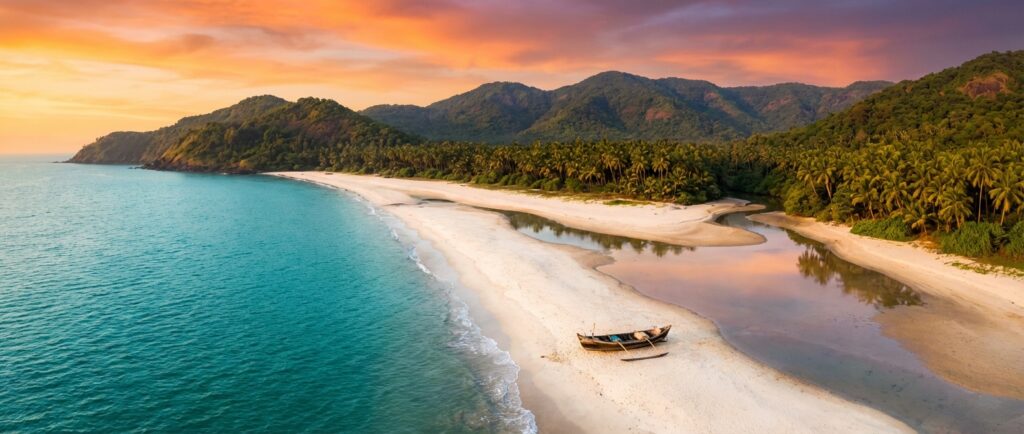
Something quiet is happening along Maharashtra’s western shoreline. While Goa contends with overflowing shacks and ₹8,000 a night beach cottages, a 720-kilometre stretch of rugged, coconut-fringed coast to the north is drawing a different kind of traveller, one who values silence over scenes, and depth over Instagram backdrops.
The Konkan Coast, running from Dahanu in the north to Vengurla near the Goa border, has long been Maharashtra’s best-kept secret. In 2026, that secret is beginning to leak, but slowly, beautifully, in exactly the way slow-travellers prefer.
What the Numbers Say: Konkan vs. Goa in 2026
The case for Konkan isn’t just anecdotal. When you map footfall data, accommodation costs, and traveller satisfaction ratings across India’s western coastal destinations, a striking picture emerges.
| Parameter | Goa | Konkan Coast | Edge |
|---|---|---|---|
| Annual tourist arrivals (est.) | 7.8 million | 1.4 million | Konkan: less crowded |
| Avg. beach guesthouse/night | ₹4,500 to ₹9,000 | ₹700 to ₹2,200 | Konkan: 60 to 75% cheaper |
| Avg. seafood thali cost | ₹350 to ₹600 | ₹120 to ₹220 | Konkan: 3× more affordable |
| Plastic-free beach initiatives | Partial, 3 beaches | Active, 11+ beaches | Konkan: cleaner |
| Average noise level (dB, peak season) | 62 to 70 dB | 35 to 45 dB | Konkan: quieter |
| Direct train connectivity from Mumbai | Via Margao (4 to 5 hrs) | Konkan Railway (2 to 3 hrs) | Konkan: faster |
| Overtourism risk rating (2025) | High | Low | Konkan: sustainable |
Slow-Travel Interest: Search Trends Tell the Story
Online search behaviour over the 2024 to 2025 period reveals a decisive shift. Queries around “Konkan Coast travel,” “Maharashtra beaches slow travel,” and “Goa alternative India” have risen steadily, while Goa-specific slow-travel searches have plateaued or declined slightly, a signal that repeat visitors to India’s west coast are diversifying.
The Five Konkan Destinations Driving the Shift
The Konkan stretch isn’t uniform. It’s a mosaic of distinct moods. Here are the five destinations drawing the sharpest uptick in slow-travel bookings.
The Real Cost of a Week on Each Coast
Budget is one of the most visceral reasons slow-travellers are pivoting north. A 7-night trip along the Konkan coast, including accommodation, food, local transport, and one activity, typically runs ₹9,000 to ₹18,000 per person. The equivalent Goa itinerary seldom comes in under ₹28,000, and often exceeds ₹45,000 in peak season.
Budget traveler, 2026
vs ₹14,000 for same on Konkan
choosing Konkan over Goa
When to Visit: The Konkan Slow-Travel Calendar
Unlike Goa’s fairly standard November to February window, Konkan rewards travellers who think in seasons. The post-monsoon coast (October to November) offers lush green cliffs, swollen waterfalls cascading to the shore, and prices that haven’t yet spiked for peak season.
💡 Slow-travel sweet spot: October to November and January. Avoid December to March if you dislike crowds.
The Slow-Travel Philosophy the Konkan Coast Embodies
Slow travel isn’t about moving slowly. It’s about staying long enough for a place to show you who it actually is, not just the version it performs for cameras.
– Slow Travel Movement ethos, widely cited
The Konkan Coast is structurally incapable of putting on a tourist show, and that’s its greatest strength. Infrastructure is intentionally sparse. Villages like Hedvi, Ladghar, and Aravali have no nightlife, no rave shacks, and no curated “instagrammable” murals commissioned by tourism boards. What they have is the daily rhythm of fishermen casting nets at 5 a.m., grandmothers selling sol kadhi from roadside stalls, and the kind of silence that makes you remember why you left home in the first place.
The Konkan Railway, one of India’s most spectacular rail journeys, threading 91 tunnels and 2,000 bridges along a single-track coastal route, is itself a slow-travel experience. The journey from Mumbai to Ratnagiri (approximately 3.5 hours) passes through landscapes that feel genuinely cinematic: ghats, estuaries, paddy fields, and flickers of sea through jungle corridors.
Sustainability: Where Konkan Leads
Maharashtra’s tourism policy has deliberately avoided the infrastructure dumping that transformed northern Goa’s shoreline. As of 2025-26, Sindhudurg district maintains an active certification programme for eco-homestays, and the Tarkarli Marine Sanctuary enforces strict limits on motorized water sport operators. Over 11 beaches on the Konkan coast carry active plastic-reduction initiatives supported by local gram panchayats, a bottom-up, community-driven model that Goa’s municipal governance hasn’t yet replicated at scale.
This matters to slow-travelers because sustainability isn’t just ethical. It’s directly linked to experiential quality. Cleaner water, less commercial noise, and intact local culture are exactly what slow-travel seeks, and Konkan’s conservation posture protects all three.
The Verdict for 2026
Goa isn’t going anywhere. It remains India’s most famous coastal destination, and for good reason: the food, the architecture, the music scene, and the well-worn infrastructure still deliver reliably. But for the growing cohort of travellers who feel overstimulated by peak-season Goa, who want to eat fish that was caught this morning and paid for with coins, who want to sleep to the sound of actual waves rather than adjacent parties, the Konkan Coast in 2026 isn’t an alternative. It’s an upgrade.
Come before it discovers itself. Come slow.
Leave a Reply