
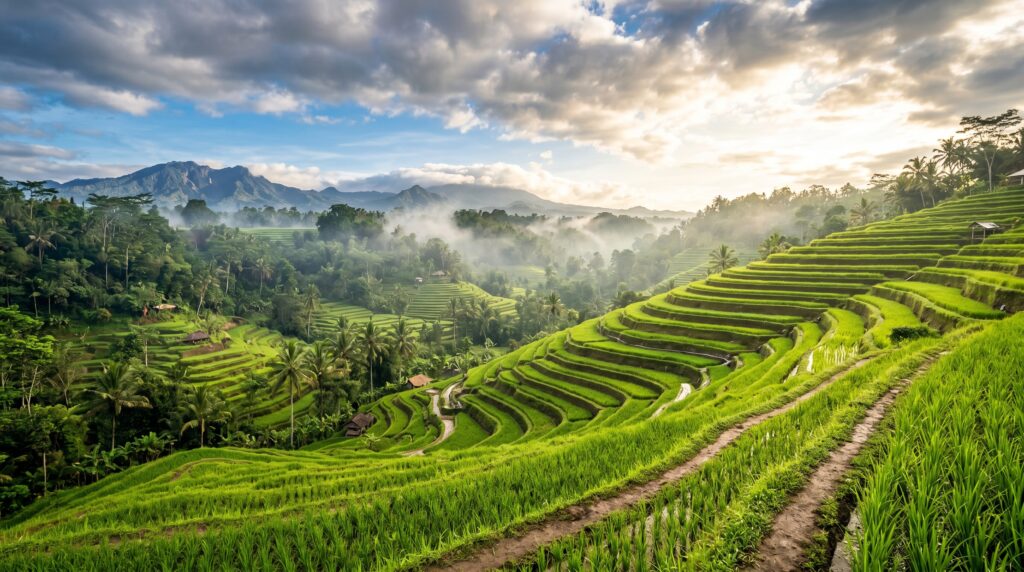
Bali’s Dry Season Begins: Why May 2026 Is the Best Time for Digital Nomads to Visit
The rains have lifted, the coworking cafes are buzzing, and the rice terraces are impossibly green. Here is everything you need to know.
Every year, somewhere around the first week of May, a quiet transformation sweeps across Bali. The heavy afternoon rains that define the wet season taper off. The skies sharpen to a blue that feels almost theatrical. The roads dry out. The surf at Canggu picks up a reliable southwest swell. And coworking spaces from Ubud to Seminyak fill back up with laptops and cold brew and people who have collectively made the same smart decision: to be in Bali when the dry season begins.
For digital nomads specifically, May 2026 represents something close to a perfect window. It sits at the opening of the dry season before the European summer crowd arrives in July and August. Accommodation prices have not yet spiked. Temperatures are comfortable. And the infrastructure that has made Bali one of the world’s top remote-work destinations has only improved since 2024.
This guide breaks down the data, the practical realities, and the neighborhood-by-neighborhood picture of why May 2026 deserves to be on every location-independent worker’s calendar.
The Climate Case for May: What the Data Actually Shows
Bali sits close to the equator and experiences two broad seasons: a wet season from roughly October through March, and a dry season running April through September. May is the first fully settled month of the dry season. Rainfall drops sharply from the wet-season peaks, skies clear, and humidity becomes noticeably more manageable than the sticky 85 percent averages of January and February.
World Meteorological Organization 30-year climate normals. Green bars indicate dry season months. May records approximately 55mm of rainfall on average.
May’s average rainfall of around 55mm is roughly 80 percent lower than January’s peak. When rain does fall in May, it tends to come in short, sharp showers in the early morning or late evening, not the all-day downpours that can paralyse transport and flooding-prone areas during the wet season. For someone trying to commute between a villa and a coworking space on a scooter, this distinction matters enormously.
Gray bars indicate wet season months. Dark green marks May. Data sourced from Bali Meteorology, Climatology and Geophysics Agency averages.
July and August do edge out May on raw sunshine hours, but they also bring Bali’s peak tourist season. Flights are more expensive, accommodation in Seminyak and Canggu becomes both scarcer and pricier, and the roads around Kuta can feel genuinely unworkable. May gives you the overwhelming majority of the weather benefits at a fraction of the crowd cost.
The Sweet-Spot Economics of Arriving in May
Bali’s tourism economy has its own predictable rhythm. School holidays in Europe and Australia drive two distinct crowding peaks: a short one in April around Easter, and a much larger one spanning July through late August. Prices, availability, and ambient noise levels all respond accordingly. May and June sit in the valley between these peaks with high weather quality, lower demand, and correspondingly attractive prices for longer stays.
Aggregated from Airbnb, Booking.com, and Flokq monthly rate data for private villa and apartment rentals in Canggu and Seminyak.
Based on aggregated rental market data and booking platform patterns, a private villa with a pool in Canggu that runs around USD 1,800 per month in August can often be secured for USD 1,100 to 1,300 per month in May on a four-week booking. That saving alone covers most of a month’s food budget.
Cost of Living in May 2026: Bali Versus Other Nomad Hubs
Bali’s cost advantage over other major digital nomad destinations is well established, but it is worth quantifying in specific terms for 2026. The comparison below reflects estimated monthly costs for a single professional working remotely at a comfortable but not extravagant standard of living.
Sources: Numbeo cost of living index Q1 2026, Nomad List community data, local property listings. Mid-range budget for a solo professional.
Chiang Mai edges out Bali on pure cost, but Bali’s infrastructure for remote workers including quality of coworking spaces, international food options, English-language accessibility, and overall quality of lifestyle amenities has advanced considerably. For many nomads, Bali now represents the optimal balance of affordability and quality of life.
The Visa Situation in 2026: What Has Changed
Indonesia introduced the Digital Nomad Visa as part of its Second Home Visa framework, and while the formal pathway saw some revision in late 2024, the practical options for remote workers in 2026 remain workable. The most commonly used route is the B211A Social and Cultural Visa, which allows stays of up to 60 days with extensions possible up to 180 days through a visa agent.
| Visa Option | Maximum Stay | Approximate Cost | Best For |
|---|---|---|---|
| Visa on Arrival (VoA) | 30 days + 30 extension | USD 35 + USD 35 | Short visits, scouting trips |
| B211A Social Cultural | 60 days base, up to 180 extended | USD 45 to 75 via agent | Most digital nomads |
| B211A Full Extension Chain | 180 days | USD 200 to 350 total | 3 to 6 month stays |
| Second Home Visa | 5 years renewable | USD 400 to 600 | Long-term residents with savings |
The key practical note: Bali is extremely well set up for visa runs and agent-assisted extensions. If you arrive on the Visa on Arrival in May and want to stay through the summer, a B211A extension handled through a reputable local agent is the standard approach. Budget an extra USD 150 to 200 for this process and factor two to three working days for paperwork.
Connectivity and Coworking: The Infrastructure Reality
Five years ago, slow internet was the main hesitation around remote work in Bali. That concern has largely been resolved. Fiber connectivity reached Canggu, Seminyak, and most of Ubud by 2022, and major coworking spaces now routinely offer speeds of 100 Mbps to 300 Mbps with redundant connections. Even many cafes and villas have made the investment.
Composite score incorporating: internet reliability, coworking density, accommodation availability, food scene quality, and transport access. Compiled from Nomad List 2025 data and community survey responses.
Canggu remains the dominant center of Bali’s nomad ecosystem. Dozens of coworking spaces are concentrated within a few square kilometers, ranging from day-pass cafes to full-service offices with hot desks, private booths, meeting rooms, and event programming. Prices typically run USD 6 to 15 per day or USD 80 to 180 per month for a hot desk.
Pick up a Telkomsel or XL Axiata SIM at the airport. A 30-day 50GB data plan costs around USD 10. Essential as a backup when villa Wi-Fi underperforms.
PLN outages still occur, especially after tropical storms. Good coworking spaces have UPS systems. Always keep your laptop charged before evening work sessions.
Always request a speed test result from landlords before committing to a monthly villa. Legitimate listings on Airbnb and Flokq increasingly show real-time speed data.
A small number of services are geoblocked in Indonesia. A reliable VPN solves this and is a standard tool in most nomad setups. Mullvad and ProtonVPN both work well from Bali.
Neighborhood Guide: Where to Base Yourself in May
Bali is not a single place. It is a collection of quite different microenvironments, each with distinct personalities and tradeoffs. The right base depends on what you need from your days off the clock as much as from your working hours.
| Area | Vibe | Avg Monthly Rent | Internet | Best For |
|---|---|---|---|---|
| Canggu | Surf, coffee, hustle | $700 to $1,200 | Excellent | First-time nomads, community seekers |
| Ubud | Culture, nature, yoga | $500 to $950 | Very good | Deep focus work, wellness routines |
| Seminyak | Beach, dining, nightlife | $900 to $1,600 | Good | Social professionals, longer stays |
| Sanur | Calm, family-friendly | $550 to $900 | Good | Families, those valuing quiet |
| Uluwatu | Cliffs, surf, boutique | $600 to $1,100 | Moderate | Experienced surfers, escapists |
| Amed | Remote, dive-focused | $300 to $600 | Limited | Deep retreats, short stays only |
Midpoint of advertised monthly rental ranges for furnished private rooms and studios. Sourced from Airbnb, Flokq, and local Facebook groups, May 2026.
For most first-time nomads, Canggu is the logical starting point. It has the densest concentration of coworking options, the strongest community events calendar, and enough variety in cafes and restaurants that daily routines never feel monotonous. For those who have done the Canggu loop before, May in Ubud offers a quieter alternative: the rice terraces are lush from the tail end of the rains, the Monkey Forest is uncrowded by 8 AM, and the concentration of yoga studios and healthy food warrants its own separate guide.
What May 2026 Specifically Offers Beyond the Weather
The cultural calendar in Bali is tied to the Balinese Hindu calendar, and May 2026 falls within a period that includes several important ceremonies and festivals at the island’s temples. Visitors who time their arrival well can witness Odalan temple anniversary ceremonies — communal events involving elaborate offerings, gamelan music, and processions that represent one of the most distinctive cultural experiences available anywhere in Southeast Asia.
Nyepi, the Balinese Day of Silence, falls in March or April depending on the lunar calendar, so it has already passed by May. The island is in a post-ceremony uplift. The surf along the southwest coast is entering its prime season. The rice fields around Tegalalang and Jatiluwih, where the UNESCO-listed subak irrigation system still operates, are at their most photogenic: green, terraced, and glittering after the tail end of the rains.
Health, Safety, and Practical Realities
Bali maintains a reasonable standard of medical infrastructure in the main tourist areas. The BIMC Hospital in Kuta and Siloam Hospitals in Denpasar handle most expatriate medical needs and operate to international standards. Travel insurance with emergency evacuation coverage is non-negotiable for any stay beyond a week.
| Health Consideration | Risk Level in May | Recommended Action |
|---|---|---|
| Dengue fever | Moderate | Use DEET repellent, especially at dawn and dusk when mosquitoes are most active |
| Bali belly (food-related) | Moderate | Stick to reputable warungs, avoid raw vegetables in the first week of arrival |
| Sun overexposure | High | SPF 50 or higher daily; UV index frequently reaches 10 to 12 in May |
| Road safety | High | Wear a helmet always; ride defensively; consider Gojek over self-driving initially |
| Water quality | Low risk | Drink bottled or filtered water only; most villas and coworking spaces provide this |
| Air quality | Low risk | No burning season in Bali. AQI is typically good to moderate throughout May. |
Comprehensive travel insurance policies covering Southeast Asia typically run USD 40 to 80 per month for a solo traveler. This is a non-negotiable line item in any serious nomad budget. Serious medical situations in Bali that cannot be handled locally will require transfer to Singapore or Bangkok, and evacuation costs without insurance can reach USD 30,000 or more.
Practical Planning: Flights, SIMs, and First-Week Logistics
Ngurah Rai International Airport in Denpasar connects Bali to major Asian hubs and a growing number of direct routes from Europe and Australia. In May 2026, average return fares from key departure cities sit well below their peak-season counterparts.
Estimates based on historical seasonal pricing patterns and 2026 booking data. Budget airlines from Southeast Asian hubs offer fares well below these midrange estimates.
Singapore, Kuala Lumpur, and Hong Kong serve as the main connecting hubs for those flying from Europe or the United States, and stopovers in these cities add negligible cost while providing a genuine added destination. Budget airlines including AirAsia and Scoot operate dense connections from Southeast Asian cities to Denpasar.
The Community Factor: Why Bali Attracts Nomads Beyond Just the Weather
Numbers tell part of the Bali story but not the most important part. What keeps digital nomads returning to Bali, and what May specifically amplifies, is the quality of the community that forms here. Remote workers from dozens of countries converge on a relatively compact geography, and the social infrastructure that has grown around this concentration is genuinely unusual.
Bali has a higher density of nomad-specific meetups, skills-sharing events, co-living communities, and founder circles than virtually any comparable destination. In May, this community is active without being overrun. The events that run through Canggu’s venues, including weekly yoga jams, Saturday markets, rooftop sunset sessions, and startup demo nights, are attended by people who are actually present in the moment rather than racing through a peak-season bucket list.
Nomad Coffee Club and various Canggu networking events run weekly. May sees strong turnout without the social fatigue and diluted quality that peak August brings.
Ubud has over 40 yoga studios. Many run weekly community classes at reduced cost. Seminyak beach clubs open for morning sessions before the crowds arrive after 10 AM.
May marks the start of the reliable southwest swell. Canggu’s Echo Beach and Pererenan are ideal for intermediate surfers. Uluwatu handles experienced surfers well throughout the dry season.
From USD 2 Nasi Goreng at local warungs to USD 20 tasting menus in Seminyak. Canggu’s plant-based and health-food scene has expanded significantly since 2023 and now rivals Ubud’s.
Overall Assessment: How May 2026 Stacks Up
Measuring Bali across the dimensions that matter most to remote workers gives a clear picture of why May sits at the top of the calendar for location-independent professionals.
Six dimensions: weather quality, accommodation value, low crowd levels (inverted), community activity, flight cost value (inverted), and cultural calendar richness.
You want dry season weather without peak season prices. You plan to stay between 30 days and 6 months and want flexible visa options that an agent can handle easily. You value a genuinely active nomad community. You want time in one of the world’s most culturally distinctive environments. And you want to book accommodation and flights before the July peak window closes off the best options.
Your priority is absolute maximum sunshine and surf quality and you are willing to pay 20 to 40 percent more for accommodation, compete for the best villa listings, and share the roads and beaches with the largest annual influx of tourists. July and August are still excellent. May is simply smarter for those who plan ahead.
Putting It All Together
There is a version of Bali that exists in peak season — crowded, expensive, slightly frantic — that is genuinely less suited to productive remote work. And there is the Bali of May: dry, warm, affordable, and buzzing with the particular energy of people who chose to be there at the right time for the right reasons.
For a digital nomad weighing options for mid-2026, the combination of favorable weather, manageable costs, strong connectivity infrastructure, a vibrant community, and one of the world’s genuinely distinctive cultural environments makes May an exceptionally well-supported choice. The data backs it. The lifestyle follows.
Book accommodation early, particularly if you want a private villa with a pool in Canggu or a rice-field-view guesthouse in Ubud. May has become well known enough that the best options fill up two to three months in advance, even outside the peak season window. Aim to lock in accommodation by late February or early March for the best selection at the best price.
The dry season in Bali does not wait for anyone. But for those who plan ahead, May 2026 offers something rare: a destination at its weather-best, its community-richest, and its cost-most-reasonable all at the same time. That combination, anywhere in the world, is worth acting on.
Ready to plan your May 2026 Bali stay?
Start with accommodation research in February, visa arrangements six weeks out, and SIM card pickup on arrival. The dry season window is real and it rewards the prepared traveler.
Leave a Reply