
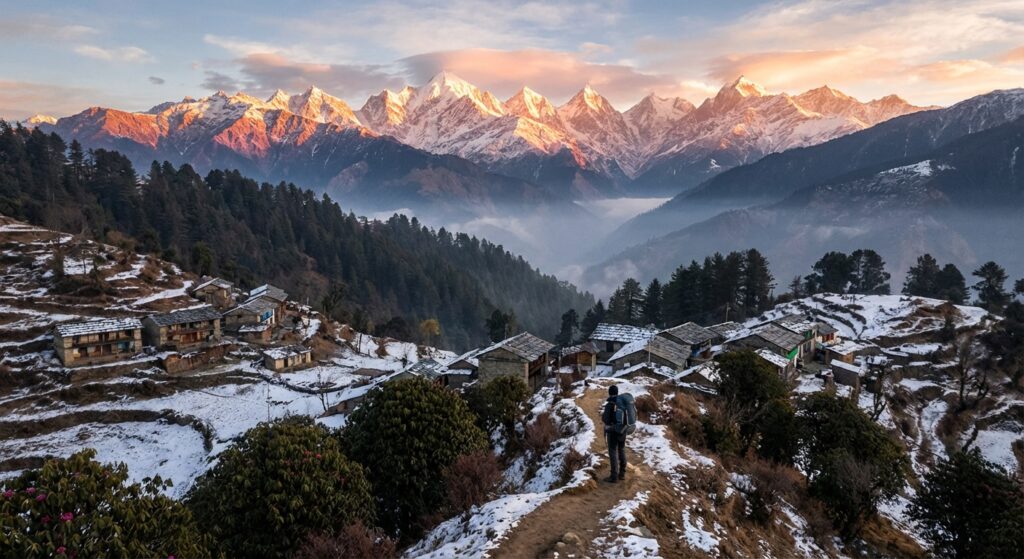
Tucked into the Johar Valley of Pithoragarh district, Munsiyari is one of Uttarakhand’s last genuinely unhurried Himalayan towns. At roughly 2,200 metres above sea level, it stands as the gateway to four iconic high-altitude treks and keeps sentinel watch before the glittering Panchachuli massif.
While Manali fills up in summer and Shimla strains under coach-tour traffic, Munsiyari quietly offers something rarer: unfiltered mountain life. Local Bhotiya families still weave traditional shawls using patterns passed across generations, shepherds move flocks across alpine meadows called bugyals, and the nearest traffic jam is a memory from the plains. For solo travelers seeking both adventure and solitude, few places in India deliver quite like this.
Why Munsiyari Deserves a Spot on Your Map
India’s mountains are well-documented, but Munsiyari falls into a rare category: genuinely known among experienced trekkers yet largely unknown to mass tourism circuits. The town sits at the base of the Panchachuli massif, five peaks ranging from 6,334m to 6,904m. Their name translates to “Five Hearths,” a reference to a mythological story connecting the peaks to the Pandavas of the Mahabharata.
Munsiyari is also the base camp for the Milam Glacier, one of the largest glaciers in Kumaon and a vital source of the Gori Ganga river. The region receives approximately 1,400mm of rainfall annually, sustaining dense oak, rhododendron, and alpine meadow ecosystems within the broader boundary of the Askot Musk Deer Sanctuary.
Monthly Temperature at Munsiyari
Understanding Munsiyari’s climate is the single most important factor in planning your trip. The town experiences genuine mountain weather, with dramatic temperature swings between day and night, and road closures during heavy snowfall from December through February.
Best Time to Visit: Season by Season
Munsiyari has four distinct windows for visitors, each with its own character. The table below maps each season against key travel factors so you can choose the visit that matches your goals and fitness level.
| Season | Months | Avg. Temp Range | Trek Suitability | Road Access | Crowd Level |
|---|---|---|---|---|---|
| Spring | April to June | 10°C to 23°C | Excellent | Open and stable | Moderate |
| Monsoon | July to September | 11°C to 20°C | Risky | Landslide risk | Very Low |
| Autumn | October to November | 2°C to 19°C | Very Good | Clear and safe | Low |
| Winter | December to March | -10°C to 7°C | Not Advised | Frequently blocked | Minimal |
Autumn in Munsiyari is a gift: post-monsoon skies turn crystalline, the Panchachuli peaks glow amber at dusk, and the trails are quiet enough to hear only the wind through the pines.
Four Trek Routes from Munsiyari
Munsiyari is the launchpad for four serious mountain treks. Each trail accesses a distinct ecological and cultural zone, and distances and difficulty levels vary significantly. Obtain Inner Line Permits from the District Magistrate’s office in Pithoragarh before starting any trek that crosses into restricted border areas near the Line of Actual Control.
Munsiyari’s flagship trek follows the Gori Ganga river through Martoli, one of India’s highest inhabited villages, before reaching the Milam Glacier at around 3,870m. Inner Line Permit is mandatory. A local guide is strongly recommended.
The most accessible trek from town. Khaliya Top sits at 3,500m and delivers panoramic views of the Panchachuli range without a multi-day commitment. Stunning rhododendron and oak forest covers the trail in spring.
Less frequented than Milam, the Ralam route passes through Ralam village with views of Hardeol (7,151m) and Tirsuli peaks. A remote, high-altitude experience requiring solid prior fitness and acclimatisation time.
A short trail to a glacial lake surrounded by forest. Excellent for birdwatching including Himalayan monal sightings. No permit needed, making this ideal for acclimatisation on your first day in Munsiyari.
How to Reach Munsiyari
Munsiyari has no direct rail or air connectivity, which is precisely what keeps the crowds manageable. The nearest railway head is Kathgodam, roughly 277 km away by road. The nearest airport is Pantnagar, about 295 km away. From Kathgodam, shared jeeps and state buses run to Munsiyari via Almora, Bageshwar, and Pithoragarh, with the journey typically taking 10 to 14 hours depending on road conditions and stops.
The most reliable route for solo travelers is to take an overnight state bus from Kathgodam to Almora or Bageshwar, then a connecting shared jeep onward the following morning. Hiring a private cab from Kathgodam costs approximately Rs 5,500 to 8,000 for the full journey and cuts uncertainty significantly.
Solo Travel Budget Breakdown
Munsiyari rewards careful planners generously. Accommodation ranges from basic guesthouses at Rs 500 to 750 per night to mid-range lodges with Panchachuli-view rooms between Rs 1,500 and 3,000. The table below gives a realistic daily cost structure for a solo traveler in 2026, reflecting current price levels across the region.
| Expense Category | Budget Option (INR/day) | Mid-Range (INR/day) | Practical Notes |
|---|---|---|---|
| Accommodation | Rs 500 to 750 | Rs 1,500 to 3,000 | Book ahead from 15 April to 15 June |
| Meals (3 per day) | Rs 300 to 450 | Rs 650 to 900 | Dhabas near the bus stand offer the cheapest food |
| Local Transport | Rs 50 to 150 | Rs 300 to 500 | Shared jeep to trek base points |
| Trek Guide or Porter | Rs 0 (self-guided) | Rs 800 to 1,100 | Guides strongly recommended for Milam and Ralam |
| Inner Line Permits | Rs 150 to 600 | Rs 150 to 600 | Obtained from DM office, Pithoragarh |
| Miscellaneous | Rs 100 to 200 | Rs 300 to 500 | Chai, local wool purchases, gear hire if needed |
| Estimated Daily Total | Rs 1,100 to 1,700 | Rs 3,800 to 6,500 | Excludes intercity travel to Munsiyari |
Solo Safety and Practical Essentials
Munsiyari is considered one of the safer Himalayan destinations for solo travelers, including solo women, largely because it is a compact town where residents know one another and strangers are noticed quickly. That said, mountain environments carry inherent risks and preparation is non-negotiable.
- Carry a physical paper map of trek routes. Mobile data is unreliable beyond the main market area.
- Register your trek details at the local police station. This is standard practice, costs nothing, and creates a safety record.
- Pack a basic first aid kit including altitude sickness medication such as Diamox after consulting a doctor beforehand.
- Spend at least one full day in Munsiyari acclimatising before attempting any high-altitude trek beyond 3,000m.
- Carry sufficient cash. The nearest reliably functional ATM is in Pithoragarh and frequently runs out during peak season.
- Pack layered clothing at all times. Temperatures at altitude can drop 15 degrees Celsius within a single hour.
- Hire a local guide for the Milam or Ralam glaciers. Routes are not marked and weather and trail conditions shift without warning.
Local Culture and Responsible Travel
The Bhotiya people of the Johar Valley have inhabited this region for centuries, historically trading wool and goods with Tibet across high mountain passes before border restrictions changed those routes in 1962. Their language, craft traditions, and festivals remain distinct from the broader Kumaoni population. Purchasing woolen shawls, caps, and gloves directly from Bhotiya weavers at Munsiyari Market supports these families far more than buying the same items in Nainital.
Munsiyari’s trails face growing pressure from plastic waste. Local community groups run periodic clean-up drives, but individual responsibility matters most. Carry a reusable bottle, avoid single-use plastic bags, and deposit waste in the bins near Munsiyari Market before leaving town.
Photography is generally welcomed in town, but always ask permission before photographing individuals, religious ceremonies, or private homes. The small Tribal Heritage Museum near the market houses tools, clothing, and artifacts from the region’s Bhotiya heritage and is worth an hour of your time on the day of arrival.
Where to Stay in Munsiyari
Most accommodation concentrates along the main road and the approach toward Khaliya Top. Options range from basic government-run tourist rest houses at Rs 500 to 750 per night to small family guesthouses with Panchachuli-facing rooms between Rs 1,500 and 3,000. The Uttarakhand Tourism Development Board operates a guest house in town that offers clean rooms at a consistent and predictable price point.
Several private homestays run by Bhotiya families offer a more immersive cultural experience and generally include home-cooked meals. Look for dishes such as bhatt ki churkani (black soybean curry), aloo ke gutke (spiced mountain potatoes), and the local rotis made from mandua flour.
Final Word: Is Munsiyari Worth the Journey?
The truthful answer is yes, with one clear condition: go with the right expectations. Munsiyari is not a resort destination. Roads are narrow and sometimes rough. Infrastructure is basic, mobile connectivity is patchy beyond the main market, and the nearest hospital with adequate facilities is several hours away. These are not problems waiting to be fixed. They are the entry cost for something genuinely off the standard circuit.
What you receive in return is a Himalayan experience that mass tourism has not yet reshaped: genuine mountain light at sunrise, trails without queues, conversations with people who live inside this landscape year-round, and the particular stillness that only arrives at altitude when the wind drops and the peaks stand close enough to feel real. For solo travelers willing to plan carefully, pack with care, and move at a mountain pace, Munsiyari offers precisely the kind of trip that stays with you long after the altitude headache fades and the dust of the plains settles back under your shoes.
Leave a Reply