
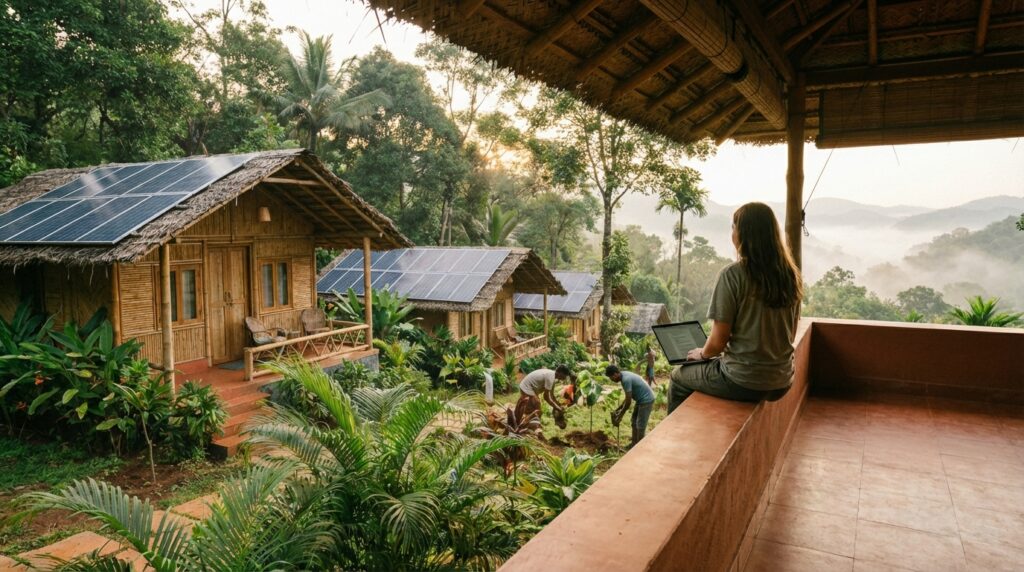
Regenerative travel is not just a trend. It is a fundamental shift in how a new generation of global citizens approaches movement, work, and purpose. Unlike sustainable tourism, which simply aims to minimize harm, regenerative travel actively restores ecosystems, supports local communities, and leaves every destination measurably better than it was found.
India in 2026 sits at a unique crossroads. The country hosts some of the world’s richest biodiversity spanning the Western Ghats, the Himalayas, the Thar Desert, and its extensive coastline, while also grappling with deforestation, rural poverty, and the pressures of mass tourism. Into this landscape has emerged a generation of eco-stays that marry conservation volunteering with dependable remote work infrastructure, creating the ideal base for the conscious digital nomad.
This guide maps out 10 exceptional Indian eco-stays where you can volunteer with purpose, maintain your productivity, and participate in genuinely regenerative practices, all while experiencing the country’s extraordinary depth and diversity.
Why India for Regenerative Travel in 2026?
Sources: Ministry of Environment India, UNWTO Eco-Tourism Outlook 2025, Booking.com Workation Trends Report 2025
India’s eco-stay market has matured rapidly. Properties are no longer simply offering rustic accommodation with a candle and a composting toilet. In 2026, serious eco-stays combine solar power, rainwater harvesting, farm-to-table dining, structured volunteering schedules, and at least 50 Mbps broadband connectivity. For the remote worker who also wants meaning, this is the sweet spot.
Source: Regenerative Travel Network India Survey, 2025 (n=1,240 respondents)
The 10 Best Indian Eco-Stays for Volunteers and Remote Workers
Nestled alongside one of India’s oldest sacred groves, this community-run retreat trains volunteers in indigenous forest monitoring techniques developed by the Khasi people over centuries. Guests contribute to trail restoration and native orchid documentation while accessing fiber-optic internet speeds that rival Indian metro cities. The mist-wrapped bamboo cabins generate electricity entirely through micro-hydro systems fed by mountain streams.
Operating across 60 acres of certified organic land in the foothills of the Western Ghats, this family-run farm stay has become a landmark for permaculture volunteering. Guests join morning farming rotations (typically two to three hours), then work remotely from a purpose-built co-working pavilion with ergonomic seating and backup power. The stay is famous for its heirloom rice seed bank project, which volunteers help maintain and document.
The Great Rann of Kutch is one of the world’s largest salt marshes and a critical flamingo breeding habitat. This desert camp channels volunteer energy into flamingo census counts, saline land restoration, and artisan documentation projects with local Kutchi craftspeople. Solar arrays power the entire operation, and the camp’s 4G-boosted satellite internet maintains surprisingly reliable connectivity for remote workers. Night skies are extraordinary.
A certified B-Corp travel enterprise, Blue Yonder has partnered with multiple Adivasi villages in Wayanad to create a network of home-stays linked by shared volunteering commitments. Guests cycle between properties across a stay, contributing to reforestation, honey harvesting support, and heritage seed gardens. The collective has planted over 15,000 native trees since 2021 through volunteer involvement. Reliable Jio fiber connectivity reaches all partner properties.
At elevations between 3,800 and 4,200 metres, the Spiti Homestay Network trains volunteers in high-altitude farming techniques essential for food security in this climate-vulnerable region. Guests help with greenhouse construction, solar dryer installation, and snow leopard camera-trap monitoring. Starlink connectivity was deployed across the network in late 2024, finally making remote work viable in this once-off-grid valley. Open April to November.
Perched at 2,000 metres in the Palani Hills, this conservation-focused stay works to protect the critically endangered Nilgiri tahr and shola grasslands. Volunteers assist with invasive species removal (particularly eucalyptus and pine encroachment on native grassland), biodiversity surveys, and community education. The stay’s dedicated work cabin has dedicated fiber internet and hosts a monthly “Conservation Tech” meetup that draws remote workers from across South India.
The Sundarbans is the world’s largest mangrove forest and home to the Royal Bengal Tiger. This solar-powered lodge channels volunteers into mangrove replanting drives, honey bee colony monitoring, and women’s cooperative support in adjacent fishing villages. Tiger sightings during river patrols are not uncommon. Connectivity is via 4G booster and works well for standard remote tasks; heavy video conferencing is best scheduled for evenings when bandwidth is highest.
Shade-grown coffee estates in Coorg represent a rare intersection of agriculture and biodiversity. This lodge is built within a 200-acre estate that serves as a wildlife corridor between two tiger reserves. Volunteers assist with corridor maintenance, bird census work (Coorg holds over 300 bird species), and shade-tree planting. The estate runs a superb co-working room with standing desks, ergonomic chairs, and 100 Mbps fiber, catering explicitly to digital nomads staying three weeks or longer.
Auroville has been a global laboratory for sustainable living since 1968. The Earth Institute’s farm stay arm accepts volunteers for compressed earth block construction, water harvesting system maintenance, and organic farming support. The community itself is an extraordinary place to work remotely, with several co-working cafes, reliable fiber networks, and a deeply international population of makers, thinkers, and builders providing rich creative community.
For those who prefer their volunteering underwater, this marine eco-stay runs one of India’s most active coral gardening programs. Certified divers volunteer in morning reef restoration sessions, while non-divers assist with coral fragment monitoring, beach debris surveys, and seagrass mapping from kayaks. The stay’s workspace is imaginatively designed with ocean views and dedicated fiber feeds. It is one of the most in-demand regenerative stays in India; book at least six months ahead for peak winter season.
Quick Comparison: All 10 Eco-Stays at a Glance
| Eco-Stay | State | Best Season | Internet | Volunteer Focus | Starting Price |
|---|---|---|---|---|---|
| Mawphlang Sacred Forest Retreat | Meghalaya | Oct to Mar | Fiber 50 Mbps | Forest monitoring | INR 1,800 |
| Sahyadri Organic Farm Stay | Maharashtra | Nov to Feb | Fiber + Backup | Permaculture, seed banking | INR 2,200 |
| Rann Riders Desert Camp | Gujarat | Nov to Mar | Satellite 4G | Flamingo census | INR 3,500 |
| Blue Yonder Village Collective | Kerala | Sep to Apr | Jio Fiber | Reforestation | INR 2,800 |
| Spiti Homestay Network | Himachal Pradesh | Apr to Nov | Starlink | Snow leopard monitoring | INR 1,500 |
| Vattakanal Conservation Trust | Tamil Nadu | Oct to May | Fiber Dedicated | Grassland restoration | INR 2,400 |
| Sundarbans Mangrove Lodge | West Bengal | Oct to Mar | 4G Boosted | Mangrove replanting | INR 3,200 |
| Coorg Coffee Forest Lodge | Karnataka | Nov to Feb | Fiber 100 Mbps | Wildlife corridor | INR 2,900 |
| Auroville Earth Institute Farm | Tamil Nadu | Year-round | Community Fiber | Earthen construction | INR 1,600 |
| Andaman Coral Restoration Stay | Andaman Islands | Oct to May | Fiber Ocean-view | Coral gardening | INR 4,200 |
By the Numbers: India’s Eco-Stay Landscape
How to Plan Your Regenerative Stay in India: Practical Tips
Planning a regenerative workation in India requires more forethought than booking a standard hotel. The following tips will help you get the most from your experience.
Most eco-stays see the deepest impact from guests who stay at least 21 days. Shorter stays often just scratch the surface of meaningful volunteer integration.
India’s monsoon patterns vary dramatically by region. Meghalaya receives rain almost year-round while Spiti is snow-locked from December through March. Always check local conditions.
Ask each property for a bandwidth test screenshot and whether backup power covers the router. Video calls require at least 10 Mbps upload; factor in time zone differences with clients.
You will need outdoor work clothes for volunteering (closed shoes, sun protection, light gloves) and presentable options for video calls. Compact packing is an art worth mastering.
A Jio or Airtel SIM with a generous data plan serves as vital backup connectivity wherever you travel. Airport SIMs require your passport and a local address reference.
Average daily cost including accommodation, meals, and local transport ranges from INR 2,500 to INR 5,000 (roughly USD 30 to 60), making India exceptionally affordable for remote workers on Western salaries.
The Bigger Picture: What Regenerative Travel Means for India
India loses approximately 1.5 million hectares of forest cover annually to agricultural expansion, infrastructure projects, and urban sprawl. At the same time, rural communities adjacent to protected areas often have limited economic alternatives, which creates pressure on the very ecosystems they live alongside. Regenerative travel addresses both sides of this equation simultaneously.
When a digital nomad from Berlin or Bangalore spends six weeks at a forest retreat in Meghalaya and plants 40 native trees, funds three weeks of local employment, and generates no single-use plastic waste during their stay, the net effect is measurably positive. Multiply that across thousands of visitors per year and the regenerative model becomes a genuine conservation finance mechanism.
India’s government has recognized this potential. The Ministry of Tourism’s 2024-2030 Responsible Tourism Mission allocates targeted funding to eco-stays that demonstrate quantified conservation outcomes, and several states including Kerala, Himachal Pradesh, and Meghalaya now have formal certification pathways for regenerative properties. The market is maturing, the infrastructure is improving, and the timing for conscious travelers could not be better.
Leave a Reply