
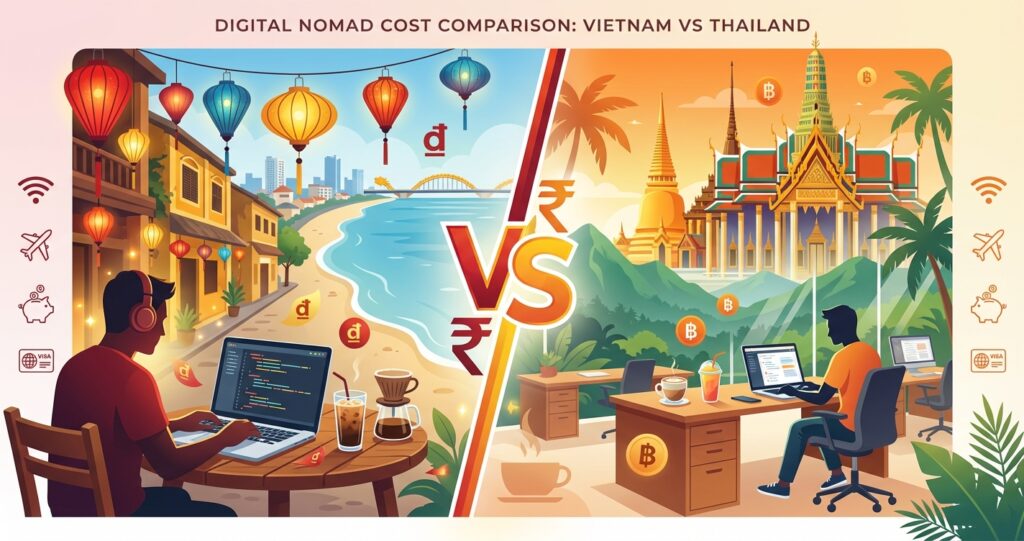
If you are an Indian digital nomad weighing your options between Vietnam and Thailand in 2026, you are not alone. Both Southeast Asian countries have emerged as top destinations for remote workers, offering stunning landscapes, vibrant cultures, and wallet-friendly lifestyles. But when it comes to the bottom line, which country actually saves you more rupees?
This comprehensive analysis breaks down the real costs, visa situations, lifestyle factors, and hidden expenses to help you make an informed decision. We have crunched the numbers, analyzed current exchange rates, and compared everything from street food to coworking spaces.
Exchange Rates: Understanding Your Rupee’s Power
1 Indian Rupee = 285 Vietnamese Dong (VND)
1 Indian Rupee = 0.35 Thai Baht (THB)
This means: ₹10,000 = 2,850,000 VND or 3,500 THB
Understanding these exchange rates is crucial for budgeting. Vietnamese dong appears large in numbers but actually offers competitive value. The Thai baht is stronger but Thailand has more established infrastructure for digital nomads, which can offset some costs.
Monthly Cost Breakdown: The Real Numbers
Budget Tier Comparison (All amounts in INR and USD)
| Expense Category | Vietnam (Da Nang) | Thailand (Chiang Mai) | Winner |
|---|---|---|---|
| Rent (1BR Apartment) | ₹25,000-35,000 ($300-420) |
₹28,000-42,000 ($335-500) |
Vietnam |
| Street Food Meal | ₹80-120 ($1-1.50) |
₹125-170 ($1.50-2) |
Vietnam |
| Restaurant Meal | ₹250-500 ($3-6) |
₹335-670 ($4-8) |
Vietnam |
| Coworking Space | ₹6,700-10,000 ($80-120) |
₹8,400-12,500 ($100-150) |
Vietnam |
| Local Beer | ₹50-85 ($0.60-1) |
₹85-125 ($1-1.50) |
Vietnam |
| Scooter Rental | ₹5,000-6,700 ($60-80) |
₹7,500-8,400 ($90-100) |
Vietnam |
| Monthly Groceries | ₹8,400-13,400 ($100-160) |
₹10,000-16,700 ($120-200) |
Vietnam |
| Gym Membership | ₹1,670-2,500 ($20-30) |
₹2,500-4,200 ($30-50) |
Vietnam |
Total Monthly Living Costs
Budget Lifestyle (Minimal Expenses)
Comfortable Lifestyle (Moderate Spending)
Upgraded Lifestyle (Luxury)
Detailed Cost Analysis by Category
Accommodation
Vietnam (Da Nang): Modern one-bedroom apartments near the beach cost ₹25,000-35,000. Studios in the city center start at ₹20,000.
Thailand (Chiang Mai): Comparable apartments range from ₹28,000-42,000. Bangkok is significantly more expensive at ₹50,000-75,000.
Savings: ₹3,000-7,000/month in Vietnam
Food & Dining
Vietnam: Pho for ₹80-120, Bun Cha for ₹100-120. Restaurant meals ₹250-500. Monthly food budget: ₹12,500-20,000.
Thailand: Pad Thai for ₹125-170, restaurant meals ₹335-670. Monthly food budget: ₹16,700-25,000.
Savings: ₹4,200-5,000/month in Vietnam
Transportation
Vietnam: Scooter rental ₹5,000-6,700/month. Grab rides ₹40-85. Extremely walkable cities.
Thailand: Scooter rental ₹7,500-8,400/month. Tuk-tuks and taxis cost more. Bangkok has excellent public transport.
Savings: ₹2,500-3,300/month in Vietnam
Coworking & Internet
Vietnam: Coworking spaces ₹6,700-10,000/month. High-speed home internet ₹1,250-2,000/month. Cafes charge ₹80-170.
Thailand: Coworking ₹8,400-12,500/month. Home internet ₹1,670-3,300/month. More established coworking scene.
Savings: ₹1,700-2,500/month in Vietnam
Visa Situations for Indian Nationals
Vietnam Visa Options (2026)
- E-Visa (90 days): Available to all Indian citizens, costs approximately ₹2,100 ($25), multiple entries allowed, easily renewable
- Tourist Visa Extensions: Can be extended multiple times without leaving the country
- Proposed Golden Visa: 5-10 year residence permit announced but not yet implemented as of February 2026
- Legal Gray Area: No official digital nomad visa, but working remotely for foreign clients is tacitly accepted
- Tax Residency: Triggered after 183 days in a calendar year
Thailand Visa Options (2026)
- Destination Thailand Visa (DTV): 5-year multiple entry visa, costs ₹23,500 (10,000 THB or $280 USD), allows 180-day stays with one 180-day extension per entry
- Requirements: ₹41,70,000 (500,000 THB or $13,600 USD) in bank savings, proof of remote work income
- Visa-Free Entry: Indians get 30-60 days visa-free (recently extended)
- Long-Term Resident Visa (LTR): For high earners making $80,000+ annually
- Tax Residency: Triggered after 180 days
Quality of Life Comparison
Vietnam Advantages
- 15-25% cheaper overall living costs
- Less touristy, more authentic experiences
- Better value for beachfront living
- Cleaner air in coastal cities like Da Nang
- Incredible coffee culture (Vietnamese coffee is world-renowned)
- Fresh seafood at unbeatable prices
- Growing but not overcrowded nomad scene
- Easier visa process (no large deposit required)
Vietnam Challenges
- Lower English proficiency outside expat areas
- Less established coworking infrastructure
- Fewer direct international flights
- Banking can be difficult without long-term visa
- Healthcare quality lower than Thailand
- Smaller expat community
- No official digital nomad visa yet
- Visa runs more frequent (every 90 days)
Thailand Advantages
- Excellent DTV visa (5 years validity)
- World-class coworking scene
- Large, established digital nomad community
- Better English proficiency
- Superior healthcare infrastructure
- More international flight connections
- Reliable high-speed internet everywhere
- Diverse cities (Bangkok, Chiang Mai, Phuket, Koh Samui)
- Well-developed tourism infrastructure
Thailand Challenges
- More expensive (15-25% higher costs)
- Overcrowded nomad scene in popular cities
- Air pollution issues (especially Chiang Mai Feb-April)
- More touristy, less authentic in popular areas
- DTV requires ₹41,70,000 in savings proof
- Becoming more expensive each year
- Alcohol significantly more expensive
- Traffic congestion in Bangkok
City-Specific Comparison
Best Cities for Digital Nomads
| Aspect | Da Nang, Vietnam | Chiang Mai, Thailand |
|---|---|---|
| Monthly Cost | ₹84,000-1,09,000 ($1,000-1,300) | ₹1,00,000-1,50,000 ($1,200-1,800) |
| Internet Speed | 100-200 Mbps (reliable) | 100-300 Mbps (excellent) |
| Coworking Spaces | Growing (10+ options) | Excellent (50+ options) |
| Beach Access | 5-10 minutes | N/A (mountains) |
| Air Quality | Generally good | Poor (Feb-April burning season) |
| Nomad Community | Growing (moderate) | Very established (large) |
| Airport Connections | Limited international | Better regional connections |
Other Notable Cities
Hanoi, Vietnam
Monthly Cost: ₹62,500-84,000 ($750-1,000)
Capital city with rich culture, cooler weather, four seasons, excellent street food, and vibrant Old Quarter. Lower English proficiency but growing expat scene in Tay Ho district.
Ho Chi Minh City, Vietnam
Monthly Cost: ₹84,000-1,25,000 ($1,000-1,500)
Vietnam’s business hub, more expensive but better infrastructure, largest nomad community in Vietnam, excellent food scene, hot and humid year-round.
Bangkok, Thailand
Monthly Cost: ₹1,50,000-2,50,000 ($1,800-3,000)
Most expensive but best infrastructure, international hub, excellent healthcare, diverse neighborhoods, great coworking, extensive public transport, intense heat and pollution.
Koh Phangan, Thailand
Monthly Cost: ₹1,17,000-1,67,000 ($1,400-2,000)
Beach paradise with growing nomad scene, reliable internet improving, perfect for beach lovers, monthly full moon parties, more expensive than mainland cities.
Hidden Costs and Considerations
Visa Run Expenses
Vietnam: Need to exit every 90 days on e-visa. Typical visa run to Cambodia or Thailand costs ₹8,400-16,700 ($100-200) including transport, visa fees, and accommodation. Annual visa run cost: approximately ₹33,600-67,000 ($400-800).
Thailand: DTV visa holders need to exit every 180 days. Visa runs are less frequent but still required. Typical cost: ₹8,400-20,000 ($100-240). Annual cost: ₹16,800-40,000 ($200-480).
Healthcare Costs
Vietnam: Basic consultation ₹420-1,250 ($5-15), dental cleaning ₹1,670-3,300 ($20-40). International insurance recommended: ₹3,300-6,700/month ($40-80).
Thailand: Doctor consultation ₹835-2,500 ($10-30), dental cleaning ₹2,500-5,000 ($30-60). Better healthcare but higher costs. Insurance: ₹4,200-8,400/month ($50-100).
Banking and Money Transfer
Vietnam: Difficult to open local bank account on tourist visa. ATM fees ₹75-185 per withdrawal. Use Wise or Revolut for best rates.
Thailand: Easier to open bank accounts with proper visa. ATM fees similar. More ATMs accept international cards.
Annual Cost Projection
| Lifestyle Level | Vietnam (Annual) | Thailand (Annual) | Annual Savings in Vietnam |
|---|---|---|---|
| Budget | ₹7,00,000-8,00,000 ($8,400-9,600) |
₹9,00,000-11,00,000 ($10,800-13,200) |
₹2,00,000-3,00,000 ($2,400-3,600) |
| Comfortable | ₹10,00,000-13,00,000 ($12,000-15,600) |
₹12,00,000-18,00,000 ($14,400-21,600) |
₹2,00,000-5,00,000 ($2,400-6,000) |
| Upgraded | ₹15,00,000-20,00,000 ($18,000-24,000) |
₹18,00,000-30,00,000 ($21,600-36,000) |
₹3,00,000-10,00,000 ($3,600-12,000) |
Best Locations on Map
Below is an interactive map showing the top digital nomad cities in Vietnam and Thailand:
Note: Monthly costs shown are for comfortable lifestyle ranges including rent, food, transport, and coworking.
Internet and Connectivity
| Connectivity Aspect | Vietnam | Thailand |
|---|---|---|
| Average Home Internet Speed | 100-200 Mbps | 100-300 Mbps |
| Home Internet Cost | ₹1,250-2,000/month | ₹1,670-3,300/month |
| Mobile Data (20GB) | ₹420-835 | ₹670-1,250 |
| Cafe WiFi Quality | Good (most cafes) | Excellent (everywhere) |
| 5G Coverage | Growing in major cities | Widespread in cities |
Both countries offer reliable internet suitable for video calls, streaming, and remote work. Thailand has a slight edge in overall connectivity infrastructure, but Vietnam is rapidly catching up, especially in cities like Da Nang and Ho Chi Minh City.
Food Scene Comparison
Daily Food Budget Comparison
Vietnam – Daily Food Options:
- Breakfast (Banh Mi or Pho): ₹80-120
- Lunch (Com Binh Dan): ₹130-250
- Dinner (Local Restaurant): ₹250-500
- Coffee (Ca Phe): ₹40-85
- Snacks/Street Food: ₹85-170
- Daily Total: ₹585-1,125
Thailand – Daily Food Options:
- Breakfast (Jok or Thai tea): ₹125-210
- Lunch (Pad Thai or Rice Plate): ₹210-335
- Dinner (Restaurant): ₹335-670
- Coffee (Latte): ₹85-170
- Snacks/Street Food: ₹125-250
- Daily Total: ₹880-1,635
Social and Networking Opportunities
Vietnam (Da Nang/Hanoi)
- Smaller, more intimate nomad community
- Vietnam Nomad Fest (annual event in Da Nang)
- Growing coworking community events
- Easier to stand out and build genuine connections
- Less saturated market for digital services
- Facebook groups active for expats
- Lower English proficiency can limit local interactions
Thailand (Chiang Mai/Bangkok)
- Huge, well-established digital nomad scene
- Weekly meetups, workshops, and networking events
- Coworking spaces host regular community activities
- Easier to find collaborators and clients
- Strong English-speaking community
- More competitive but more opportunities
- Can feel overwhelming or cliquish at times
Travel and Exploration
Regional Travel Costs from Each Country
| Destination | From Vietnam | From Thailand |
|---|---|---|
| Weekend in Cambodia | ₹8,400-12,500 | ₹6,700-10,000 |
| Weekend in Laos | ₹6,700-10,000 | ₹5,000-8,400 |
| Flight to Bali | ₹12,500-20,000 | ₹8,400-16,700 |
| Flight to Singapore | ₹10,000-16,700 | ₹6,700-12,500 |
| Domestic Beach Weekend | ₹5,000-8,400 | ₹6,700-12,500 |
Thailand generally offers better and cheaper regional flight connections due to Bangkok being a major hub. However, Vietnam offers incredible domestic travel options at lower prices.
The Verdict: Which Country is Actually Cheaper?
Clear Winner on Price: Vietnam
Vietnam is unequivocally 15-25% cheaper than Thailand across almost every expense category. An Indian digital nomad can save ₹2,00,000-5,00,000 ($2,400-6,000) annually by choosing Vietnam over Thailand while maintaining a comparable quality of life.
But Consider These Factors:
Choose Vietnam if:
- Budget is your primary concern
- You prefer less touristy, more authentic experiences
- You want beachfront living at lower costs
- You’re comfortable with smaller expat community
- You can handle visa runs every 90 days
- You don’t mind working around language barriers
- You value cleaner air and less pollution
Choose Thailand if:
- You can afford the DTV visa deposit (₹41,70,000)
- You want long-term visa stability (5 years)
- You prioritize established infrastructure and amenities
- You want a large, active digital nomad community
- Healthcare quality is a major concern
- You prefer better English proficiency
- You want more coworking and networking options
- Easy regional travel is important
The Smart Middle Ground
Many seasoned digital nomads split their time between both countries. Spend 3-6 months in Vietnam enjoying lower costs and authentic culture, then 3-6 months in Thailand for better infrastructure and community events. This approach gives you the best of both worlds while managing visa requirements naturally.
Final Numbers
Annual Cost for Comfortable Lifestyle:
- Vietnam: ₹10,00,000-13,00,000 ($12,000-15,600)
- Thailand: ₹12,00,000-18,00,000 ($14,400-21,600)
- Annual Savings in Vietnam: ₹2,00,000-5,00,000 ($2,400-6,000)
Practical Tips for Indian Digital Nomads
For Vietnam:
- Get your e-visa before arrival through the official government website
- Use Wise or Revolut for money transfers to avoid high ATM fees
- Learn basic Vietnamese phrases – it makes a huge difference
- Join Facebook groups like “Digital Nomads in Vietnam” before arriving
- Stock up on Indian spices – they’re hard to find and expensive
- Rent in advance through local Facebook groups for better deals
- Invest in a good VPN for accessing content
- Plan visa runs to neighboring countries in advance
For Thailand:
- If you qualify, apply for DTV visa – it’s worth the effort
- Start savings early to meet the ₹41,70,000 requirement
- Join nomad communities on Facebook and Slack before arriving
- Book coworking space day passes initially before committing monthly
- Use Grab for transport – cheaper and more reliable than taxis
- Avoid Chiang Mai during burning season (February-April)
- Indian restaurants are everywhere but expensive – cook at home to save
- Get comprehensive health insurance – you’ll use healthcare more here
Monthly Budget Templates
Vietnam – Comfortable Lifestyle Budget
- Rent (1BR near beach): ₹30,000
- Food (mix local/Western): ₹18,000
- Coworking space: ₹8,400
- Scooter rental: ₹6,000
- Phone/Internet: ₹2,000
- Gym membership: ₹2,000
- Entertainment/Social: ₹12,000
- Health insurance: ₹5,000
- Utilities: ₹3,000
- Miscellaneous: ₹5,000
- Total: ₹91,400 ($1,095)
Thailand – Comfortable Lifestyle Budget
- Rent (1BR near city): ₹35,000
- Food (mix local/Western): ₹22,000
- Coworking space: ₹10,000
- Scooter rental: ₹8,000
- Phone/Internet: ₹2,500
- Gym membership: ₹3,500
- Entertainment/Social: ₹15,000
- Health insurance: ₹6,500
- Utilities: ₹4,000
- Miscellaneous: ₹7,000
- Total: ₹1,13,500 ($1,360)
Conclusion
For Indian digital nomads in 2026, Vietnam emerges as the clear winner purely on cost considerations. You can maintain a comfortable lifestyle while saving ₹2,00,000-5,00,000 annually compared to Thailand. The beaches are just as beautiful, the food is incredible (and cheaper), and the authentic cultural experience is unmatched.
However, Thailand offers superior infrastructure, a revolutionary long-term visa option, better healthcare, and a more established digital nomad ecosystem. If you can afford the DTV visa deposit and prefer convenience over cost savings, Thailand remains an excellent choice.
The ideal strategy? Start with Vietnam to save money and experience authentic Southeast Asian culture. If your income grows and you qualify for the DTV, move to Thailand for long-term stability and community. Many successful digital nomads rotate between both countries, enjoying the unique advantages each offers.
Whichever you choose, both Vietnam and Thailand offer Indian digital nomads incredible opportunities to live, work, and thrive in Southeast Asia – all while spending far less than you would in major Indian metros like Mumbai, Bangalore, or Delhi.
Leave a Reply