
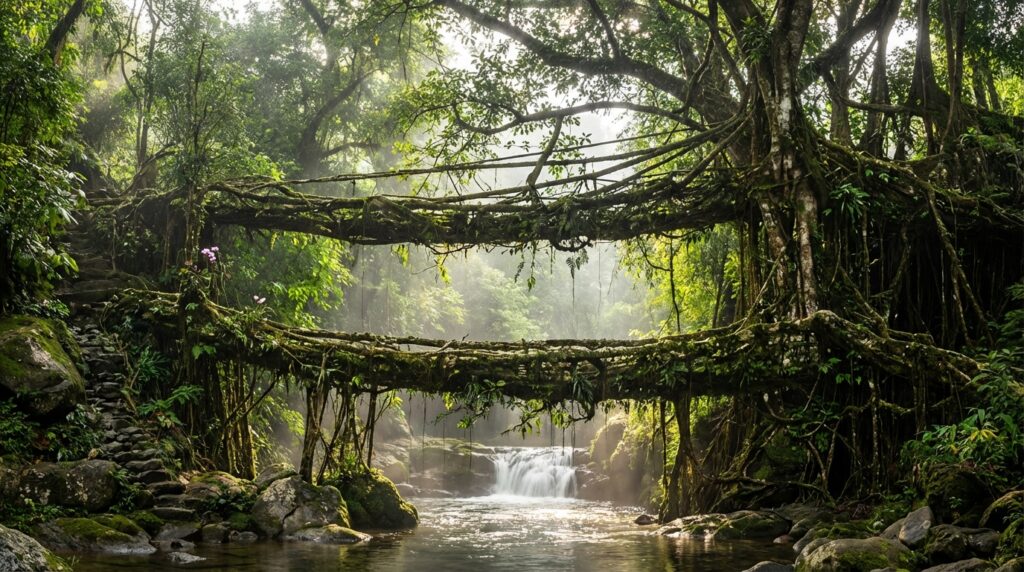
Nestled in the northeastern corner of India, Meghalaya stands as one of Earth’s most extraordinary natural laboratories. This cloud-wrapped state receives more rainfall than virtually anywhere else on the planet, creating landscapes so lush and mysterious that they seem plucked from fantasy. From living root bridges engineered by indigenous communities to valleys perpetually shrouded in mist, Meghalaya offers travelers an experience that combines raw natural power with profound cultural heritage.
(Mawsynram)
(Cherrapunji)
(Oldest Root Bridges)
Understanding Meghalaya’s Climate Extremes
Meghalaya translates to “abode of clouds,” and the name proves remarkably accurate. The state’s unique geographical position creates a meteorological phenomenon that has earned two of its towns the distinction of being the wettest inhabited places on Earth. Mawsynram currently holds the world record with an average annual rainfall of 11,872 millimeters, narrowly surpassing neighboring Cherrapunji at 11,777 millimeters.
This extraordinary precipitation occurs primarily due to the orographic effect. Moisture-laden monsoon winds from the Bay of Bengal race northward across the Bangladeshi plains, encountering the steep Khasi Hills. As these winds are forced upward, they cool rapidly, causing massive condensation and unprecedented rainfall concentrated in a relatively small geographic area.
The Marvel of Living Root Bridges
Perhaps no feature of Meghalaya captures the imagination quite like the living root bridges. These extraordinary structures represent a perfect synthesis of human ingenuity and natural processes. The indigenous Khasi and Jaintia tribes discovered centuries ago that the roots of the Ficus elastica tree, commonly known as the rubber fig tree, could be trained and shaped into functional bridges.
The process requires remarkable patience and foresight. Young, pliable roots are carefully guided across streams and rivers using hollowed-out betel nut tree trunks as directional supports. Over 15 to 20 years, these roots thicken and strengthen, eventually creating bridges capable of supporting the weight of 50 or more people simultaneously. Unlike conventional bridges that deteriorate over time, living root bridges actually grow stronger with age, with some specimens estimated to be over 500 years old.
The Double Decker Root Bridge
The most famous example is the Umshiang Double-Decker Root Bridge near Nongriat village. This two-tiered structure spans approximately 3 meters in length and represents one of the most complex examples of bioengineering in the world. Reaching it requires descending roughly 3,500 stone steps through dense jungle, but the sight of this living architecture makes the arduous trek worthwhile for thousands of visitors annually.
Optimal Travel Windows: When to Visit Meghalaya
Timing your visit to Meghalaya requires careful consideration of your priorities. The state experiences dramatically different conditions throughout the year, each offering distinct advantages and challenges.
| Season | Months | Rainfall | Temperature | Best For |
|---|---|---|---|---|
| Winter (Dry) | October – February | Minimal (60-280mm/month) | 10-24°C | Trekking, photography, root bridge visits |
| Pre-Monsoon | March – May | Moderate (250-980mm/month) | 15-25°C | Waterfalls at peak flow, fewer crowds |
| Monsoon | June – September | Extreme (750-2,850mm/month) | 18-25°C | Experiencing world’s heaviest rainfall |
Best Time for Living Root Bridges: October to March
For most travelers, the period from October through March represents the ideal window for visiting Meghalaya’s living root bridges. During these months, rainfall drops to manageable levels, trails become significantly safer, and visibility improves dramatically. The post-monsoon period from October to November offers particularly stunning conditions, as the landscape remains lush and green from months of rain, while the weather becomes comfortably dry.
November and December are especially popular, with daytime temperatures ranging between 15-20°C and virtually guaranteed clear skies. This is when the living root bridges are most accessible, and the surrounding forests display their full magnificence without the obscuring veil of constant mist and rain. Photography enthusiasts particularly prize these months, as the combination of vibrant greenery and excellent lighting creates spectacular opportunities.
Experiencing the Monsoon: June to September
While the dry season attracts the majority of visitors, there’s something profoundly compelling about experiencing Meghalaya during the monsoon. This is when the state truly lives up to its reputation as Earth’s wettest region. From June through September, the landscape transforms into a primordial wonderland of cascading waterfalls, swollen rivers, and clouds so thick they seem tangible.
Visiting during monsoon requires significant preparation and realistic expectations. Roads become treacherous, with landslides occurring frequently. Many trekking routes to root bridges become impassable or extremely dangerous. However, for those willing to accept these limitations, the monsoon offers rewards unavailable any other time of year. Waterfalls that trickle during winter become thundering torrents. The famous Nohkalikai Falls, India’s tallest plunge waterfall at 340 meters, reaches its most spectacular during peak monsoon months.
Essential Practical Considerations for 2026
Planning a trip to Meghalaya requires attention to several practical factors. The state’s tourism infrastructure has improved significantly in recent years, but it remains relatively undeveloped compared to mainstream Indian destinations, which is part of its charm.
Permits and Documentation: Foreign nationals require a Protected Area Permit to visit Meghalaya, though this is typically issued on arrival for most countries. Indian citizens need no special permits. Always carry multiple copies of identification documents, as mobile connectivity can be unreliable in remote areas.
Physical Preparation: Many of Meghalaya’s most remarkable sites, including the Double-Decker Root Bridge, require substantial physical exertion. The descent to Nongriat involves navigating approximately 3,500 stone steps, and what goes down must come back up. Visitors should assess their fitness level honestly before attempting these treks.
Accommodation: Shillong, the state capital, offers the widest range of accommodation options, from budget homestays to comfortable hotels. For root bridge treks, villages like Tyrna and Nongriat offer basic homestays that provide authentic cultural experiences alongside convenient access to trailheads.
Beyond the Bridges: Other Meghalayan Wonders
While living root bridges rightfully claim the spotlight, Meghalaya offers numerous other compelling attractions. Dawki, near the Bangladesh border, features the Umngot River, renowned for water so crystalline that boats appear to float in mid-air. The limestone caves of the Jaintia Hills, including Krem Liat Prah (one of the longest caves in India at over 30 kilometers), attract serious spelunkers from around the world.
Mawlynnong, dubbed “Asia’s cleanest village,” demonstrates the remarkable community organization of Khasi society. Every household maintains scrupulous cleanliness, with bamboo dustbins placed throughout the village and a complete absence of litter. The village’s Sky View platform, built entirely from bamboo, offers panoramic views across the Bangladesh plains.
Conclusion: Timing Your Meghalaya Adventure
Meghalaya represents one of Earth’s most extraordinary destinations, where human ingenuity has worked in harmony with extreme natural conditions to create something truly unique. For most travelers seeking to explore the living root bridges and experience the full breadth of what the state offers, the months from October through February provide optimal conditions. November and December stand out as particularly ideal, offering the best balance of accessibility, weather, and visual splendor.
However, adventurous souls who wish to witness the raw power of Earth’s wettest place should consider the monsoon months, accepting the challenges and limitations in exchange for an experience few others will have. Regardless of when you visit, Meghalaya promises encounters with landscapes and cultures that exist nowhere else on Earth, making any effort to reach this cloud-wrapped realm abundantly worthwhile.
Leave a Reply