
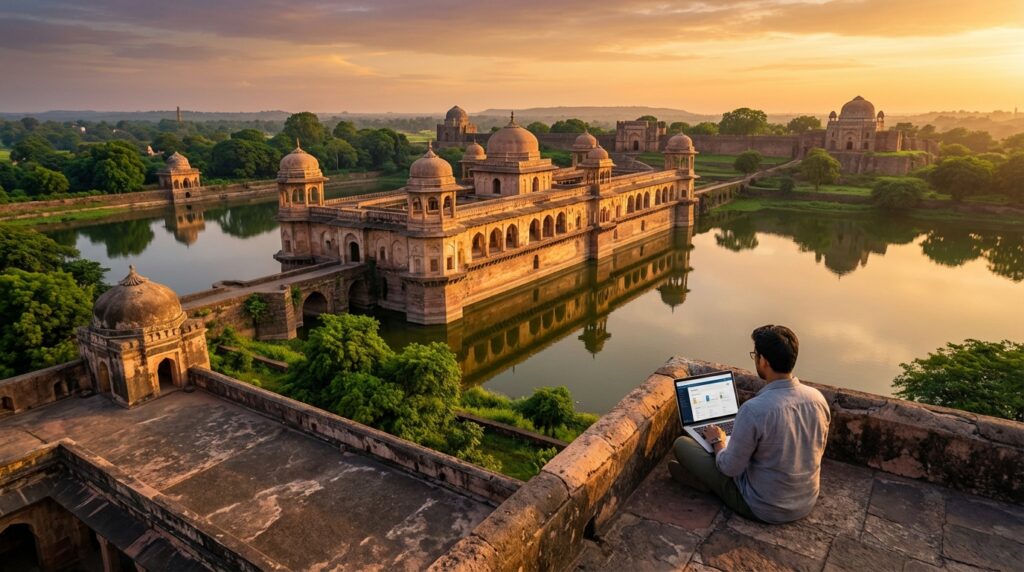
As remote work reshapes the professional landscape in 2026, digital nomads and remote professionals are seeking destinations that blend productivity with inspiration. While mainstream workation hubs like Goa and Udaipur dominate conversations, a hidden gem in Madhya Pradesh is emerging as the year’s most compelling offbeat workspace: Mandu, the ancient city of Afghan architecture and untold stories.
The Remote Work Revolution: India’s 2026 Landscape
India’s remote work ecosystem has undergone a dramatic transformation. According to the India Skills Report 2026, the country’s overall employability rate has risen to 56.35 percent, up from 54.81 percent in 2025. More significantly, India now holds 16 percent of the world’s artificial intelligence talent, positioning itself as a global hub for digital professionals.
The trend toward workations has matured beyond the initial pandemic-era experimentation. Remote workers in 2026 are choosing mid-term stays of one to three months in single locations, prioritizing sustainability over constant movement. This shift creates the perfect environment for discovering hidden gems like Mandu.
Mandu: Where History Meets Modern Productivity
Perched at an elevation of 633 meters in the Malwa region of western Madhya Pradesh, Mandu is a fortified city with a rich history spanning from the 6th century. This ruined city, once the capital of the Malwa Sultanate, boasts over 82 kilometers of fort perimeter, making it one of India’s largest forts.
What makes Mandu extraordinary for remote workers is its unique combination of architectural grandeur, natural beauty, and relative isolation. Unlike overcrowded tourist destinations, Mandu offers the tranquility necessary for deep focus work while providing enough cultural stimulation to prevent the monotony that often plagues remote workers.
Mandu’s Key Attractions for Remote Professionals
Infrastructure Reality Check: Can Mandu Support Remote Work?
The primary concern for any workation destination is connectivity. While Mandu itself is a small historic town, it benefits from Madhya Pradesh’s expanding digital infrastructure. The nearest major city, Indore, located approximately 99 kilometers away, has emerged as a thriving coworking hub with over ten established spaces offering high-speed internet, dedicated workstations, and collaborative environments.
| Infrastructure Element | Availability in Mandu Region | Distance from Mandu |
|---|---|---|
| Coworking Spaces | Multiple options in Indore | 99 km |
| High-Speed Broadband | JIO Fiber, Airtel, RailWire available | Available in town |
| Nearest Airport | Devi Ahilya Bai Holkar Airport, Indore | 99 km |
| Railway Station | Ratlam Junction | 124 km |
| Accommodation Options | Government guesthouses, private hotels, heritage stays | Within Mandu |
| Healthcare Facilities | Basic facilities in Mandu, advanced in Indore | 0-99 km |
For remote workers willing to invest in portable connectivity solutions such as 4G/5G hotspots, Mandu offers reliable mobile internet coverage through major providers. The MP Tourism Development Corporation’s Malwa Resort provides comfortable accommodation with modern amenities, making it an ideal base for extended stays.
The Cost Advantage: Budget Breakdown
One of Mandu’s most compelling advantages is its affordability compared to popular workation destinations. In an era where remote workers earn 22 percent more on average, strategic location choices can dramatically increase savings and quality of life.
Monthly Cost Comparison: Mandu vs. Popular Workation Hubs
| Expense Category | Mandu (INR) | Goa (INR) | Udaipur (INR) |
|---|---|---|---|
| Accommodation | 12,000 – 20,000 | 25,000 – 50,000 | 20,000 – 40,000 |
| Food & Dining | 6,000 – 10,000 | 15,000 – 25,000 | 12,000 – 20,000 |
| Internet & Utilities | 1,500 – 2,500 | 2,000 – 3,000 | 2,000 – 3,000 |
| Local Transportation | 2,000 – 3,000 | 5,000 – 8,000 | 4,000 – 6,000 |
| Total Monthly Cost | 21,500 – 35,500 | 47,000 – 86,000 | 38,000 – 69,000 |
Budget-conscious remote workers can save between 40 to 60 percent monthly by choosing Mandu over mainstream alternatives while enjoying a superior quality of life and cultural immersion.
The Productivity Paradox: Why Isolation Enhances Focus
Research on remote work trends in 2026 reveals a counterintuitive insight: extreme mobility decreases productivity. The constant movement between cities every few weeks creates decision fatigue and prevents the establishment of sustainable routines. Mandu’s relative isolation from major metropolitan areas becomes an advantage rather than a limitation.
The town’s architectural wonders provide natural breaks from screen time. A morning walk to Jahaz Mahal, the ship-like palace floating over twin lakes, offers mental rejuvenation without the crowds found at tourist hotspots. The Baz Bahadur Palace and Rani Roopmati Pavilion provide panoramic views ideal for afternoon contemplation and problem-solving.
Cultural Immersion Without Tourist Overload
Unlike destinations suffering from over-tourism, Mandu maintains authentic local culture. Remote workers can experience traditional Malwa cuisine, including the famous Dal Paniya cooked in tandoors, and witness the city’s unique African baobab trees, locally known as Khorasani Imli, gifted by Egyptian Caliphs in the 14th century.
The annual Mandu Festival showcases regional heritage through cultural programs, heritage walks, adventure sports including zip-lining and rock climbing, and yoga sessions, all without the commercialization plaguing similar events in popular destinations.
Best Practices for a Mandu Workation
To maximize the benefits of a Mandu workation, remote professionals should consider the following strategy:
- Optimal Duration: Plan for 1-3 month stays to establish routines and deeply experience the location. This aligns with 2026’s trend toward mid-term stays over hyper-mobility.
- Connectivity Setup: Arrange multiple internet backups including fiber broadband, 4G/5G hotspots from different providers, and offline work capabilities for occasional connectivity issues.
- Accommodation Selection: Book heritage properties or government tourism accommodations that offer modern amenities within historic settings.
- Work Schedule Design: Leverage the town’s quiet mornings for deep work, exploring monuments during less intense afternoon hours, and returning to evening tasks with renewed mental clarity.
- Community Building: Connect with local professionals in nearby Indore through coworking spaces for occasional collaboration and networking.
The Climate Advantage
Timing is critical for any workation. Mandu’s climate follows distinct seasonal patterns that remote workers should consider:
| Season | Months | Temperature Range | Workation Suitability |
|---|---|---|---|
| Winter | October – March | 10°C – 25°C | Excellent – Pleasant weather, ideal for work and exploration |
| Summer | April – June | 25°C – 40°C | Moderate – Lower hotel prices, fewer tourists, but hot afternoons |
| Monsoon | July – September | 20°C – 30°C | Good – Lush landscapes, romantic ambiance, occasional connectivity disruptions |
The winter months offer the optimal balance of pleasant weather and peak productivity conditions, making this period ideal for remote professionals seeking extended stays.
Sustainability and Long-Term Impact
One emerging trend in 2026 workations is the focus on sustainability and positive local impact. Unlike destinations experiencing environmental strain from tourism, Mandu can benefit from thoughtful remote worker engagement. Extended stays contribute to local economies without overwhelming infrastructure, and the lower tourist density means remote workers become community members rather than transient visitors.
This aligns with the broader shift identified in recent research: workations in 2026 are treated as infrastructure rather than experiences, emphasizing sustainable, repeatable patterns over Instagram-worthy moments.
Who Should Choose Mandu?
Mandu is particularly suited for:
- Writers and creative professionals seeking inspiration from historical narratives and architectural beauty
- Software developers and AI engineers who need deep focus periods and can work asynchronously with global teams
- Digital marketers and content creators looking for unique visual content and cultural stories
- Entrepreneurs and consultants who value cost efficiency and mental space for strategic thinking
- Professionals in time-zone compatible roles where physical presence is unnecessary but internet connectivity is essential
The Verdict: Mandu’s Workation Potential
As remote work stabilizes into sustainable patterns in 2026, success lies not in chasing trending destinations but in finding locations that support long-term productivity, cultural enrichment, and economic efficiency. Mandu delivers on all three fronts while remaining largely undiscovered by the workation crowd.
With India’s remote work readiness climbing to third place among developing nations and 43 percent of professional jobs now offering full remote options, the infrastructure supporting remote professionals continues expanding into tier-two and tier-three cities. Mandu, positioned between these categories, benefits from improved connectivity while maintaining the charm that attracted sultans and poets centuries ago.
For remote professionals willing to trade beach sunsets for palatial sunrises and crowded cafes for monument-dotted landscapes, Mandu represents 2026’s most compelling offbeat workspace. It is not merely a destination but a workspace philosophy: prioritizing depth over breadth, sustainability over spectacle, and meaningful work over performative productivity.
In an era where 80 percent of software engineers work remotely at least part-time and hybrid arrangements become the norm, the question is no longer whether remote work will persist but where it will thrive. The answer, increasingly, lies in hidden gems like Mandu where history whispers productivity secrets that modern coworking spaces can only echo.
Leave a Reply