Where the Himalayas Guard a Living Culture
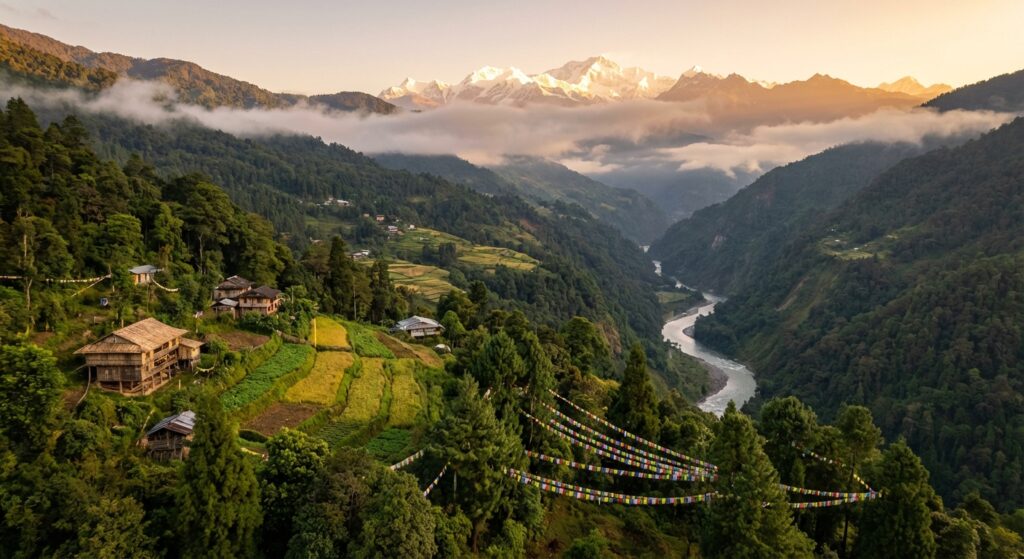
Tucked between the thundering Teesta River and the snow-draped ramparts of the Kanchenjunga range, Dzongu is one of the last truly protected indigenous homelands in the Indian Himalayas. Officially declared a Lepcha Reserve in 1960 by Chogyal Palden Thandup Namgyal, and later declared a “Primitive World” by the Government of Sikkim on 4 April 2018, this roughly triangular forested mountain region sits in North Sikkim at elevations ranging from approximately 3,000 to 20,000 feet above sea level.
Visiting Dzongu in 2026 is a privilege, not a right. Unlike a national park where you come to observe landscapes, here you are entering someone’s living homeland. The Lepcha people, who call themselves “Rong” (ravine dwellers), have inhabited and shaped this landscape for centuries. They worshipped animism, revering the natural spirits of land, water, and trees, and their ties with Kanchenjunga run so deep that the mountain is considered the protector of all life. Approaching Dzongu with humility and awareness transforms a good trip into a genuinely meaningful one.
This guide covers everything you need, from permits and geography to festivals, etiquette, and data on the ecosystem, so that your visit strengthens rather than strains this irreplaceable place.
Key Facts About Dzongu
Geography
Bordered by Teesta River (south-east), Tholung Chu or Rongyoung Chu (north-east), and the Kanchenjunga Biosphere Reserve to the north.
Population
Over 4,000 Lepchas reside within Dzongu. Total global Lepcha population is estimated at around 50,000 spread across Sikkim, West Bengal, Nepal, and Bhutan.
Ecology
The reserve falls within the Khangchendzonga Biosphere Reserve and shelters over 200 bird species, 118 documented medicinal plant species, and rare orchids.
Legal Status
Non-Lepchas cannot own land or establish permanent settlements. Entry requires an Inner Line Permit. The reserve was notified via Royal Darbar notification 3069 in 1958.
Livelihoods
Residents grow rice, buckwheat, millet, barley, maize, and cardamom. Cardamom cultivation is a significant cash crop and a cornerstone of the local economy.
Spirituality
The majority practice Buddhism alongside traditional Animism (Mun religion). Kanchenjunga (27,803 ft) is revered as a guardian deity by all Lepchas.
Understanding Dzongu’s Terrain
Dzongu is a fairly triangular dense forested mountain region bounded by majestic Himalayan peaks including Mt. Kanchenjunga (27,803 ft), Mt. Pandim (21,950 ft), Mt. Simvo (22,476 ft), and Mt. Siniolchu (22,600 ft) to the west. The region is divided into Lower, Middle, and Upper Dzongu, each with distinct character, accessibility, and altitude.
Source: Ethnomedicinal study by Lepcha tribe, Dzongu Valley, published in academic research on Khangchendzonga Biosphere Reserve.
A Sanctuary Within a Sanctuary
The entire Dzongu reserve falls inside the Khangchendzonga Biosphere Reserve, one of UNESCO’s World Network of Biosphere Reserves. The biodiversity found here is staggering, with dense broadleaf forests, cloud forests, alpine meadows, and glacial rivers creating habitats for hundreds of species. Dzongu is a natural paradise for birds with more than 200 species in the surrounding area. The sparse population with scattered houses and dense evergreen forests with topographical extremes creates a perfect arena for avifaunal diversity.
Approximate breakdown based on field surveys and academic documentation of the Dzongu valley ecosystem.
Research has documented 118 species of medicinal plants belonging to 71 families and 108 genera used by Lepchas for treating approximately 66 ailments, grouped under 14 broad categories. The Zingiberaceae family (ginger relatives) appeared as the most frequently used, with 8 species and 5 genera. This extraordinarily rich ethnobotanical knowledge, passed through oral tradition for generations, is itself a reason for the reserve’s legal protection.
How to Get Permission to Enter Dzongu
Dzongu requires a valid Inner Line Permit (ILP) issued by the District Collector’s office in Mangan, the headquarters of North Sikkim district. This is not merely bureaucratic formality. It is a legal instrument that preserves the rights of Lepcha landowners and limits the flow of visitors to what the community can absorb sustainably.
Step-by-Step Permit Process (2026)
Important: Entry Points in 2026
After a devastating landslide in 2016 changed the course of the Teesta River, the Sankalang entry point connecting Mangan to Upper Dzongu via Passingdong is now the primary access route. The previously used Pheedang entry near Dikchu into Lower Dzongu may have limited connectivity. Always confirm current road conditions with your homestay before departure.
Getting to Dzongu
| Route | Distance | Travel Time | Transport Options | Approx. Cost (INR) |
|---|---|---|---|---|
| Gangtok to Dzongu (Tingvong) | ~70 km | 3 hours | Shared jeep via Mangan, or private cab | 150 (shared) / 1,200 (private) |
| Siliguri / NJP to Dzongu | ~145 km | 5 to 6 hours | Shared jeep to Singtham then Mangan, or private car | 300 (shared) / 4,000 (private) |
| Bagdogra Airport to Gangtok | ~125 km | ~4.5 hours | Cab or helicopter (season-dependent) | 2,500 to 3,500 |
| Pakyong Airport to Gangtok | ~27 km | ~1.5 hours | Cab | 800 to 1,200 |
| Mangan to Dzongu (Tingvong) | ~12 km | 45 minutes | Shared jeep (last one leaves ~3 PM) or homestay pickup | 60 (shared) / 400 (private) |
Critical Transport Note
The last shared jeep from Mangan to Dzongu departs at around 3 PM. After that no shared vehicle is available. It is advisable for first-time visitors to ask their homestay owner to arrange a pickup in advance. Plan your Gangtok to Mangan connection to arrive well before noon.
Best Time to Visit Dzongu
Dzongu’s altitude range means its climate varies dramatically by elevation and season. The window for comfortable, safe travel is narrower here than in many Himalayan destinations, and timing directly affects what you will experience, from blooming rhododendrons to ancient masked festival dances.
October through November offers the clearest mountain views, freshest post-monsoon air, and harvest-season energy in the villages. April to May brings rhododendron blooms and the cardamom plantation fragrance. December and January are excellent for the Namsoong Festival, which has been attracting increasing attention, when visitors can experience local delicacies served on handspun yak-wool rugs, and enjoy traditional Lepcha food culture. The Lingthem village area also hosts famous masked dances around December.
Villages and Sites Worth Exploring
Tingvong
Lingthem
Hee Gyathang
Tholung Monastery
Pentong
Lingzya Waterfall
What You Can Do in Dzongu
| Activity | Best Season | Difficulty | Notes |
|---|---|---|---|
| Passingdang to Lingthem Trek | Oct, Nov, Apr, May | Moderate | 3-hour uphill through bamboo groves. Best mountain views at the top. |
| Birdwatching | Oct to May | Easy | Over 200 species. Hire a local Lepcha guide who knows the forest sounds. |
| Tholung Monastery Visit | Year-round | Easy to Moderate | Ancient monastery. Remove footwear, speak softly, ask before photographing. |
| Angling (Ringpi Chu) | Apr to Jun, Sep to Nov | Easy | Ringpi Chu cascades into Rongyong Chu. Obtain local permissions first. |
| Lepcha Museum Visit | Year-round | Easy | Located at Namprikdong near Sangkalang checkpost. Excellent cultural overview. |
| Hot Springs Soak (Lingthem) | Oct to Mar | Easy | Natural hot springs with therapeutic properties. Modest behavior expected. |
| Namsoong Festival | December to January | Easy (cultural) | Major Lepcha festival. Experience local food, song, and dance in its original setting. |
| Cardamom Farm Walk | Apr to Nov | Easy | Arranged through homestay. Never enter private farmland without an invitation. |
Where to Stay: Homestays Only
There are no hotels in Dzongu, only homestays. This is not an oversight but by design: the reserve’s rules ensure that all tourism revenue flows directly to Lepcha families. Staying in a homestay is also by far the richest experience available. You share meals, observe agricultural rhythms, and may hear folklore directly from the people who still live by it.
Well-regarded options include Munlom Nature Resort and various Lepcha-run homestays in Tingvong, Lingthem, and Passingdang. Rooms are simple, food is locally grown, and the hospitality is genuine. Advance booking is essential since capacity is intentionally limited.
A Note on Lepcha Meal Times
The Lepchas have a completely different daily routine that can be a shock to urban visitors. Breakfast is served by 7 AM, lunch by 10:30 AM, and this routine is not usually changed even for local guests. Accept the rhythm. It is part of the experience.
| Homestay Location | Zone | Best For | Approx. Cost per Night |
|---|---|---|---|
| Tingvong Homestays | Upper Dzongu | First-time visitors, valley views | INR 800 to 1,500 (with meals) |
| Lingthem Village | Upper Dzongu | Mountain views, architecture | INR 700 to 1,200 (with meals) |
| Passingdang | Upper Dzongu | Trek base, river access | INR 700 to 1,000 (with meals) |
| Hee Gyathang | Lower Dzongu | Cultural immersion, folklore | INR 600 to 1,000 (with meals) |
Cultural Etiquette: The Heart of Respectful Travel
Dzongu is not a museum exhibit. It is someone’s ancestral homeland, held together by spiritual connections, legal protections, and decades of community resistance to forces of cultural erosion. The Lepchas have faced cultural erosion due to external influences, migration, and modernization, which is precisely why the Chogyal rulers created this protected reserve in the first place. How you behave as a visitor is a direct reflection of whether tourism here is a threat or a blessing.
- Carry your permit at all times and present it willingly at checkpoints
- Ask explicit permission before photographing people, rituals, or private homes
- Remove footwear before entering monasteries or any Lepcha home
- Support local homestays and buy locally made crafts directly from artisans
- Walk softly in forested areas and avoid damaging plants or orchids
- Accept and participate in the daily schedule of your host family
- Hire a local Lepcha guide for treks and cultural interpretation
- Dispose of all waste responsibly and carry out what you carry in
- Enter private farmlands, forests, or sacred groves without permission
- Photograph people during sacred rituals without express consent
- Attempt to stay overnight without a confirmed homestay booking
- Offer unsolicited gifts that create dependency or distort local economics
- Collect plants, stones, or any natural material from the reserve
- Drink alcohol in public spaces or bring excessive alcohol into the reserve
- Bargain aggressively on homestay or guide rates that are already modest
- Assume you can enter Dzongu without prior permit arrangements
Lepcha Festivals in Dzongu
Traditional festivals such as Tendong Lho Rum Faat and Chu Rum Faat are celebrated with great fervor among the Lepcha people, and efforts continue to preserve the Lepcha language, which is unique in its script and phonetics. Attending a festival in Dzongu is unlike any cultural tourism experience elsewhere. There is no stage, no performance for visitors. You are a respectful witness to a living tradition.
| Festival | Timing | Significance | Where in Dzongu |
|---|---|---|---|
| Namsoong | December to January | Lepcha New Year celebration. Traditional food, dance, and community gathering. | Throughout Dzongu villages |
| Tendong Lho Rum Faat | August (8th day of 6th Lepcha month) | Worship of Mt. Tendong as protector during mythological floods. One of the most sacred Lepcha rituals. | Village ceremonies |
| Chu Rum Faat | Variable (spring) | Water worship ritual honoring rivers and springs as sacred life-giving sources. | Riverbanks and sacred springs |
| Lingthem Masked Dances | December | Ancient Nyingma Buddhist masked dances performed at Lingthem Monastery. | Lingthem Village Monastery |
| Harvest Celebrations | October to November | Post-harvest thanksgiving tied to millet, rice, and cardamom cycles. | All inhabited villages |
The Challenges Dzongu Faces
Understanding the pressures on Dzongu makes you a more informed, empathetic visitor. The reserve exists because of threats: past and present.
In the 2000s, the Sikkim government proposed several hydropower projects in Dzongu, leading to widespread protests from the Lepcha community. The Affected Citizens of Teesta (ACT), an activist group, played a crucial role in opposing these projects, arguing that they threatened the environment and the cultural sanctity of Dzongu. As a result of the protests, many projects were either stalled or scrapped, demonstrating the Lepchas’ commitment to protecting their homeland.
Despite being a reserve, Dzongu faces ongoing threats from hydropower development, deforestation, and climate change. The local community, along with NGOs, actively protests against environmentally destructive activities to safeguard Dzongu’s fragile ecosystem.
Index compiled from academic research, government reports, and community-documented concerns.
Practical Information for 2026
| Category | Information |
|---|---|
| Mobile Network | Very limited. BSNL may work in some areas. Do not rely on internet access. Download offline maps before departure. |
| ATMs | None inside Dzongu. Withdraw cash in Mangan or Gangtok before entering. |
| Medical Facilities | A basic health sub-centre exists in the region but serious medical care requires Mangan or Gangtok. Carry a first-aid kit. |
| Nearest Hospital | District hospital, Mangan (~12 km from upper Dzongu entry). |
| Electricity | Available at most homestays but may be intermittent. Carry a power bank. |
| Altitude Sickness | Possible above 8,000 ft. Acclimatize in Gangtok or Mangan for a day before heading to upper Dzongu. |
| Water | Glacial stream water is generally pure but carry purification tablets for higher treks. |
| Tipping | Not mandatory but appreciated for guides and homestay staff. INR 200 to 500 per day for a guide is reasonable. |
Travel as Stewardship
Dzongu is not simply a travel destination. It is, as the Lepchas themselves believe, the bridge to something sacred: a homeland, a cosmology, a way of being in the world that the modern era has largely forgotten. The privilege of entering this space comes with a responsibility.
Choose homestays run by Lepcha families. Hire local guides. Shop from local artisans. Leave no trace in the forests. Share your experience honestly and encourage others to visit with the same awareness you bring. Tourism, when done well, funds the kind of life that makes cultural survival possible. When done carelessly, it becomes one more force of erosion.
The mountains that ring Dzongu have watched over the Lepchas for thousands of years. When you visit in 2026, you are a guest in their story. Walk accordingly.
Leave a Reply