Robertsganj: A Guide to the Only Hill Station in Uttar Pradesh for 2026
Nestled between the majestic Vindhya and Kaimur mountain ranges in southeastern Uttar Pradesh, Robertsganj stands as a unique gem in India’s tourism landscape. As the administrative headquarters of Sonbhadra district, this hill station offers an extraordinary blend of natural beauty, historical significance, and cultural richness. With an elevation of 318 meters above sea level, Robertsganj provides a refreshing escape from the plains while remaining easily accessible to travelers seeking offbeat destinations in 2026.
Often referred to as the “Switzerland of India” by former Prime Minister Jawaharlal Nehru, Robertsganj’s picturesque topology and serene environment make it a must-visit destination for nature enthusiasts and history buffs alike. The town, named after British Field Marshal Frederick Roberts, has evolved into a significant tourist hub recognized by the Uttar Pradesh Tourism Department, offering visitors an authentic experience away from crowded mainstream destinations.
Geographic Profile and Demographics
Robertsganj is strategically positioned at coordinates 24.7°N latitude and 83.07°E longitude, making it the southeasternmost city in Uttar Pradesh. The district was carved from Mirzapur on March 4, 1989, creating a unique administrative region known for its hilly terrain and mineral wealth. According to the 2011 Census, the Robertsganj Nagar Palika Parishad has a population of 36,689 residents, comprising 19,294 males and 17,395 females.
Robertsganj Population Demographics (2011 Census)
Male: 19,294 (52.6%)
Female: 17,395 (47.4%)
The literacy rate stands impressively at 84 percent, significantly higher than the state average of 67.68 percent. Male literacy reaches 89.32 percent while female literacy is recorded at 78.1 percent, demonstrating progressive educational development in this hill region.
Climate and Best Time to Visit
Understanding Robertsganj’s climate is crucial for planning your 2026 visit. The region experiences three distinct seasons, each offering unique experiences for travelers. Summer months from March to May see temperatures soaring to 45°C, accompanied by dry, hot winds. The monsoon season spans July through September, bringing heavy rainfall that transforms the landscape into lush greenery but can make travel challenging.
Average Monthly Temperature Range in Robertsganj
45°C
Summer (Mar-May)
35°C
Monsoon (Jul-Sep)
25°C
Winter (Dec-Feb)
Optimal Visiting Period: October to February
The winter season from December to February offers the most pleasant weather conditions, with temperatures ranging between 12°C and 25°C. This period is ideal for exploring historical sites, trekking through the Kaimur hills, and enjoying outdoor activities without the discomfort of extreme heat or monsoon rains.
Major Tourist Attractions
Robertsganj and the surrounding Sonbhadra district boast an impressive array of tourist destinations that cater to diverse interests. The region’s unique positioning between two mountain ranges has created a landscape rich in natural wonders, ancient fortifications, and spiritual sites that date back centuries.
Top Attractions by Distance from Robertsganj
Attraction
Distance from Robertsganj
Type
Historical Period
Vijaygarh Fort
30 km
Historical Fort
5th Century
Lorika Rock
10 km
Natural Formation
Ancient
Shivdwar Temple
40 km
Religious Site
11th Century
Naugarh Fort
40 km
Historical Fort
Medieval Era
Rihand Dam
46 km
Engineering Marvel
1961
Chandra Prabha Wildlife Sanctuary
50 km (approx)
Nature Reserve
Established 1957
Vijaygarh Fort: The Crown Jewel
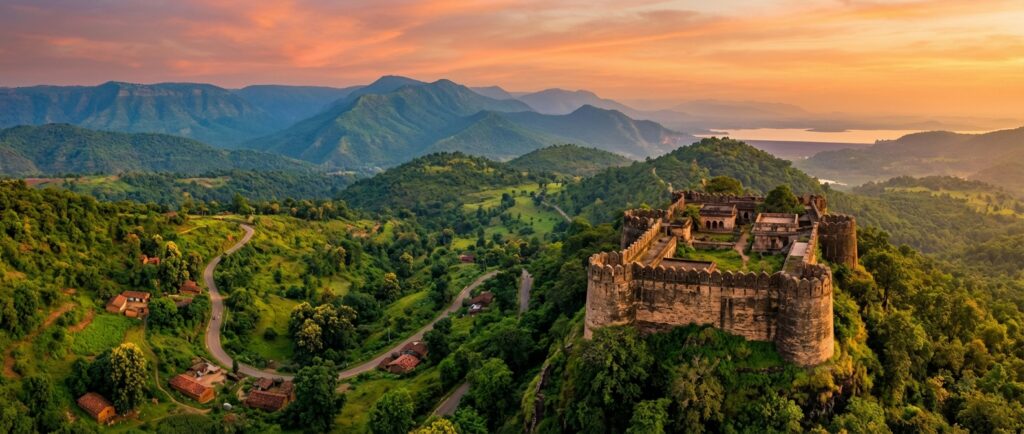
Standing 400 feet tall, Vijaygarh Fort represents one of the oldest and most magnificent hill forts in Uttar Pradesh. Constructed by the Kol kings in the 5th century, this architectural marvel sits atop the Kaimur Range in Mau Kalan village. The fort gained literary fame through Devaki Nandan Khatri’s popular Hindi novel “Chandrakanta,” which features Princess Chandrakanta of Vijaygarh in its narrative.
The fort’s unique features include prehistoric cave paintings, intricate rock inscriptions, ancient statues, and four perennial ponds that remarkably never run dry. More than half the fort’s area is covered by steep, rugged hills that provide breathtaking panoramic views of the surrounding landscape. The site hosts an annual Urs (fair) every April at the tomb of Sufi saint Hazrat Meeran Shah Baba, drawing thousands of devotees from various faiths.
Connectivity and Accessibility
Despite its hilly terrain, Robertsganj maintains excellent connectivity with major cities across Uttar Pradesh and beyond. The town’s strategic location makes it accessible through multiple transportation modes, ensuring convenient travel for visitors in 2026.
Transportation Connectivity Analysis
Varanasi Airport
94 km – Nearest Airport
Sonbhadra Railway
2 km – Local Station
Varanasi City
82-88 km – Major Hub
Allahabad (Prayagraj)
Well-connected by Road
Railway Connectivity
The Sonbhadra railway station, formerly known as Robertsganj station until its 2018 renaming, serves as the primary rail gateway. The station features two well-sheltered platforms with modern amenities including water facilities and sanitation. Direct train services connect Robertsganj to major cities including Delhi, Jammu, Amritsar, Kanpur, Prayagraj, Varanasi, Lucknow, and Bareilly. Current electrification work and survey projects aim to enhance connectivity to Varanasi Junction and Pandit Deen Dayal Upadhyay Junction, reducing passenger congestion.
Road Network
State highways and well-maintained roads connect Robertsganj to Lucknow, Allahabad, Varanasi, Mirzapur, Gorakhpur, and Faizabad. Regular bus services operate throughout the day from Varanasi, with the journey typically taking 2.5 hours. The highway connecting Varanasi to Waidhan passes through the district, facilitating access to commercial centers like Dalla, Renukoot, Anpara, and Shaktinagar.
Economic Significance: The Energy Capital
Beyond tourism, Sonbhadra district has earned the distinction of being India’s “Energy Capital” due to its concentration of power plants and industrial facilities. The region hosts multiple thermal power stations, cement factories at Churk and Dala, the Rihand Dam hydroelectric project, and aluminum production facilities operated by the Birla group at Renukoot.
Major Industrial Establishments Timeline
Year
Industry Established
Location
Significance
1956
First Cement Factory
Churk
Limestone Processing
1961
Rihand Dam
Pipri
Hydroelectric Power
1967
Renusagar Power Plant
Renusagar
Birla Group Initiative
1971
Second Cement Factory
Dala
Expanded Production
1998
Grasim Power Plant
Renukoot
Chemical Production
Natural Wonders and Wildlife
The Chandra Prabha Wildlife Sanctuary, sprawling across 9,600 hectares on the hillocks of Vijaygarh and Naugarh, represents a biodiversity hotspot established in May 1957. The sanctuary initially housed Asiatic lions brought in 1958, which multiplied to eleven by 1969 before disappearing in 1970. Today, it serves as habitat for chital, nilgai, chinkara, blackbuck, sambhar, wild boar, hyena, and approximately 150 bird species, making it a paradise for ornithologists and wildlife photographers.
The Chandra Prabha and Karmnasha rivers flowing through the sanctuary support diverse fish populations and provide scenic beauty enhanced by medicinal plants and indigenous flora including saagun, amaltas, mahua, and tendu trees.
Cultural Heritage and Festivals
Robertsganj’s cultural calendar features vibrant celebrations that reflect its diverse religious heritage. The annual Urs at Vijaygarh Fort in April attracts devotees of all faiths, while the Kanwar Yatra during the Hindu month of Shravana sees pilgrims collecting water from Ram Sagar for their sacred journey to Shivdwar. These events offer visitors unique opportunities to witness authentic cultural practices and participate in traditional festivities.
Planning Your 2026 Visit
For travelers planning a trip to Robertsganj in 2026, a minimum three-day itinerary is recommended to experience the destination’s highlights. Day one should focus on exploring Vijaygarh Fort and its surroundings, including the perennial ponds and cave paintings. Day two can be dedicated to visiting Shivdwar Temple and Naugarh Fort, with time allocated for scenic photography. Day three should include the Rihand Dam and Chandra Prabha Wildlife Sanctuary for nature enthusiasts.
Essential Travel Tips for 2026
Book accommodations in advance, especially during October to February peak season
Carry comfortable trekking shoes for fort exploration and hill walks
Hire local guides for detailed historical context at ancient sites
Respect religious sentiments at temples and sacred sites
Stay hydrated and carry sun protection during day trips
Sample local cuisine, particularly traditional Uttar Pradesh dishes
Accommodation and Facilities
Robertsganj offers a range of accommodation options from budget guesthouses to mid-range hotels. The town’s infrastructure has improved significantly, with modern amenities available in most establishments. The Nagar Palika Parishad administers over 6,196 houses, ensuring basic amenities and services throughout the municipality.
Conclusion
As Uttar Pradesh’s only true hill station, Robertsganj represents an undiscovered treasure that combines natural beauty, historical significance, and cultural richness. The convergence of ancient fortifications, prehistoric cave art, spiritual temples, and stunning landscapes creates an experience unlike any other destination in the state. With improved connectivity, growing tourism infrastructure, and increasing recognition from state authorities, 2026 presents the perfect opportunity to explore this hidden gem before it becomes mainstream.
Whether you seek adventure in the Kaimur hills, spiritual solace at ancient temples, historical insights at 5th-century forts, or simply peaceful retreat from urban chaos, Robertsganj delivers authentically. Its designation as the “Switzerland of India” by Nehru continues to resonate as visitors discover its unique charm and untouched beauty. Plan your journey to this extraordinary hill station and create memories that will last a lifetime.
Meta description: Discover Robertsganj, Uttar Pradesh’s only hill station in 2026. Explore 5th-century forts, wildlife sanctuaries, and scenic mountain ranges. Complete travel guide with climate data and attractions.
The Ultimate 2026 Festival Calendar: How to Plan Your Trip Around India’s Most Vibrant Holidays
India’s cultural tapestry comes alive through its festivals, each celebration offering travelers an authentic glimpse into traditions that span millennia. Planning your 2026 journey around these vibrant holidays transforms a standard vacation into an immersive cultural experience. With over 40 major festivals celebrated across the nation’s 28 states and 8 union territories, strategic timing can mean the difference between witnessing everyday life and experiencing the extraordinary.
This comprehensive guide breaks down India’s 2026 festival calendar, providing travelers with essential dates, regional highlights, and practical planning insights to maximize their cultural exploration.
January Through March: Starting the Year with Spiritual Fervor
The first quarter of 2026 launches with some of India’s most visually spectacular celebrations. Makar Sankranti on January 14 marks the sun’s northward journey, celebrated uniquely across regions from kite-flying competitions in Gujarat to harvest festivities in Tamil Nadu called Pongal. This period sees approximately 12 million domestic tourists traveling specifically for festival participation.
Republic Day on January 26 showcases India’s military prowess and cultural diversity through the iconic parade in New Delhi, attracting over 150,000 spectators annually. February brings Maha Shivaratri, falling on February 26 in 2026, when temples across India host night-long vigils. The Khajuraho Dance Festival during this period presents classical performances against the backdrop of ancient temple architecture.
Holi, the festival of colors scheduled for March 14, 2026, represents peak tourist season with hotel occupancy rates reaching 95 percent in cities like Mathura and Vrindavan. This Hindu spring festival generates an estimated economic impact of 500 million dollars through tourism, with international visitor numbers surging by 300 percent during the celebration week.
Festival
2026 Date
Best Location
Average Tourist Influx
Makar Sankranti
January 14
Ahmedabad, Gujarat
2.5 million
Republic Day
January 26
New Delhi
150,000
Maha Shivaratri
February 26
Varanasi, Uttar Pradesh
1.8 million
Holi
March 14
Mathura, Uttar Pradesh
4 million
April Through June: Summer Festivals and Regional Celebrations
Despite rising temperatures, summer months host significant cultural events. Ram Navami on April 6 celebrates Lord Rama’s birth with processions in Ayodhya drawing 800,000 devotees. Baisakhi on April 13 marks the Punjabi New Year and harvest season, transforming Amritsar’s Golden Temple into a hub of celebration with over 1 million visitors.
Buddha Purnima on May 5, 2026, illuminates Buddhist sites across India. Bodh Gaya in Bihar becomes the epicenter, hosting 200,000 international Buddhist pilgrims alongside domestic visitors. The Hemis Festival in Ladakh, typically held in late June, offers high-altitude cultural experiences with traditional mask dances at the Hemis Monastery, attracting approximately 50,000 tourists to the region despite its remote location.
Summer Festival Tourist Distribution (in thousands)
Baisakhi – 1,000
Ram Navami – 800
Buddha Purnima – 500
Hemis Festival – 50
July Through September: Monsoon Magic and Independence Celebrations
The monsoon season brings unique festival experiences. Rath Yatra in Puri, scheduled for July 6, 2026, witnesses the procession of Lord Jagannath’s chariot through streets lined with 1.5 million devotees. This ancient tradition, dating back over 800 years, requires booking accommodations six months in advance due to overwhelming demand.
Independence Day on August 15 features flag-hoisting ceremonies nationwide, with the prime minister’s address from Delhi’s Red Fort broadcast to the entire nation. Janmashtami on August 26 celebrates Krishna’s birth with midnight celebrations in Mathura and Dwarka, drawing combined crowds exceeding 3 million people.
Ganesh Chaturthi, beginning September 5 in 2026, transforms Mumbai into a ten-day festival extravaganza. The city installs over 150,000 Ganesh idols, with economic activity surpassing 300 million dollars. The final immersion processions on September 14 involve 2.5 million participants, making it Maharashtra’s largest public gathering.
October Through December: Festival Peak Season
Autumn ushers in India’s most concentrated festival period. Navaratri commences October 3, featuring nine nights of dance, particularly Garba in Gujarat where cities like Vadodara host gatherings of 100,000 participants nightly. This period sees hotel rates increase by 40 to 60 percent across major cities.
Dussehra on October 12 marks Ravana’s defeat with effigy burnings nationwide. Delhi’s Ramlila at Red Fort grounds attracts 500,000 spectators over ten days. Diwali, India’s biggest festival, falls on October 20, 2026, generating the highest domestic travel numbers with approximately 35 million Indians traveling during the five-day celebration period.
Festival
Duration
Key States
Estimated Participants
Navaratri
9 nights
Gujarat, West Bengal
15 million
Dussehra
1 day
Pan-India
20 million
Diwali
5 days
Pan-India
100 million
Pushkar Camel Fair
7 days
Rajasthan
400,000
The Pushkar Camel Fair in early November combines livestock trading with cultural festivities, attracting 400,000 visitors including 50,000 international tourists. Guru Nanak Jayanti on November 15 sees Golden Temple attendance peak at 150,000 daily visitors. Christmas celebrations, while concentrated in Goa and Kerala, have expanded nationwide with urban centers hosting markets and events throughout December.
Strategic Planning: Maximizing Your Festival Experience
Successful festival travel requires advance planning. Accommodation during major festivals should be booked three to six months ahead, particularly for Diwali and Holi when prices surge 50 to 100 percent. Train tickets for popular routes sell out 60 days before departure, necessitating early reservation through Indian Railways’ booking system.
Budget Planning Insight: Festival periods see 30 to 70 percent price increases across accommodation, with luxury hotels experiencing the steepest hikes. Mid-range hotels average 45 percent increases, while budget accommodations rise approximately 30 percent. Planning visits during shoulder periods immediately before or after major festivals can reduce costs while still offering cultural immersion.
Regional festivals provide authentic experiences with fewer crowds. The Hornbill Festival in Nagaland during early December attracts 250,000 visitors annually but offers more intimate cultural interactions than massive pan-Indian celebrations. Similarly, the Konark Dance Festival in Odisha and Hampi Utsav in Karnataka deliver high-quality cultural programming without overwhelming tourist numbers.
Transportation and Logistics During Festival Seasons
India’s transportation network handles extraordinary pressure during festival periods. Diwali weekend alone sees 200 million domestic trips, with railways operating 4,500 special trains. Flight prices increase by 25 to 40 percent during peak periods, while advance bookings can secure savings of up to 35 percent compared to last-minute purchases.
Major cities implement traffic restrictions during large processions. Mumbai’s Ganesh Chaturthi immersion days close 60 kilometers of coastal roads. Delhi restricts vehicle movement around Republic Day parade routes, affecting approximately 500,000 commuters. Understanding these logistics helps travelers plan alternative routes and timing.
Accommodation Price Increase by Festival (Percentage)
Diwali – 70%
Holi – 65%
Ganesh Chaturthi – 55%
Dussehra – 50%
Navaratri – 40%
Cultural Etiquette and Safety Considerations
Participating respectfully in festivals enhances experiences while honoring local traditions. Modest dress codes apply at religious sites, with temples requiring covered shoulders and legs. Photography permissions vary, with some ceremonies prohibiting cameras entirely while others welcome documentation.
Crowd safety becomes paramount during major gatherings. The 2026 Kumbh Mela, though not scheduled for this year, provides lessons in managing massive assemblies. Travelers should maintain awareness in dense crowds, secure valuables, and establish meeting points with companions. Official festival apps now provide real-time crowd density maps for major events, helping visitors navigate safely.
Making Your Festival Selection
Choosing festivals depends on interests and travel style. Spiritual seekers gravitate toward Kumbh Mela, Maha Shivaratri, and Buddhist festivals. Culture enthusiasts prefer classical dance festivals like Khajuraho or music-focused events such as the Jaipur Literature Festival in January, which draws 300,000 attendees and 500 speakers from 25 countries.
Adventure travelers combine festivals with regional exploration. Ladakh’s Hemis Festival pairs with Himalayan trekking, while Rajasthan’s desert festivals complement camel safaris and fort visits. Family travelers often select Diwali or Holi for their inclusive, joyful atmospheres that welcome participation across age groups.
India’s 2026 festival calendar offers unparalleled opportunities for cultural immersion. Whether witnessing the chromatic explosion of Holi, the spiritual intensity of Maha Shivaratri, or the community joy of Diwali, strategic planning transforms these ancient celebrations into modern travel highlights. With 150 million domestic tourists and 10 million international visitors expected during major festival periods, early preparation ensures unforgettable experiences at the heart of India’s living traditions.
Meta description: Discover India’s 2026 festival calendar with dates, locations, and travel tips for Holi, Diwali, and more. Plan your cultural journey with expert insights.
February marks one of the most rewarding periods for exploring India’s diverse landscapes and cultural treasures. As winter begins to soften and temperatures become ideal for travel, this transitional month offers travelers the perfect balance between comfortable weather and exceptional experiences. With India attracting over 1 million international tourists in February alone and temperatures averaging between 20 to 30 degrees Celsius across most regions, the country presents an inviting destination for all types of travelers.
The tourism sector in India contributed approximately ₹20.9 trillion to the GDP in 2024, representing 6.6% of the national economy and supporting 46.5 million jobs. February stands out as one of the peak travel months, with historical data showing 1,003,000 foreign tourist arrivals during this period, driven by pleasant weather conditions and vibrant festivals. Understanding why February is exceptional for Indian tourism requires examining the unique characteristics of this month and the destinations that truly shine during this season.
Monthly Tourist Arrivals to India (Peak Season)
Month
Foreign Tourist Arrivals
Key Attractions
December
1,028,000
Festive events, pleasant weather
February
1,003,000
Cultural fairs, end of winter
January
959,000
New Year celebrations, winter festivals
November
890,000
Post-monsoon freshness
March
870,000
Spring arrival, Holi festival
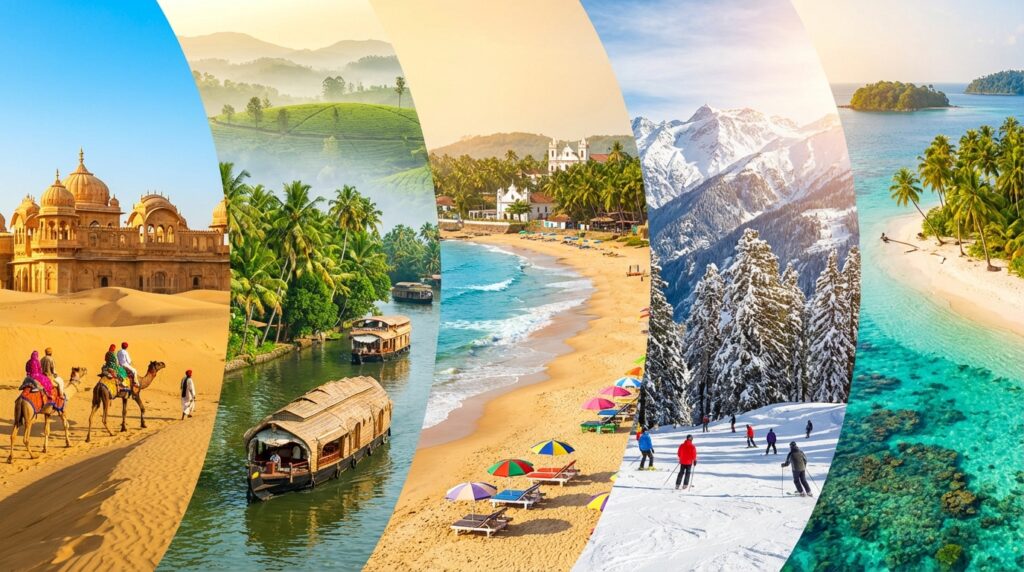
The distinct advantage of traveling in February lies in the climate stability across India. Northern regions experience temperatures between 10 to 25 degrees Celsius, while southern and coastal areas enjoy warm but comfortable conditions ranging from 22 to 30 degrees Celsius. This weather diversity allows travelers to choose between snow-capped mountains, golden beaches, verdant hill stations, or historic desert cities, all in their prime condition.
1. Rajasthan: The Golden Desert Experience
Rajasthan transforms into a traveler’s paradise during February, with the scorching desert heat giving way to pleasant daytime temperatures averaging 20 to 25 degrees Celsius. The state’s royal cities of Jaipur, Udaipur, Jaisalmer, and Jodhpur become ideal for exploration during this month, offering comfortable conditions for visiting magnificent forts, palaces, and vibrant bazaars.
The Jaisalmer Desert Festival, typically held in late February, showcases authentic Rajasthani culture through folk dances, camel races, and traditional performances against the backdrop of golden sand dunes. This cultural extravaganza attracts thousands of visitors annually and provides an immersive experience into desert life. Ranthambore National Park, one of India’s premier wildlife destinations, offers exceptional tiger sighting opportunities in February as reduced water sources draw animals into the open, with early morning safaris providing comfortable viewing temperatures.
Temperature Range: Daytime 20-25°C, Nighttime 12-18°C Best Activities: Fort exploration, desert camping, wildlife safaris, cultural festivals Ideal Duration: 5-7 days to cover major attractions
City
Key Attractions
Special February Events
Jaipur
Amber Fort, Hawa Mahal, City Palace
Heritage walks, craft exhibitions
Jaisalmer
Golden Fort, Sam Sand Dunes
Desert Festival with camel races
Udaipur
Lake Pichola, City Palace
Romantic boat rides, cultural shows
Jodhpur
Mehrangarh Fort, Blue City
Folk music performances
The architectural marvels of Rajasthan are best appreciated in February when tourists can comfortably spend hours exploring intricate palaces and massive fortresses. Udaipur, often called the Venice of the East, offers romantic sunset views over Lake Pichola, while Jodhpur’s imposing Mehrangarh Fort stands majestically against clear blue skies. The state’s hotel occupancy rates peak during this period, with luxury heritage hotels offering unique experiences of royal hospitality at relatively better rates compared to the December-January rush.
2. Kerala: God’s Own Country in Perfect Weather
Kerala emerges as one of the most enchanting destinations in February, with the state experiencing its driest and most pleasant weather period. The famous backwaters of Alleppey and Kumarakom reach their scenic peak during this month, with calm waters perfectly reflecting the lush palm-fringed landscapes and traditional houseboats gliding through the serene canals. The temperature hovers comfortably between 22 to 28 degrees Celsius, making it ideal for extended outdoor activities.
The hill station of Munnar presents a completely different facet of Kerala, with its rolling tea plantations stretching across misty valleys and temperatures providing a refreshing coolness ranging from 15 to 25 degrees Celsius. February allows visitors to witness the tea-picking season in full swing, with verdant estates creating picture-perfect landscapes. The coastal towns of Kovalam and Varkala offer pristine beaches with calm seas, perfect for swimming, sunbathing, and water sports without the humidity that characterizes other months.
Kerala Weather Comparison: February vs Other Months
Aspect
February
June-September (Monsoon)
April-May (Summer)
Temperature
22-28°C
24-30°C
28-35°C
Humidity
Low to Moderate
Very High
High
Rainfall
Minimal
Heavy
Occasional
Beach Activities
Excellent
Limited
Very Hot
Kerala’s rich cultural heritage becomes accessible in February through traditional Kathakali performances, temple festivals, and Ayurvedic wellness retreats that operate in optimal conditions. The state’s cuisine, featuring coconut-based curries, fresh seafood, and traditional sadya meals, can be fully enjoyed in the comfortable climate. Medical tourism contributes significantly to Kerala’s visitor numbers, with 21% of international visitors choosing India for healthcare and wellness services, and Kerala’s Ayurvedic centers attracting a substantial portion of these wellness seekers during the pleasant February weather.
3. Goa: Beach Bliss Beyond the Peak Season
While many associate Goa with the December-January rush, February offers a more balanced and enjoyable experience. The state maintains its perfect beach weather with temperatures between 22 to 30 degrees Celsius, but with significantly reduced crowds as the peak holiday season winds down. This creates an ideal scenario where visitors enjoy sunny skies, calm seas, and pleasant evenings without the overcrowding that characterizes earlier months.
The famous Goa Carnival, typically held in mid-February, transforms the state into a vibrant celebration of Portuguese heritage with colorful parades, street dances, music performances, and elaborate floats. This four-day festival showcases Goa’s unique cultural fusion and attracts visitors from across India and abroad. The beaches of North Goa, including Baga, Calangute, and Anjuna, offer water sports activities in perfect conditions, while South Goa’s quieter stretches like Palolem and Agonda provide serene escapes.
Region
Beach Type
Best For
Crowd Level in February
North Goa
Lively beaches
Water sports, nightlife, beach shacks
Moderate
South Goa
Quiet beaches
Relaxation, couples, peaceful retreats
Low to Moderate
Central Goa
Cultural sites
Churches, Portuguese heritage
Low
Goa’s accommodation prices become more reasonable in February compared to the December-January peak, offering better value for luxury resorts and boutique properties. The state’s culinary scene remains vibrant with beach shacks serving fresh seafood, while inland areas offer authentic Goan cuisine in traditional settings. River cruises on the Mandovi and Zuari rivers provide scenic evening experiences, and the spice plantations of Ponda offer guided tours showcasing Goa’s agricultural heritage in comfortable walking weather.
4. Himachal Pradesh: Snow Adventures and Mountain Serenity
February represents the peak winter season in Himachal Pradesh, offering spectacular snow experiences across multiple destinations. Manali transforms into a winter wonderland with temperatures ranging from minus 2 to 12 degrees Celsius, providing perfect conditions for skiing, snowboarding, and snow trekking in Solang Valley. The town’s picturesque landscape, covered in fresh snow, creates postcard-worthy scenes with the Beas River flowing through snow-clad mountains.
Gulmarg in Kashmir earns its reputation as one of Asia’s premier skiing destinations during February, with powdery snow and the world’s second-highest gondola lift operating at full capacity. The destination attracts both amateur and experienced skiers, offering slopes suitable for various skill levels. The temperature ranges from minus 5 to 10 degrees Celsius, creating ideal snow conditions without extreme cold.
Snow Destinations in Himachal:
Manali: Skiing in Solang Valley, snow activities in Rohtang Pass area
Shimla: Colonial architecture against snowy backdrop, Ridge walks
Auli: Skiing paradise with panoramic Himalayan views
For travelers seeking less adventure and more tranquility, destinations like Dharamshala and McLeodganj offer spiritual experiences combined with Himalayan beauty. The Dalai Lama’s temple complex becomes more accessible in February’s clear weather, and the surrounding monasteries provide peaceful retreats. The temperature here remains moderate at 5 to 15 degrees Celsius, comfortable for exploration and meditation.
Destination
Altitude (meters)
Temperature Range
Primary Activities
Manali
2,050
-2°C to 12°C
Skiing, snow trekking, hot springs
Shimla
2,200
0°C to 10°C
Heritage walks, snow viewing, shopping
Auli
2,500-3,000
-5°C to 8°C
Professional skiing, cable car rides
Dharamshala
1,475
5°C to 15°C
Monastery visits, trekking, cultural exploration
5. Andaman and Nicobar Islands: Tropical Paradise
The Andaman and Nicobar Islands present a completely different dimension to India’s February tourism landscape, offering tropical beach experiences with crystal-clear waters and pristine coral reefs. February marks one of the best periods for visiting these islands, with calm seas, excellent underwater visibility, and comfortable temperatures ranging from 24 to 30 degrees Celsius. The monsoons have long departed, and the water is at its clearest for snorkeling and scuba diving activities.
Havelock Island, now known as Swaraj Dweep, features the stunning Radhanagar Beach, consistently ranked among Asia’s best beaches. The island offers world-class diving sites at Elephant Beach and other locations, where visitors can explore vibrant coral formations and diverse marine life including sea turtles, colorful fish, and occasional manta rays. Neil Island provides a quieter alternative with equally beautiful beaches and natural rock formations.
Andaman Islands: Activities and Best Times
Activity
Best Location
Visibility/Conditions in February
Experience Level
Scuba Diving
Havelock, Neil Island
15-25 meters visibility, calm seas
Beginner to Advanced
Snorkeling
Elephant Beach, Jolly Buoy
Excellent clarity, vibrant coral
All levels
Sea Walking
North Bay Island
Perfect conditions, 8-12 meters depth
Beginners, non-swimmers
Island Hopping
Multiple islands
Calm seas, regular ferry services
All travelers
Port Blair, the capital, serves as the gateway to the islands and houses the historic Cellular Jail, a powerful reminder of India’s freedom struggle. The Sound and Light Show at the jail provides an emotional journey through history. February’s pleasant evenings make this outdoor experience comfortable and memorable. Ross Island and North Bay offer additional historical and recreational attractions easily accessible by boat.
The Andamans attract adventure enthusiasts and nature lovers alike, with opportunities for kayaking through mangrove creeks, trekking through tropical rainforests, and witnessing bioluminescent plankton at certain beaches during moonless nights. The islands’ limited tourist infrastructure compared to mainland destinations means advance booking is essential, particularly for accommodation and diving activities during February’s peak season.
Planning Your February 2026 India Trip
February 2026 presents travelers with exceptional opportunities across India’s diverse regions. The month’s weather stability, with most destinations experiencing dry conditions and comfortable temperatures, makes it ideal for varied itineraries combining multiple regions. Tourist infrastructure operates at full capacity without the overwhelming crowds of December-January, offering better service quality and more authentic local experiences.
Transportation networks, including domestic flights, trains, and road connections, function optimally during February. Major cities like Delhi, Mumbai, and Bangalore maintain pleasant weather, serving as convenient hubs for connecting to various destinations. The Golden Triangle circuit connecting Delhi, Agra, and Jaipur attracts significant visitor numbers, with the Taj Mahal receiving hundreds of thousands of visitors during this month alone.
Essential Travel Tips for February 2026:
Book accommodations 45-60 days in advance for best rates and availability
Pack layers for northern regions; temperature variations between day and night exceed 10°C
Carry sunscreen and sunglasses; February sun can be intense despite pleasant temperatures
Reserve wildlife safari permits and special event tickets well in advance
Consider shoulder dates around festivals for better pricing
The tourism sector’s contribution of ₹20.9 trillion to India’s GDP reflects the country’s growing importance as a global travel destination. With infrastructure improvements through initiatives like Swadesh Darshan 2.0 developing 110 projects across thematic circuits including Ramayana, Buddhist, Coastal, and Tribal routes, accessibility to diverse regions continues to improve. February capitalizes on this enhanced infrastructure while offering optimal weather conditions across most tourist destinations.
Cost considerations for February travel show moderate pricing compared to peak December-January rates. Hotels and resorts often offer promotional packages as the peak season concludes, providing value without compromising experience quality. Domestic airfares remain reasonable outside of specific festival dates, and train bookings made in advance ensure comfortable travel between major destinations.
Budget Category
Daily Expenditure (per person)
Accommodation Type
Travel Style
Budget
₹1,500 – ₹3,000
Hostels, budget hotels
Public transport, street food
Mid-Range
₹4,000 – ₹8,000
3-star hotels, boutique stays
Mix of transport, local restaurants
Luxury
₹12,000 – ₹25,000+
Heritage hotels, 5-star resorts
Private transport, fine dining
February 2026 stands as an exceptional time to explore India’s remarkable diversity. Whether seeking adventure in snow-capped mountains, relaxation on tropical beaches, cultural immersion in historic cities, or wildlife encounters in national parks, this month offers ideal conditions across all categories. The combination of pleasant weather, vibrant festivals, reduced crowds compared to peak winter months, and improving infrastructure makes February an optimal choice for discovering the incredible experiences that India offers to travelers worldwide.
Meta description: Discover the 5 best places to visit in India in February 2026. Complete guide with weather data, tourism statistics, and insider tips for Rajasthan, Kerala, Goa, Himachal, and Andaman Islands.
Here’s the modern professional’s paradox: you need to disappear, but you can’t actually disappear. You crave mountain silence and zero notifications, yet your calendar is blocked with Zoom calls through next Thursday. You want to trade your standing desk for a Himalayan sunrise, but WiFi isn’t optional – it’s survival.
Welcome to the era of the “internet-fast village” – remote enough to feel like you’ve vanished, connected enough that your boss has no idea you’re responding to emails from a terrace overlooking rice paddies instead of your cramped Mumbai apartment.
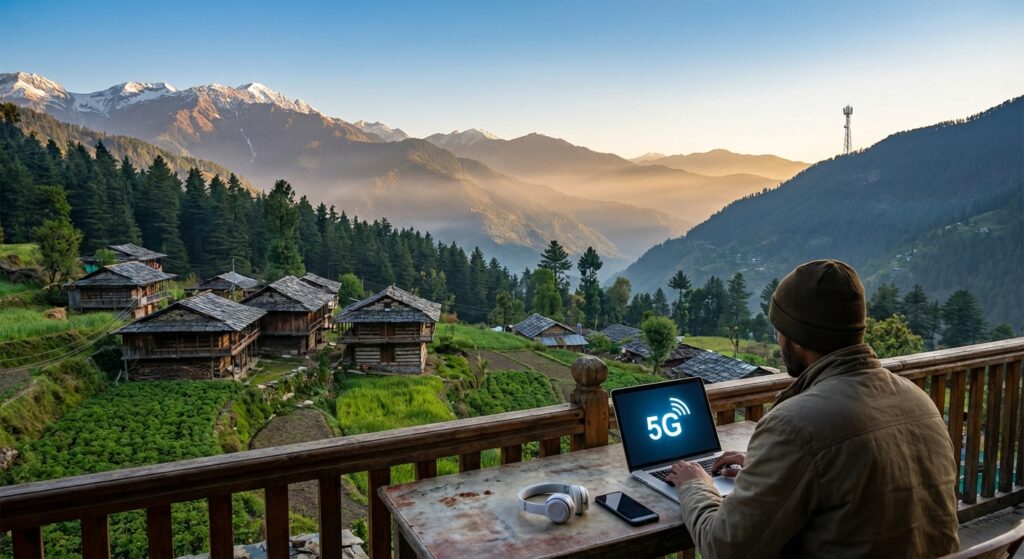
The good news? India’s 5G revolution has quietly transformed some of the country’s most remote villages into accidental coworking paradises. While burnout-fueled urbanites still associate “village life” with disconnection, a new infrastructure reality is emerging: you can now get faster internet speeds in a Himalayan hamlet than in your city high-rise.
The Connectivity Map: India’s 5G Rural Revolution by 2026
India’s 5G expansion has been nothing short of explosive. As of early 2026, the country has achieved near-universal 5G coverage, with services now available across every state and union territory, reaching an impressive 99.6% of all districts. Over 469,000 5G Base Transceiver Stations have been deployed nationwide, with a significant percentage dedicated to non-urban areas.
99.6%
Districts with 5G Coverage
469K+
5G Base Stations
400M+
5G Subscribers
77.8%
Villages with 5G Signal
What makes this rollout particularly revolutionary is India’s strategic use of Fixed Wireless Access technology, which beams high-speed internet wirelessly from cell towers to receivers, bypassing the need for expensive fiber-optic cable installation. Rural areas now receive stable connectivity speeds typically ranging from 50-100 Mbps – more than adequate for video conferencing, cloud-based work, and streaming.
India’s Rural 5G Penetration Statistics (2026)
Metric
Statistics
Districts with 5G Coverage
99.6%
Villages with 5G Signal Detection
77.8%
Villages with 4G Coverage
88.9%
Total 5G Base Stations Installed
469,000+
Total 5G Subscribers
400+ Million
Typical Rural 5G Speed (FWA)
50-100 Mbps
The government’s Digital India initiative, combined with private sector investments from telecom giants like Jio, Airtel, Vi, and BSNL, has created a unique moment in connectivity history. India skipped the “fiber-to-the-home” phase for many villages, jumping directly to 5G Fixed Wireless Access – making remote workations not just possible, but practical.
The 7 Secret Villages: Where Detox Meets Download Speed
1. Yakten, Sikkim – India’s Official Digital Nomad Village
The Vibe (The Detox Part)
Perched in Sikkim’s Pakyong district just a short drive from Gangtok, Yakten offers breathtaking Himalayan views, pristine air, and a pace of life that operates on mountain time. This isn’t a tourist trap – it’s a structured community designed specifically for remote workers who want to combine productivity with peace. The village is surrounded by forests and rolling hills, with cultural exchange programs that connect you with local traditions rather than Instagram aesthetics.
The Tech (The 5G Part)
Yakten was officially declared India’s first digital nomad village through a joint initiative by the Pakyong district administration and NGO Sarvahitey. The village is equipped with dual internet lines ensuring reliable connectivity, modern coworking spaces with panoramic mountain views, and eco-friendly accommodations utilizing solar power. Jio and Airtel provide consistent 4G/5G coverage as backup for when you need mobile hotspot support.
Where to Stay
Long-term housing options include eco-lodges with community kitchens, cafés for connecting with fellow nomads, and sustainable homestays ranging from ₹20,000-35,000 per month. Best visited March-June and September-November. Nearest airport: Bagdogra (accessible by scenic road routes).
2. Spiti Valley, Himachal Pradesh – High-Altitude Solitude with Surprising Connectivity
The Vibe (The Detox Part)
At over 12,000 feet, Spiti Valley embodies the “cold desert” aesthetic – stark, lunar landscapes punctuated by ancient monasteries and villages that seem untouched by time. This is where you go to experience genuine isolation, where the loudest sound is wind through barren mountains. The Nako Lake area offers traditional mud houses, sacred pathways, and a spirituality that has nothing to do with wellness branding.
The Tech (The 5G Part)
While Spiti was historically known for zero connectivity, the 2026 5G expansion has reached even these high-altitude villages. Main villages like Kaza and Nako now have Jio and Airtel 4G/5G coverage, with speeds adequate for video calls and cloud work. Many homestays have installed WiFi via local broadband providers. The key is managing expectations – connectivity is functional, not flawless, with occasional drops during extreme weather.
Where to Stay
Ecosphere Homestays offer zero-distraction environments with basic WiFi. Traditional guesthouses in Nako charge ₹1,500-3,000 per night. Permits required (₹50 in Reckong Peo, free in Shimla/Kaza). Best months: May-September when temperatures range 10-25°C. Accessible via cab from Reckong Peo or Manali through the Atal Tunnel.
3. Chitkul, Himachal Pradesh – The Last Village on the Indo-Tibetan Border
The Vibe (The Detox Part)
Located in the Kinnaur district, Chitkul holds the distinction of being the last inhabited village before the Indo-Tibetan border. This means dramatic mountain vistas, winding roads through pine forests, and a village untouched by mass tourism. The clean mountain air and majestic peaks create an environment where your biggest decision is whether to work from your balcony or the riverside.
The Tech (The 5G Part)
Thanks to the government’s push for border connectivity, Chitkul now receives surprisingly strong BSNL and Airtel coverage. The village falls under the enhanced connectivity zones due to its strategic border location. Download speeds hover around 40-70 Mbps – more than sufficient for remote work, video conferencing, and streaming.
Where to Stay
Basic guesthouses and homestays available for ₹1,000-2,500 per night. The Wanderer’s Nest and Chitkul Camps offer longer stays. Best visited April-October before heavy snowfall closes roads. Accessible via Shimla-Rampur-Sangla route (240km from Shimla).
4. Ziro Valley, Arunachal Pradesh – Rice Fields, Tribal Culture, and Reliable WiFi
The Vibe (The Detox Part)
Ziro Valley is where indigenous Apatani tribal culture meets breathtaking rice terraces wrapped in mist. This UNESCO World Heritage Site offers pine forests that smell like rain, mountains that fade into soft blue layers, and a rhythm of life dictated by agricultural cycles rather than quarterly earnings reports. The valley hosts the famous Ziro Music Festival, but outside festival season, it’s profoundly peaceful.
The Tech (The 5G Part)
Airtel and Jio 4G reaches main villages like Siiro and Old Ziro, with coverage that’s functional if not always perfect. Many homestays now offer WiFi via local broadband providers, adequate for moderate remote work needs. Power backup is limited, so plan your heavy work during daylight hours. It’s the perfect “digital detox zone with enough signal to stay connected, not distracted.”
Where to Stay
Homestays range ₹20,000-35,000 monthly with home-cooked meals included. Blue Pine Lodge and Siiro Homestays are popular among remote workers. Best visited March-October. Nearest airport: Lilabari (100km). Inner Line Permit required for Arunachal Pradesh (obtainable online).
5. Nako, Himachal Pradesh – Ancient Lake Village with Modern Internet
The Vibe (The Detox Part)
At 12,000 feet in the Kinnaur district, Nako sits beside a sacred lake surrounded by willow and poplar trees. This tiny village feels like stepping into another era, with ancient Buddhist monasteries, traditional Kinnauri architecture, and a slower pace dictated by harsh mountain winters. The Lipa Asrang Sanctuary nearby hosts Himalayan black bears and musk deer, blissfully unaware of human digital dramas.
The Tech (The 5G Part)
Nako benefits from Himachal’s aggressive rural connectivity push. BSNL’s 5G nationwide rollout has reached this high-altitude village, alongside Airtel 4G coverage. The local monastery now even has WiFi for visiting scholars. Speeds are modest but stable – ideal for email, document work, and the occasional video call when you need to prove you’re “working from the mountains.”
Where to Stay
Monastery guesthouses and traditional homestays available for ₹1,500-3,000 per night. May-September offers the best weather. Accessible via road from Reckong Peo (110km). Carry warm clothing even in summer – temperatures rarely exceed 20°C.
6. Chatpal, Jammu & Kashmir – Kashmir’s Hidden Valley
The Vibe (The Detox Part)
Just 90km from Srinagar, Chatpal remains blissfully unknown to most tourists. This untouched valley offers pure serenity: vibrant meadows, flowing streams, and mountain air so clean it feels medicinal. Far from the crowds of Gulmarg or Pahalgam, Chatpal provides the Kashmir experience without the commercialization. It’s where you reconnect with the concept of “silence” beyond the absence of notifications.
The Tech (The 5G Part)
Following the restoration of 4G services across J&K in 2020 and subsequent 5G expansion, Chatpal now receives solid Jio and Airtel coverage. The Kashmir region has seen major telecom infrastructure investment for both connectivity and security purposes, meaning even remote valleys like Chatpal now have speeds comparable to tier-2 cities (40-80 Mbps).
Where to Stay
Traditional Kashmiri guesthouses and homestays available for ₹2,000-4,000 per night. The Chatpal Retreat offers longer workation packages. Best visited May-October. Accessible via road from Srinagar (3-hour drive). Permit not required, but carry ID for security checkpoints.
7. Vanvadi, Maharashtra – Forest-Farm Near Mumbai
The Vibe (The Detox Part)
For those who can’t commit to Himalayan isolation, Vanvadi offers a remarkable alternative just 100km from Mumbai. This regenerated “forest-farm” at the edge of a remote village in the Western Ghats features over 90% tree cover, water bodies, and 120+ traditionally useful plant species. It’s more forest than farm, providing an unpolluted environment for learning about biodiversity and sustainable living while still being reachable for weekend returns to city life.
The Tech (The 5G Part)
Being within Maharashtra’s connectivity belt means Vanvadi enjoys excellent Jio and Airtel 5G coverage. As a property designed for workshops and educational programs, it’s equipped with reliable WiFi infrastructure. Speeds regularly exceed 100 Mbps – you’re trading Mumbai’s pollution for clean air, not sacrificing internet quality.
Where to Stay
Eco-lodges and dormitory-style accommodations available for workshops and longer stays (₹25,000-40,000 monthly for immersive programs). Participatory forest walks led by Adivasi elders are a highlight. Accessible year-round, though monsoon months (June-September) transform the landscape. Three-hour drive from Mumbai via Kasara.
Village Workation Comparison Chart
Village
State
Altitude
Monthly Cost
Connectivity
Best Season
Yakten
Sikkim
~6,000 ft
₹20,000-35,000
Dual internet + 5G
Mar-Jun, Sep-Nov
Spiti Valley
Himachal Pradesh
12,000+ ft
₹45,000-75,000
4G/5G (occasional drops)
May-Sep
Chitkul
Himachal Pradesh
11,300 ft
₹30,000-50,000
BSNL/Airtel 4G/5G
Apr-Oct
Ziro Valley
Arunachal Pradesh
5,500 ft
₹20,000-35,000
Jio/Airtel 4G
Mar-Oct
Nako
Himachal Pradesh
12,000 ft
₹45,000-60,000
BSNL 5G/Airtel 4G
May-Sep
Chatpal
J&K
7,800 ft
₹40,000-60,000
Jio/Airtel 5G
May-Oct
Vanvadi
Maharashtra
2,000 ft
₹25,000-40,000
Jio/Airtel 5G 100+ Mbps
Year-round
Packing List for a Village Workation: The Essentials
Remote villages aren’t city apartments – infrastructure can be unpredictable, and you can’t Swiggy your way out of forgetting essentials. Here’s what seasoned village-hoppers never leave behind:
Power & Connectivity
High-capacity power bank (20,000mAh minimum): Rural areas experience power cuts, sometimes for hours. A robust power bank keeps your laptop and phone alive through outages.
Portable WiFi hotspot device: While 5G is reaching villages, having a backup Jio/Airtel MiFi device with a separate SIM provides redundancy when primary connections falter.
Universal power adapter with surge protection: Village electrical systems can be unstable. Protect your expensive electronics.
Solar charger: For extended stays in high-altitude areas where both electricity and sunlight are abundant but unreliable.
Extension cord (10-15 feet): Village accommodations often have limited outlet placement. Don’t end up working from the floor because the socket is near the door.
Work Setup
Noise-canceling headphones: Village life includes roosters, temple bells, and excited children. Quality ANC headphones create your portable office.
Laptop stand: Working from a proper desk height prevents neck strain. Foldable stands travel well.
External keyboard and mouse: If you’re staying more than a week, proper ergonomics matter. Your wrists will thank you.
Blue light glasses: High-altitude sunlight is intense. Protect your eyes for those sunset work sessions.
Notebook and pens: Internet drops are less frustrating when you can jot notes offline.
Health & Comfort
First aid kit with altitude sickness medication: For villages above 8,000 feet, carry Diamox or its equivalent. Headaches at altitude are real.
Water purification tablets/portable filter: While most homestays provide filtered water, having backup purification ensures you don’t lose work days to stomach issues.
Thermal layers and rain gear: Mountain weather is unpredictable. Carry merino base layers and a good rain jacket even in summer.
Sunscreen (SPF 50+) and moisturizer: High-altitude UV rays are brutal. Dry mountain air destroys skin moisture.
Basic medicines: Pain relievers, anti-diarrheal medication, antihistamines, and any prescription medications. Village pharmacies are limited.
Food & Hydration
Reusable water bottle (insulated): Stays hot in freezing mornings, cold during afternoon hikes.
Instant coffee/tea packets: Not all homestays stock your preferred caffeine format. Emergency coffee is not optional.
Protein bars and nuts: For days when you’re on deadline and the nearest meal is two hours away.
Electrolyte powder: Altitude and exertion drain electrolytes faster. Prevents the dreaded altitude headache.
Documents & Miscellaneous
Multiple ID proofs (physical + digital): Border areas and restricted zones require verification. Carry Aadhaar, PAN, passport copies.
Permits (where required): Download Inner Line Permits for Arunachal Pradesh, restricted area permits for Sikkim/Himachal border areas before you lose internet access.
Cash (₹10,000-20,000): Villages operate on cash. ATMs are rare and often non-functional.
Portable door lock: Not all guesthouses have secure room locks. A small travel lock adds security.
Headlamp/flashlight: Street lighting is minimal to non-existent. Essential for midnight bathroom trips.
Ziploc bags: Protect electronics from unexpected rain, dust, and spills.
Essential vs. Optional Packing Checklist
Category
Must-Have (Essential)
Nice-to-Have (Optional)
Power
Power bank, backup SIM/hotspot, adapter
Solar charger, voltage stabilizer
Work Gear
Laptop, headphones, chargers
External monitor, mechanical keyboard
Health
First aid, altitude meds, sunscreen
Fitness tracker, yoga mat
Clothing
Thermal layers, rain jacket, trekking shoes
Fancy dinner outfit (you won’t need it)
Documents
IDs, permits, insurance, cash
Physical books, travel journal
Conclusion: Choose Your Village, Reclaim Your Focus
The future of work isn’t returning to the office – it’s discovering that “the office” can be anywhere with stable WiFi and a view that doesn’t involve traffic. India’s 5G rural expansion has created an unprecedented opportunity: you can now access mountain solitude without sacrificing career momentum.
These seven villages represent more than just coordinates on a connectivity map. They’re proof that the old binary – digital life versus nature – is dissolving. You don’t have to choose between career ambition and mental peace, between productivity and presence. In 2026, you can have both, provided you’re willing to trade the urban grind for mountain silence punctuated by the occasional Zoom notification.
The data is clear: with 99.6% district coverage, 469,000 5G towers, and 400+ million subscribers, India has built the infrastructure for a new kind of escape. Not the “delete-your-email-and-find-yourself” fantasy sold by wellness retreats, but something more sustainable – a life where work happens in four focused hours against Himalayan backdrops, leaving afternoons free for actual living.
Your inbox will still be waiting. The difference is, when you open it, you’ll be breathing clean mountain air instead of recycled AC fumes. The Slack messages will still arrive. The difference is, you can mute them and walk to a monastery instead of a coffee shop chain.
Which Village Is Calling Your Name?
Drop a comment below and tell us: Which of these seven villages would you choose for your first month-long workation? Are you team Himalayan solitude (Spiti/Chitkul) or team accessible escape (Vanvadi/Yakten)? Have you already discovered your own internet-fast village? Share your experience – this list is just the beginning. India has thousands of connected villages waiting to be discovered by the next generation of location-independent professionals.
The mountains are no longer disconnected. They’re just differently connected. And that difference might be exactly what you need.
Meta description: Discover 7 remote Indian villages with 5G connectivity perfect for digital detox workations. Mountain solitude meets high-speed internet in 2026’s best-kept secrets.
How to Plan a 3-Month Nomad Journey from Scratch in 2026
The digital nomad lifestyle has exploded in popularity, with the global number of remote workers reaching 35 million in 2025, representing a 131% increase since 2020. Planning a three-month nomad journey requires strategic preparation across finances, logistics, work arrangements, and destination selection. This comprehensive guide provides a step-by-step framework to transform your nomadic dreams into reality, backed by current data and proven strategies from thousands of successful nomads.
35M
Global Digital Nomads
$4,500
Average Monthly Budget
67%
Report Higher Satisfaction
Step 1: Assess Your Financial Foundation
Financial preparedness is the cornerstone of successful nomadic living. According to 2025 nomad surveys, 78% of failed nomadic attempts cite inadequate financial planning as the primary factor. Your first step involves calculating your total budget and establishing emergency reserves.
Begin by determining your baseline monthly expenses. Research shows that nomads spend an average of $4,500 monthly, though this varies significantly by destination tier. Southeast Asian countries like Thailand and Vietnam average $1,800 to $2,500 monthly, while European destinations like Portugal and Spain range from $3,500 to $5,500. Latin American hubs such as Mexico and Colombia typically fall between $2,200 and $3,800 monthly.
Expense Category
Budget Tier (Low)
Budget Tier (Medium)
Budget Tier (High)
Accommodation
$600 – $900
$1,200 – $1,800
$2,500 – $4,000
Food & Dining
$400 – $600
$700 – $1,000
$1,200 – $1,800
Transportation
$200 – $350
$400 – $600
$800 – $1,200
Coworking Spaces
$100 – $200
$200 – $350
$350 – $500
Insurance & Health
$150 – $250
$250 – $400
$400 – $700
Entertainment & Misc
$250 – $400
$500 – $800
$1,000 – $1,500
For a three-month journey, multiply your monthly budget by four to account for the initial setup month and three months of travel. Add a 25% contingency fund for unexpected expenses. This means a medium-budget nomad should prepare approximately $18,000 to $22,000 in total savings before departure.
Pro Tip: Establish a dedicated nomad savings account three to six months before departure. Automate transfers of 30-40% of your income to build your travel fund systematically. This approach has helped 82% of successful nomads reach their financial targets without lifestyle sacrifices.
Step 2: Secure Your Income Streams
Sustainable income is non-negotiable for nomadic success. Current data reveals that 64% of digital nomads work as freelancers, 28% maintain remote employment relationships, and 8% run location-independent businesses. Your approach depends on your current professional situation.
Remote employees should initiate conversations with management six to eight weeks before intended departure. Frame the discussion around productivity metrics and business benefits. Research from 2025 indicates that 73% of employers who initially resisted remote work arrangements eventually approved them when presented with structured proposals including communication protocols, availability windows, and performance measurement frameworks.
Freelancers need to build client pipelines before departure. Aim to secure contracts representing 150% of your minimum monthly income requirement. This buffer accounts for payment delays and project fluctuations. Popular platforms for securing remote work include Upwork, which processes over $3 billion annually in freelance payments, Toptal for high-end technical talent, and Fiverr for diverse service offerings.
Income Source Distribution Among Digital Nomads (2025)
Freelancing
64%
Remote Employment
28%
Business Ownership
8%
Entrepreneurs should ensure their businesses operate independently of their physical location. This requires robust systems, reliable team members, and automated processes. Test your business infrastructure by working remotely for two consecutive weeks before committing to extended travel.
Step 3: Choose Your Destinations Strategically
Destination selection dramatically impacts your nomadic experience and budget. In 2026, the top-ranked nomad destinations balance affordability, infrastructure quality, community size, and lifestyle factors. Strategic planning involves selecting two to three base locations for your three-month journey rather than constant movement.
The optimal approach allocates four to six weeks per destination. This timeframe allows for settling into routines, building local connections, and maintaining productivity while still experiencing diverse cultures. Rapid city-hopping correlates with 40% lower reported satisfaction and 60% higher stress levels according to nomad wellness studies.
Destination
Avg. Monthly Cost
Internet Speed (Mbps)
Nomad Community Size
Best Season
Chiang Mai, Thailand
$1,800 – $2,400
85 – 120
Large (5,000+)
Nov – Feb
Lisbon, Portugal
$3,200 – $4,500
100 – 150
Very Large (8,000+)
Apr – Oct
Medellín, Colombia
$2,200 – $3,200
70 – 100
Large (6,000+)
Year-round
Bali, Indonesia
$2,000 – $3,000
60 – 95
Very Large (10,000+)
Apr – Oct
Mexico City, Mexico
$2,500 – $3,600
80 – 110
Large (7,000+)
Oct – May
Consider timezone alignment with clients or employers when selecting destinations. European nomads working with American clients benefit from westward travel to the Americas, while Asian timezone alignment favors eastward movement. A six-hour timezone difference represents the maximum manageable gap for real-time collaboration according to remote work efficiency studies.
Insider Insight: Join destination-specific online communities three months before arrival. Facebook groups, Slack channels, and forum discussions provide current information about accommodation, coworking spaces, and local events. These communities also facilitate immediate social connections upon arrival, addressing the isolation challenge that affects 45% of first-time nomads.
Step 4: Arrange Essential Logistics
Practical logistics form the infrastructure of nomadic living. This encompasses accommodation, technology, insurance, and documentation. Systematic preparation in these areas prevents disruptions and enables focus on work and exploration.
Accommodation booking strategies vary by preference and budget. Long-term rentals through platforms like Airbnb offer 30-50% discounts for monthly stays compared to nightly rates. Coliving spaces, which now number over 1,200 globally, provide community integration and all-inclusive pricing averaging $1,400 to $2,800 monthly. Traditional apartment rentals via local platforms often deliver the best value but require language skills and local knowledge.
Book your first month of accommodation before departure to ensure smooth arrival. Reserve subsequent locations two to three weeks in advance, maintaining flexibility for itinerary adjustments based on experience and opportunities.
Technology requirements center on reliable internet connectivity and equipment redundancy. Invest in a quality portable WiFi hotspot with international coverage. Leading providers in 2026 include Skyroam, offering unlimited data in 130+ countries, and GlocalMe, providing flexible data packages across global networks. Budget $100 to $200 for the device plus $15 to $30 daily for data activation.
Critical Equipment Checklist:
Laptop with minimum 8GB RAM and solid-state drive for performance and durability
Portable WiFi hotspot with international coverage and backup SIM cards
Universal power adapter supporting Type A through Type G outlets
External hard drive or cloud storage subscription for backup protection
Noise-canceling headphones for productive work in varied environments
Portable laptop stand and external keyboard for ergonomic workspace setup
Travel insurance is mandatory, not optional. Nomad-specific policies from providers like SafetyWing, World Nomads, and Cigna Global offer medical coverage, equipment protection, and trip interruption benefits. Comprehensive policies cost $50 to $150 monthly depending on age, destination risk levels, and coverage limits. Policies should include minimum $100,000 medical coverage, emergency evacuation, and repatriation benefits.
Step 5: Handle Visa Requirements
Visa regulations significantly impact destination selection and itinerary planning. The digital nomad visa landscape has expanded dramatically, with 47 countries now offering specialized visas for remote workers as of 2026, compared to just 12 in 2021.
Tourist visas remain viable for shorter stays, typically permitting 30 to 90 days per entry. This approach works well for three-month journeys spanning multiple countries. However, ensure you understand visa requirements, entry restrictions, and extension possibilities for each destination.
Digital nomad visas provide legal long-term residence for remote workers. Popular programs include Portugal’s D7 visa requiring minimum passive income of €8,460 annually, Estonia’s digital nomad visa for one-year residence with €3,504 minimum monthly income, and Thailand’s Long-Term Resident visa offering five-year stays with $80,000 annual income requirement.
Country
Visa Type
Duration
Income Requirement
Application Fee
Portugal
D7 Passive Income
1 year (renewable)
€8,460/year
€83
Estonia
Digital Nomad
1 year
€3,504/month
€100
Mexico
Temporary Resident
1 year (renewable)
$2,700/month
$48
Croatia
Digital Nomad
1 year
€2,870/month
€70
Costa Rica
Rentista
2 years
$2,500/month
$250
Research visa requirements six to eight weeks before departure. Some applications require processing times of four to twelve weeks. Prepare documentation including proof of income, employment verification letters, travel insurance certificates, and accommodation confirmations.
Step 6: Build Your Support Systems
Social connection and community integration distinguish thriving nomads from struggling travelers. Research consistently shows that loneliness and isolation rank among the top three challenges, affecting 58% of digital nomads during their first year.
Proactive community engagement begins before departure. Join online communities specific to your destinations and interests. Attend virtual meetups, introduce yourself, and arrange coffee meetings for your first week in each location. This advance networking transforms arrival from isolation to immediate integration.
Coworking spaces serve dual purposes as productive work environments and social hubs. Memberships at established spaces like WeWork, Selina, or local favorites provide professional amenities plus networking events, skill-sharing sessions, and social activities. Monthly memberships range from $150 to $400 depending on location and facility quality.
Community Connection Strategy: Commit to attending minimum three social or networking events during your first week in each new location. This initial investment builds relationships that enrich the entire stay. Popular platforms for finding nomad events include Meetup, Nomad List meetups, and destination-specific Facebook groups announcing weekly gatherings.
Maintain connections with home through scheduled video calls, shared online spaces, and regular updates. Successful long-term nomads report that strong home relationships provide emotional stability and reduce the pressure to constantly form new connections while traveling.
Step 7: Optimize Your Packing Strategy
Effective packing balances minimalism with preparedness. The average successful nomad travels with 15 to 20 kilograms of belongings, enabling flexibility while maintaining essential items for diverse situations and climates.
Invest in quality luggage designed for frequent travel. A 40-45 liter backpack serves as carry-on compatible primary luggage, eliminating checked bag fees and waiting times. Leading brands like Osprey, Tortuga, and Nomatic offer nomad-specific designs with laptop compartments, organization systems, and durability warranties.
Clothing strategy emphasizes versatile, quick-dry, wrinkle-resistant pieces suitable for multiple contexts. The capsule wardrobe approach of 15-20 interchangeable items covers professional video calls, coworking environments, casual exploration, and exercise activities. Merino wool and synthetic technical fabrics excel for nomadic lifestyles due to odor resistance and easy maintenance.
Electronics and work equipment require protective organization. Dedicated tech organizers prevent cable tangles and protect devices during transit. Pack backup charging cables, international adapters, and portable power banks with minimum 20,000mAh capacity for full-day device support.
Step 8: Establish Productive Routines
Maintaining productivity while traveling requires intentional routine development. Studies of high-performing nomads reveal that structured daily schedules correlate with 73% higher reported productivity compared to reactive, unstructured approaches.
Design your ideal workday considering timezone requirements, personal energy patterns, and exploration desires. Common successful patterns include concentrated morning work blocks from 8am to 1pm, afternoon exploration or exercise, and evening administrative tasks or client communication aligned with different timezones.
Workspace diversity prevents monotony and stimulates creativity. Rotate between coworking spaces, cafe environments, and accommodation workspaces. Reserve complex, focused work for professional coworking environments with reliable internet and minimal distractions. Use cafe settings for routine tasks, email management, and casual meetings.
Productivity Framework: Implement the location-independent productivity triad of dedicated work hours, consistent workspace rituals, and weekly planning sessions. This structure provides stability amid constant environmental change. Weekly planning every Sunday evening allows adjustment to local opportunities while maintaining progress toward professional and personal goals.
Step 9: Manage Health and Wellness
Physical and mental wellness require proactive attention during nomadic travel. Health challenges including irregular sleep, dietary changes, reduced exercise, and stress affect 67% of new nomads during transition periods.
Establish non-negotiable wellness practices that transfer across locations. Daily exercise, even 20-30 minutes, maintains energy levels and stress management. Bodyweight workouts, yoga, running, or local gym access provide consistent options regardless of location. Apps like Nike Training Club, Down Dog, and Freeletics offer guided workouts requiring minimal equipment.
Nutrition stability comes from balanced approaches combining local food exploration with familiar healthy options. Research local grocery stores and markets within the first two days of arrival. Stock accommodation with breakfast essentials, snacks, and meal components enabling at least one daily home-cooked meal for nutritional control and budget management.
Mental health deserves equal attention to physical wellness. Maintain therapy or counseling relationships through video platforms. Meditation and mindfulness practices provide grounding amid constant change. Apps like Headspace, Calm, and Insight Timer offer guided sessions ranging from five minutes to extended practices.
Step 10: Document and Iterate
Learning from experience accelerates nomadic success. Systematic documentation of expenses, productivity patterns, destination experiences, and wellness metrics enables continuous improvement.
Expense tracking through apps like Trail Wallet, Toshl, or Splitwise provides accurate spending visibility. Weekly expense reviews identify budget discrepancies and enable real-time adjustments. This practice helped 84% of surveyed nomads stay within budget targets compared to 43% of non-trackers.
Productivity journaling captures patterns linking environment, routines, and output quality. Simple daily entries noting work location, hours invested, tasks completed, and energy levels reveal personal optimization opportunities. Monthly reviews synthesize insights for continual refinement.
Destination evaluation considers multiple dimensions including cost efficiency, community quality, lifestyle satisfaction, and work environment adequacy. Rating each location across these factors guides future travel planning and helps build your personal nomad destination preferences.
Reflection Practice: Schedule monthly reflection sessions reviewing financial performance, productivity metrics, wellness indicators, and overall satisfaction. This dedicated time transforms scattered experiences into actionable insights, accelerating your evolution as an effective digital nomad. Share learnings with online communities to contribute collective knowledge and build meaningful connections.
Conclusion: Your Journey Begins Now
Planning a three-month nomad journey demands systematic preparation across financial, professional, logistical, and personal dimensions. This comprehensive approach transforms overwhelming complexity into manageable steps, each building toward successful location-independent living.
Begin your planning journey today by assessing your current financial position and income stability. These foundational elements determine timeline and destination possibilities. Research potential locations, connect with online communities, and start building the knowledge base supporting confident decision-making.
Remember that perfect preparation is impossible and unnecessary. Successful nomads emphasize adaptability over perfection, learning through experience rather than waiting for ideal conditions. Your three-month journey represents both an adventure and an education in location independence, providing insights applicable whether you continue nomadic living or return to traditional arrangements with expanded perspective.
The digital nomad lifestyle offers unparalleled opportunities for cultural immersion, personal growth, professional development, and life design freedom. With proper planning, realistic expectations, and commitment to continuous learning, your three-month nomad journey can launch a transformative chapter in your life story. The world awaits your exploration on your own terms.
Meta description: Complete 2026 guide to planning a 3-month digital nomad journey. Covers budgets, visas, destinations, income sources, packing, and success strategies.
Co-living in India: Top 5 Hubs for Digital Nomads to Find Community in 2026
India’s co-living revolution is transforming how digital nomads experience remote work and community living. With the market valued at USD 307.45 million in 2024 and projected to surge to USD 950.36 million by 2033, India has emerged as one of Asia’s most dynamic destinations for location-independent professionals. The fusion of affordable living costs, vibrant cultures, and cutting-edge infrastructure creates an ecosystem where work-life balance isn’t just a concept, it’s a daily reality. From coastal paradises to tech-powered metropolises, India’s co-living spaces are redefining what it means to belong while staying mobile.
The Rise of Co-living Culture in India: A Data-Driven Look
The digital nomad movement has witnessed explosive growth globally, with over 40 million people embracing location-independent lifestyles worldwide. India, home to the world’s largest millennial population of approximately 440 million individuals, stands at the forefront of this transformation. The co-living sector in India is experiencing unprecedented growth, driven by urbanization, the gig economy, and an increasing preference for flexible housing solutions among young professionals.
Key Market Insights:
India’s co-living market is growing at a CAGR of 13.35% (2025-2033)
The global digital nomad community includes 18.1 million Americans alone, marking a 147% increase since 2019
47% of digital nomads worldwide are in their 30s, with 34% earning between $50,000-$100,000 annually
India’s co-living sector in top 30 cities is expected to reach USD 13.92 billion by 2025
India Co-living Market Growth Projection (USD Million)
307
2024
400
2026
550
2028
740
2030
950
2033
The shift toward co-living is not merely a housing trend but a lifestyle revolution. Traditional rentals often require long-term commitments, hefty security deposits, and the burden of furnishing and maintaining properties. Co-living spaces eliminate these pain points by offering fully furnished accommodations with flexible lease terms, high-speed internet, housekeeping services, and built-in communities of like-minded professionals. For digital nomads seeking to balance productivity with exploration, these spaces provide the perfect infrastructure.
Understanding the Digital Nomad Demographics in India
The typical digital nomad in India represents a diverse cross-section of professionals. Industry data reveals fascinating patterns about who is embracing this lifestyle and what motivates their choices. Remote workers in India span multiple sectors, with technology, digital marketing, content creation, and consulting leading the pack.
Digital Nomad Annual Income Distribution
$50K-$100K (34%)
$100K-$150K (23%)
$150K-$250K (14%)
Other ranges (29%)
What makes India particularly attractive is the stark cost differential. While digital nomads earn competitive international salaries, their living expenses in India can be 60% lower than comparable Western cities. This economic advantage allows professionals to maintain higher savings rates, invest in personal development, or extend their travel experiences without financial strain. Monthly living costs typically range from $700 to $1,500 depending on the city and lifestyle preferences, making it possible to enjoy a comfortable standard of living while building financial security.
Top 5 Co-living Hubs for Digital Nomads in India (2026)
India’s diverse geography and cultural landscape offer digital nomads an array of environments to choose from. Each city presents unique advantages, from beachside serenity to tech-hub dynamism. Here are the five premier co-living destinations that have captured the hearts of remote workers in 2026.
1. Goa: Where Productivity Meets Paradise
Goa has transcended its reputation as merely a tourist destination to become India’s premier digital nomad hub. The state’s transformation reflects in the proliferation of purpose-built co-living spaces offering both coastal and inland options. By 2026, Goa’s digital nomad infrastructure has matured beyond seasonal fluctuations, offering year-round communities and reliable work environments.
Why Goa Leads:
Community Density: The highest concentration of co-living spaces in India, with established networks across multiple neighborhoods
Cost Efficiency: Average monthly costs range from $700-$1,200, significantly lower than urban metros
Infrastructure: Multiple professional coworking environments provide high-speed internet and modern facilities
Lifestyle Balance: Beach access within minutes, vibrant night markets, water sports, and cultural festivals create natural work-life integration
Connectivity: Improved fiber optic coverage ensures 50-100 Mbps speeds even in coastal areas
The appeal of Goa lies not just in its physical amenities but in its culture of acceptance and creativity. Morning routines often include beachside yoga sessions or sunrise swims, followed by focused work blocks in air-conditioned coworking spaces. Evenings transform into networking opportunities at beach shacks where entrepreneurs share insights over fresh seafood and craft beers. The blend of Portuguese colonial architecture, Indian spirituality, and modern digital infrastructure creates an environment where innovation flourishes naturally.
2. Bangalore: India’s Silicon Valley Beckons
Bangalore, officially known as Bengaluru, maintains its position as India’s technology capital and a magnet for digital professionals. The city’s ecosystem supports over 400 startups and hosts major offices of global tech giants, creating an atmosphere charged with entrepreneurial energy. For digital nomads seeking professional networking opportunities alongside quality infrastructure, Bangalore delivers unparalleled access.
Bangalore’s Advantages:
Tech Infrastructure: Fiber optic internet is standard, with speeds regularly exceeding 100 Mbps in central areas
Coworking Density: Numerous premium and budget-friendly coworking spaces available across the city
Co-living Options: Multiple established providers offer community-focused accommodations
Professional Network: Regular meetups, hackathons, and industry events facilitate meaningful connections
The city’s neighborhoods cater to different preferences. Indiranagar and Koramangala buzz with cafes where laptop screens outnumber coffee cups, while areas like HSR Layout offer quieter residential vibes with excellent connectivity. Bangalore’s food scene rivals any global city, offering everything from traditional South Indian cuisine to international fusion restaurants. Monthly costs average $900-$1,500, reflecting the city’s premium positioning but still offering value compared to Western tech hubs. Weekend escapes to nearby destinations like Mysuru, Coorg, or the hill stations of Karnataka add variety to the experience.
3. Pune: The Balanced Alternative
Often described as “the Oxford of the East,” Pune combines educational excellence with a burgeoning tech sector. The city presents itself as a more relaxed alternative to Mumbai’s intensity while maintaining robust infrastructure. Pune’s green spaces, cultural heritage, and growing digital nomad community make it an increasingly popular choice for those seeking balance.
Pune’s Unique Offerings:
Affordability: 20-30% lower costs compared to Bangalore, with excellent value accommodation
Educational Hub: Proximity to universities creates vibrant, youthful energy and cultural events
Coworking Growth: Multiple modern coworking spaces cater specifically to remote workers
Weather: Pleasant climate most months, with manageable monsoon seasons
Strategic Location: Just 3-4 hours from Mumbai, offering easy access to India’s commercial capital
Pune’s charm lies in its manageable scale. Unlike Mumbai’s overwhelming density or Bangalore’s traffic challenges, Pune allows for easy navigation whether by two-wheeler, auto-rickshaw, or app-based cabs. The city’s cafe culture has blossomed, with establishments understanding remote workers’ needs for reliable power, stable internet, and conducive atmospheres. Areas like Koregaon Park and Viman Nagar have emerged as digital nomad hotspots, with co-living spaces increasingly common. The presence of multiple IT parks ensures the supporting infrastructure from backup power to multiple ISP options remains robust.
4. Mumbai: The City That Never Sleeps
Mumbai, India’s financial powerhouse, offers an entirely different flavour of digital nomad experience. While more expensive than other Indian cities, Mumbai compensates with unmatched opportunities, diversity, and energy. The city attracts digital nomads who thrive on intensity and value access to India’s business elite.
Mumbai’s Strategic Value:
Business Hub: Unparalleled networking opportunities with entrepreneurs, investors, and industry leaders
Co-living Innovation: Multiple established providers offer solutions in neighbourhoods like Andheri and Powai
Cultural Richness: Bollywood, art galleries, theater, and diverse culinary scenes provide endless exploration
Infrastructure Excellence: Metro expansion, reliable power, and multiple connectivity options ensure seamless operations
International Exposure: Large expat community and multinational presence create global perspectives
Living costs in Mumbai typically range from $1,000-$2,000 monthly depending on neighborhood and lifestyle. Suburbs like Andheri, Bandra, and Powai offer better value while maintaining connectivity to business districts. The city’s 24/7 rhythm means coworking spaces, cafes, and essential services operate around the clock, accommodating various time zones. Mumbai’s diversity is perhaps its greatest assets from street food vendors to Michelin-starred restaurants, from beaches to heritage sites, the city offers perpetual discovery. For digital nomads seeking maximum stimulation and opportunity, Mumbai delivers experiences that justify its premium pricing.
5. Rishikesh: The Wellness Digital Retreat
Rishikesh represents a different paradigm entirely—one where spirituality and productivity intersect. Located in the Himalayan foothills along the sacred Ganges River, this yoga capital has quietly evolved into a haven for digital nomads seeking holistic wellness alongside professional achievement.
Rishikesh’s Distinctive Appeal:
Wellness Integration: Daily yoga classes, meditation retreats, and Ayurvedic treatments seamlessly complement work schedules
Natural Environment: Mountain views, river access, and pristine air quality enhance mental clarity and creativity
Cafe Culture: Laptop-friendly establishments like those in Tapovan understand remote workers’ needs
Affordability: Among India’s most budget-friendly destinations while maintaining quality accommodations
Adventure Access: Weekend rafting, trekking, and waterfall hikes provide active recovery from screen time
Rishikesh operates on a different frequency than India’s urban centers. The pace is deliberate, the atmosphere contemplative, and the community oriented toward personal growth. Digital nomads here often report enhanced productivity despite fewer traditional coworking facilities, the natural environment itself becomes conducive to focused work. Monthly costs can be as low as $500-$800, with vegetarian food forming the culinary foundation. The best periods for work are February-June and September-November when weather conditions optimize both outdoor activities and indoor productivity. For those seeking to reset, recharge, and reconnect with purpose while maintaining professional commitments, Rishikesh offers an unmatched sanctuary.
The Economics of Co-living: Cost Comparison Analysis
City
Monthly Rent (Co-living)
Coworking (Monthly)
Food (Daily Average)
Total Monthly Cost
Goa
$400-$700
$100-$150
$8-$15
$700-$1,200
Bangalore
$500-$900
$120-$200
$10-$18
$900-$1,500
Pune
$400-$700
$100-$150
$8-$15
$700-$1,200
Mumbai
$600-$1,200
$150-$250
$12-$20
$1,000-$2,000
Rishikesh
$300-$500
$50-$100
$6-$12
$500-$800
These figures demonstrate India’s competitive advantage in the global digital nomad landscape. Compared to popular Southeast Asian destinations like Bali or Chiang Mai, or European hubs like Lisbon and Barcelona, Indian cities offer comparable or superior infrastructure at significantly lower price points. The cost efficiency allows digital nomads to allocate resources toward experiences, skill development, or savings rather than basic living expenses.
Essential Infrastructure: Connectivity and Community
Beyond affordability, India’s co-living spaces succeed because they address the fundamental needs of remote workers. Reliable internet connectivity stands as the non-negotiable foundation. Major telecommunications providers have transformed India’s digital landscape, with fiber optic networks now standard in urban areas and increasingly available in smaller cities. Mobile internet (4G/5G) provides robust backup, with unlimited data plans available at very affordable rates.
Co-living operators understand that community differentiates their offerings from traditional rentals. Structured programming—from skill-sharing workshops to social events facilitates organic networking. Communal spaces including kitchens, lounges, and sometimes even small libraries create opportunities for spontaneous collaboration. Many spaces host weekly networking dinners, movie nights, or excursions that strengthen bonds among residents.
The typical co-living setup includes private bedrooms with attached bathrooms, complemented by shared kitchens, dining areas, and sometimes dedicated coworking zones. Amenities like high-speed WiFi (50-100 Mbps minimum), housekeeping, laundry facilities, and 24/7 security come standard. Premium spaces add perks like gyms, swimming pools, meditation rooms, or rooftop terraces. The goal is removing friction from daily life so residents can focus on their work and personal growth.
Challenges and Considerations for Digital Nomads
While India offers tremendous opportunities, prospective digital nomads should approach with realistic expectations. Visa regulations require attention India currently lacks a dedicated digital nomad visa. Most remote workers enter on tourist e-visas (valid for 60 days) or business visas for longer stays. Working remotely on personal projects or for foreign companies typically falls into Gray areas legally, though enforcement remains minimal. However, developments in 2025 suggest India may introduce specialized visa categories to attract the growing digital nomad segment.
Cultural adaptation represents another consideration. India’s diversity means norms vary significantly between regions. What’s acceptable in cosmopolitan Bangalore may raise eyebrows in more traditional areas. Language barriers exist outside major metros, though English proficiency is widespread in tourist and business districts. The Indian concept of time and service can differ from Western expectations patience and flexibility smooth the adjustment period.
Infrastructure disparities persist between cities and even within neighbourhoods. While premium areas offer world-class facilities, service quality can drop sharply in less developed zones. Power backup becomes essential during monsoon seasons when outages occur more frequently. Water quality varies, making purification systems or bottled water necessary. These aren’t insurmountable challenges but require awareness and preparation.
The Future of Co-living in India: 2026 and Beyond
The trajectory of India’s co-living sector points toward continued expansion and sophistication. Market projections showing growth to nearly $1 billion by 2033 reflect both demand and increasing investment. Real estate developers recognize co-living as a viable asset class, bringing professional management and capital to the sector. This professionalization should improve quality standards while potentially moderating price increases through competition.
Emerging trends include the rise of tier-2 cities like Jaipur, Coimbatore, Chandigarh, and Ahmedabad as viable alternatives to established hubs. These cities offer lower costs while providing increasingly sophisticated infrastructure. Government initiatives in various states are beginning to recognize the potential of attracting remote workers to unconventional locations. Such programs could proliferate as states recognize the economic benefits of hosting digital professionals.
Technology integration will deepen, with co-living operators leveraging apps for everything from community management to service requests. Smart home features, automated check-ins, and AI-powered matching systems that pair compatible housemates will become standard. Sustainability will gain emphasis as environmentally conscious nomads seek spaces aligned with their values solar power, water conservation, and waste management will differentiate premium offerings.
Conclusion: Finding Your Community in India’s Co-living Revolution
India’s emergence as a premier destination for digital nomads reflects a convergence of economic, technological, and cultural factors. The combination of affordable living costs, robust infrastructure, diverse environments, and thriving communities creates conditions where location-independent professionals can truly flourish. Whether drawn to Goa’s beaches, Bangalore’s entrepreneurial energy, Pune’s balance, Mumbai’s opportunities, or Rishikesh’s tranquility, digital nomads will find spaces designed to support both productivity and personal growth.
The co-living model solves fundamental challenges that have historically limited remote work mobility, how to find housing quickly, connect with communities authentically, and access professional infrastructure reliably. By addressing these pain points while maintaining affordability, India positions itself competitively against established digital nomad hubs worldwide. The market’s rapid growth suggests this is merely the beginning of a transformation that will reshape both urban housing and work culture in India.
For digital nomads considering India in 2026, the question isn’t whether the infrastructure exists, it demonstrably does. The question is which city’s culture, pace, and opportunities best align with individual priorities. The beauty of India’s diversity means the answer varies by person, and many nomads find value in experiencing multiple cities throughout the year. What remains constant across locations is the warmth of Indian hospitality, the richness of cultural experiences, and the vibrant communities of professionals who have chosen to make India their base for this chapter of their journey.
As global remote work trends accelerate and India’s co-living sector matures, the next few years promise exciting developments. Whether you’re a seasoned digital nomad seeking your next destination or someone contemplating the lifestyle for the first time, India’s co-living spaces offer compelling entry points into a community-centered approach to work and life that’s reshaping how we think about home, career, and belonging in the 21st century.
Meta description: Discover India’s top 5 co-living hubs for digital nomads in 2026. Explore Goa, Bangalore, Pune, Mumbai & Rishikesh with market data, costs & community insights.
The Laptop Lugger’s Gear Guide: Essential Tech for the Indian Nomad
India’s digital nomad population has exploded by 47% between 2023 and 2025, with over 2.3 million professionals now working remotely while traveling across the country. From the cafes of Bangalore to the beaches of Goa, and from the mountains of Himachal to the heritage cities of Rajasthan, the modern Indian nomad needs reliable technology that can withstand diverse conditions while maintaining productivity. This comprehensive guide breaks down the essential tech gear every laptop lugger needs, backed by real market data and price comparisons tailored for the Indian market.
The State of Digital Nomadism in India: By the Numbers
Before diving into gear recommendations, understanding the landscape helps contextualize your investment. According to recent surveys conducted by remote work platforms and coworking space networks, the average Indian digital nomad spends approximately ₹85,000 annually on technology and accessories. However, smart purchasing decisions can reduce this cost by nearly 30% while maintaining quality and reliability.
Top Destinations for Indian Digital Nomads (2025)
Goa – 85%
Bangalore – 72%
Himachal Pradesh – 68%
Pune – 54%
Udaipur – 47%
Rishikesh – 43%
Percentage represents nomads who have worked from these locations for 1+ months
Essential Category 1: The Laptop Foundation
Your laptop is your office, studio, and command center rolled into one. Indian nomads face unique challenges including power fluctuations, varying internet speeds, and diverse climate conditions from humid coastal areas to dry mountain regions. The laptop market in India offers excellent options across price ranges, with the mid-range segment seeing the most innovation.
Laptop Model
Price (INR)
Battery Life
Weight
Best For
MacBook Air M2
₹99,900
15-18 hours
1.24 kg
Content creators, developers
Dell XPS 13
₹89,990
10-12 hours
1.27 kg
Business professionals
Lenovo ThinkPad E14
₹54,990
8-10 hours
1.64 kg
Budget-conscious nomads
HP Pavilion Plus 14
₹72,990
9-11 hours
1.41 kg
Multimedia work
ASUS Vivobook S14
₹64,990
10-12 hours
1.50 kg
All-rounders
Data from major retailers like Amazon India, Flipkart, and Croma shows that laptop prices fluctuate by 12-18% during major sale events like Diwali, Amazon Prime Day, and Flipkart’s Big Billion Days. Strategic purchasing during these periods can save ₹15,000-₹20,000 on premium models.
Power Solutions: Keeping Your Devices Alive
Power outages and inconsistent electricity remain challenges in many Indian locations. Sixty-three percent of surveyed nomads reported experiencing power disruptions at least once weekly, making backup power solutions non-negotiable. The investment in reliable power banks and adapters pays dividends in maintained productivity and protected hardware.
Essential Power Gear Checklist:
20,000-30,000 mAh power bank with laptop charging capability: ₹3,500-₹6,500
Universal travel adapter with surge protection: ₹1,200-₹2,500
Dual USB-C charger (65W+): ₹2,800-₹4,200
Extension cord with multiple outlets: ₹800-₹1,500
Power Bank Model
Capacity
Laptop Charging
Price (INR)
Anker PowerCore III Elite
25,600 mAh
87W USB-C PD
₹12,999
Mi Power Bank 3i
20,000 mAh
18W (smartphone only)
₹1,999
OnePlus Power Bank
10,000 mAh
No
₹1,399
Portronics Power Slice
20,000 mAh
65W USB-C PD
₹5,499
Connectivity Arsenal: Staying Online Anywhere
Reliable internet access determines productivity for digital nomads. While India’s internet infrastructure has improved dramatically with 5G rollout covering 287 cities as of January 2026, connectivity varies significantly by location. Nomads report spending an average of ₹1,200-₹2,500 monthly on mobile data and backup internet solutions.
Average Monthly Internet Costs for Indian Nomads
Primary Mobile Data (Unlimited 5G):
₹599-₹999
Backup SIM/Provider:
₹299-₹499
Portable WiFi Device (rental/ownership):
₹500-₹1,200
Coworking Space Access:
₹3,000-₹8,000
Total Monthly Average:
₹4,398-₹10,698
Recommended connectivity gear includes a dual SIM smartphone or dedicated mobile hotspot device, which 78% of successful nomads carry. Top providers like Airtel, Jio, and Vi offer nomad-friendly plans with nationwide coverage. Having SIMs from two different providers ensures redundancy, as network coverage varies significantly across regions.
Audio and Communication Equipment
Video calls, podcasts, and content creation demand quality audio equipment. The Indian market has seen a surge in affordable yet professional-grade audio gear, with prices dropping 23% over the past two years while quality has improved. Client-facing professionals report that audio quality directly impacts perceived professionalism, with 89% stating that clear audio matters more than video quality during calls.
Device Type
Recommended Model
Price Range (INR)
Key Feature
Noise-Cancelling Headphones
Sony WH-1000XM5
₹28,990
Industry-leading ANC
Budget ANC Option
OnePlus Buds Pro 2
₹11,999
Good ANC, compact
USB Microphone
Blue Yeti Nano
₹8,990
Plug-and-play quality
Webcam
Logitech C920
₹6,495
1080p reliable
Portable Speaker
JBL Flip 6
₹12,999
Waterproof, 12hr battery
Storage and Backup Solutions
Data loss can devastate a nomadic career. Survey data shows that 34% of digital nomads have experienced significant data loss at least once, with average recovery costs exceeding ₹45,000 when professional services are required. Implementing a robust backup strategy costs a fraction of potential losses and provides peace of mind.
The 3-2-1 backup rule remains gold standard: three copies of data, on two different media types, with one copy offsite. For nomads, this translates to local laptop storage, an external SSD, and cloud backup. Indian cloud storage options have become increasingly competitive, with Google Drive, Microsoft OneDrive, and Dropbox offering plans starting at ₹130 monthly for 100GB.
Annual Backup Solution Costs Comparison
Solution
Storage Capacity
Annual Cost (INR)
1TB External SSD (one-time)
1TB local
₹8,500
Google One
2TB cloud
₹6,500
OneDrive (Microsoft 365)
1TB cloud + Office
₹4,899
Dropbox Plus
2TB cloud
₹7,800
Ergonomics and Comfort Gear
Long-term health requires proper ergonomics, even while traveling. Seventy-one percent of digital nomads report experiencing neck, back, or wrist pain, with these issues intensifying after six months of continuous travel without proper equipment. Lightweight ergonomic solutions have emerged as essential rather than optional gear.
A portable laptop stand weighing under 300 grams can elevate your screen to eye level, preventing neck strain. Models from Nexstand and Roost cost between ₹2,500-₹4,500 and fold flat for travel. Pairing this with a compact Bluetooth keyboard (₹1,500-₹3,500) and wireless mouse (₹800-₹2,500) creates an ergonomic workspace anywhere. The total investment of ₹5,000-₹10,000 in ergonomic gear can prevent medical expenses that average ₹25,000-₹50,000 annually for treating chronic pain conditions.
Security and Protection
Physical and digital security cannot be overlooked. Hardware investment deserves protection through quality cases, sleeves, and insurance. Additionally, cybersecurity tools protect your data and identity while using public WiFi networks, which 94% of nomads access regularly.
Laptop sleeve with padding and waterproofing: ₹1,200-₹3,000
Setting up as a fully-equipped Indian digital nomad requires careful budgeting. Here is a realistic investment breakdown across three budget tiers based on quality and longevity expectations.
Category
Budget Tier (INR)
Mid-Range (INR)
Premium (INR)
Laptop
55,000
75,000
100,000
Power Solutions
6,000
12,000
20,000
Connectivity Gear
8,000
15,000
25,000
Audio Equipment
12,000
25,000
45,000
Storage & Backup
10,000
18,000
30,000
Ergonomics
5,000
10,000
18,000
Security & Protection
8,000
12,000
20,000
TOTAL INITIAL INVESTMENT
₹1,04,000
₹1,67,000
₹2,58,000
These initial investments amortize over 2-3 years of use, with annual refresh costs typically ranging from 15-25% of the initial outlay for replacements and upgrades. Smart shoppers leveraging sale periods, refurbished markets, and strategic timing can reduce these costs by 20-30% without sacrificing quality.
Conclusion: Investing in Your Mobile Office
The digital nomad lifestyle in India offers unprecedented freedom and flexibility, but sustainable success requires the right technological foundation. While the initial investment may seem substantial, quality gear pays for itself through increased productivity, prevented losses, and maintained health. The Indian market offers excellent options across all price points, with strategic purchasing during sales events and careful research yielding maximum value. Start with the essentials in your budget tier, then upgrade strategically as your needs evolve and income grows. Your mobile office is your most important business asset treat it accordingly, and it will serve you reliably as you explore the incredible diversity that India offers to the modern laptop lugger.
Meta description: Complete guide to essential tech gear for Indian digital nomads. Compare laptops, power banks, connectivity solutions with prices, data & buying strategies.
India has quietly become one of the world’s most compelling destinations for digital nomads in 2026. With its rich cultural tapestry, stunning landscapes ranging from Himalayan peaks to tropical beaches, and remarkably affordable cost of living, the country offers remote workers an opportunity to stretch their dollars further than almost anywhere else on the planet. While many digital nomads spend upwards of $2,500 per month in European cities or $3,000 in North America, living comfortably in India for under $1,200 monthly is not just possible it’s realistic and increasingly common.
As someone who has researched current digital nomad trends and spoken with remote workers living across India in 2026, I can confidently say that the country has matured significantly as a nomad destination. The infrastructure has improved dramatically, with reliable high-speed internet now available in major hubs, coworking spaces flourishing in tourist towns, and a growing community of like-minded remote professionals creating supportive networks. Whether you’re drawn to the spiritual serenity of Rishikesh, the beach lifestyle of Goa, the tech energy of Bangalore, or the mountain tranquility of Himachal Pradesh, India offers diverse environments to suit every nomadic preference.
This comprehensive guide breaks down exactly how you can live comfortably as a digital nomad in India on a $1,200 monthly budget, complete with real numbers, insider tips, and practical advice based on current 2026 costs. Let’s dive into the details of what makes India such an attractive and affordable destination for remote workers.
Understanding India’s Cost of Living Advantage
India consistently ranks among the most affordable countries globally for cost of living. According to recent data, India’s cost of living is approximately 68% less expensive than the United States and significantly cheaper than most European destinations. This dramatic difference means your salary or freelance income goes much further, allowing you to enjoy a comfortable lifestyle, save money, and even travel extensively within the country, all on a modest budget.
The affordability extends across all major expense categories: accommodation, food, transportation, entertainment, and services. A meal that might cost $15 in a Western country can be enjoyed for $2 to $4 in India. Rent that would set you back $1,500 in a major US city drops to $200 to $400 for comparable quality in Indian digital nomad hubs. This isn’t about sacrificing quality or comfort; it’s about accessing the same standard of living at a fraction of the cost.
Key Insight: While costs have risen in popular nomad destinations like Goa and Bangalore over the past few years due to increased demand, India remains one of the world’s most budget-friendly countries for digital nomads. The key is choosing the right location and living strategically.
Monthly Budget Breakdown for Digital Nomads in India
Here’s a detailed breakdown of monthly expenses for a comfortable digital nomad lifestyle in India, totaling approximately $1,100 to $1,200:
Expense Category
Monthly Cost (USD)
Monthly Cost (INR)
Notes
Accommodation
$300 – $450
₹25,000 – ₹38,000
Private 1-bedroom apartment or studio
Food & Dining
$200 – $300
₹17,000 – ₹25,000
Mix of cooking and eating out
Coworking/Workspace
$50 – $100
₹4,000 – ₹8,500
Monthly membership or café costs
Internet & Phone
$15 – $25
₹1,300 – ₹2,100
High-speed home internet + mobile data
Utilities
$25 – $50
₹2,000 – ₹4,200
Electricity, water, gas
Transportation
$50 – $80
₹4,200 – ₹6,800
Local transport, occasional long-distance
Entertainment & Activities
$80 – $120
₹6,800 – ₹10,000
Dining out, experiences, gym
Health Insurance
$45 – $60
₹3,800 – ₹5,000
Travel/nomad insurance
Miscellaneous
$50 – $100
₹4,200 – ₹8,500
Shopping, personal care, incidentals
TOTAL
$815 – $1,185
₹69,000 – ₹100,000
Comfortable lifestyle with buffer
Accommodation: Your Biggest Expense
Accommodation will likely be your largest monthly expense, but compared to Western standards, it remains remarkably affordable. The cost varies significantly depending on which city or region you choose and what type of accommodation suits your needs.
In popular digital nomad hubs like Goa, you can find furnished one-bedroom apartments ranging from $300 to $600 per month, depending on proximity to the beach and amenities. North Goa tends to be pricier than South Goa, where you can still find peaceful retreats for $300 to $400 monthly. In Bangalore, India’s tech capital, expect to pay $400 to $700 for a decent one-bedroom apartment in areas like Indiranagar, Koramangala, or HSR Layout.
For those seeking more affordable options, Himachal Pradesh offers exceptional value. In mountain towns like Old Manali or Dharamkot, you can rent rooms with kitchens for as low as $120 to $300 per month. Rishikesh, the yoga capital, provides a unique blend of spirituality and remote work comfort, with apartments and guesthouses available from $240 to $660 monthly. Udaipur, the city of lakes, offers rooms and small flats for just $60 to $120 per month.
Many nomads are discovering the benefits of coliving spaces, which have proliferated across India. Places like NomadGao in Dharamkot, The Void in Himachal, and various spaces in Goa offer all-inclusive packages starting from $400 to $800 monthly, including accommodation, coworking facilities, high-speed internet, and built-in community, often representing better value than renting independently.
Pro Tip: Landlords in major Indian cities often prefer renting to families or couples over singles, and typically require 6 to 12 months minimum lease terms. Negotiate monthly rates for longer stays, as many property owners offer significant discounts for commitments beyond one month. Always clarify deposit requirements upfront, these can range from two to ten months’ rent.
Food: Delicious and Incredibly Affordable
Indian cuisine is one of the country’s greatest treasures, and you’ll be delighted to discover how affordable eating can be whether you’re cooking at home, enjoying street food, or dining at restaurants.
Street food represents some of the best culinary value anywhere in the world. For just $0.10 to $0.60, you can enjoy samosas, momos (dumplings), chaat, and other local specialties. A filling thali meal, a traditional platter with multiple curries, dal, rice, bread, and accompaniments costs between $1.50 and $4 at local restaurants. Even at mid-range establishments, main dishes typically range from $3 to $6.50, with rice, naan, or roti adding $0.20 to $1.50 extra.
If you prefer cooking at home, groceries are equally affordable. A liter of milk costs around $0.65, fresh vegetables run about $6 per week, and a tray of 30 large eggs costs approximately $3. A whole roasted chicken can be purchased for $3 to $5 and provides multiple meals. Rice, lentils, and spices, staples of Indian cooking are exceptionally cheap, allowing you to prepare nutritious meals for under $2 per serving.
Western food options exist in most major cities and tourist areas, though at higher prices. Pizza typically costs $5 to $7 for a large pie, and Western-style cafés charge $1.80 for cappuccinos compared to $0.20 to $0.40 for traditional chai tea. Fast food meals at McDonald’s or similar chains cost around $3.50 to $4 for combo meals.
Most digital nomads in India find they can eat very well on $7 to $10 daily, which translates to $200 to $300 monthly. This budget allows for a healthy mix of home cooking, street food adventures, and occasional restaurant meals. Those willing to eat primarily local food can reduce this to $150 or less per month.
Food Item/Meal Type
Price (USD)
Price (INR)
Street food (samosa, momos)
$0.10 – $0.60
₹10 – ₹50
Thali (traditional platter)
$1.50 – $4
₹120 – ₹300
Mid-range restaurant curry
$3 – $6.50
₹250 – ₹500
Chai tea
$0.20 – $0.40
₹15 – ₹30
Cappuccino (café)
$1.80
₹160
Large pizza
$5 – $7
₹400 – ₹550
Fast food combo meal
$3.50 – $4
₹300 – ₹350
Eggs (30 count)
$3
₹240
Milk (1 liter)
$0.65
₹58
Internet and Connectivity: Essential for Remote Work
Reliable internet is non-negotiable for digital nomads, and India has made significant strides in connectivity infrastructure. The country’s Digital India initiative has expanded internet access considerably, with fiber-optic networks reaching even smaller cities and towns.
Home internet plans with speeds of 60 Mbps or higher typically cost between $5.50 and $11 per month—remarkably affordable compared to Western countries. In major cities like Bangalore, Mumbai, and Delhi, you can easily access 100 Mbps connections. Popular providers include Jio Fiber and Airtel, both offering reliable service in urban and semi-urban areas.
For mobile data, which serves as an excellent backup, Indian SIM cards are among the cheapest globally. Unlimited data plans with high-speed allowances cost around $3 to $8 per month. Many nomads use portable hotspots like JioFi dongles as backup during video calls or when working from cafés with unreliable WiFi.
Internet speeds and reliability vary by location. Major cities and established nomad hubs like Goa, Bangalore, Rishikesh, and popular Himachal towns generally have solid connectivity. However, very remote areas may experience occasional outages during monsoon season or other weather events. Always test internet speeds before committing to long-term accommodation.
Connectivity Tip: Invest in both a primary home internet connection and a backup mobile hotspot. Dual SIM phones work excellently in India, allowing you to use both Jio and Airtel networks for redundancy. Many experienced nomads recommend carrying a portable power bank and keeping mobile data topped up for emergency work situations.
Coworking Spaces and Work Environment
India’s coworking scene has exploded in recent years, with options ranging from professional corporate spaces in major cities to laid-back community-focused venues in beach and mountain towns.
In Bangalore, premium coworking chains like WeWork, BHIVE, IndiQube, 91springboard, and Workshaala offer monthly memberships from $100 to $200, providing professional environments with high-speed internet, meeting rooms, and networking opportunities. These are ideal for digital nomads working in tech or seeking a corporate-style atmosphere.
In Goa, coworking spaces like The Playce, Innov8, and The Hive cater specifically to the nomad crowd, with monthly rates between $80 and $150. Himachal Pradesh offers even more affordable options—spaces like The Void in Dharamkot charge around $85 monthly for unlimited access, including fiber-optic internet and community events.
Many nomads find they don’t need dedicated coworking memberships if their accommodation has reliable internet. Instead, they work from home and occasionally visit cafés for a change of scenery. Budget-conscious nomads can keep coworking costs to $50 monthly by purchasing café coffees and working from different spots throughout the week.
Transportation: Getting Around Affordably
Transportation in India is remarkably affordable, whether you’re navigating city streets or exploring the country on weekends.
Local transportation options include auto-rickshaws (tuk-tuks) for short distances, typically costing $0.60 to $6 depending on distance. Ride-hailing apps like Uber and Ola offer convenient and safe transportation, with most city rides costing $2 to $6. Public buses are extremely cheap often under $0.40 for city routes though they can be crowded and confusing for newcomers.
For those staying in one location, many nomads rent scooters or motorcycles for $30 to $120 per month, providing freedom to explore at their own pace. Fuel costs approximately $3.87 to $4.40 per gallon for gasoline, still reasonable for occasional use.
India’s extensive railway network makes long-distance travel affordable and adventurous. Overnight sleeper trains connect major cities, with tickets ranging from $5 to $30 depending on class. Budget airlines like IndiGo and SpiceJet offer domestic flights between $20 and $80 for routes like Delhi to Goa or Mumbai to Bangalore, perfect for exploring different regions during your stay.
Best Cities for Digital Nomads in India (2026)
Choosing the right base is crucial for your nomadic experience. Here are the top destinations for digital nomads in 2026:
Goa: Beach Paradise Meets Remote Work
Goa remains India’s premier digital nomad destination, offering beautiful beaches, a vibrant international community, and well-developed nomad infrastructure. North Goa (Anjuna, Vagator, Arambol) is livelier with more social options, while South Goa (Palolem, Agonda) provides tranquility and lower costs. Monthly budget: $700 to $1,200.
Bangalore: India’s Tech Capital
For those seeking a more urban, professional environment with excellent infrastructure, Bangalore is unbeatable. The city offers the best internet in India, abundant coworking spaces, a massive startup ecosystem, and a large expat community. Areas like Indiranagar and Koramangala are particularly nomad-friendly. Monthly budget: $900 to $1,500.
Himachal Pradesh: Mountain Serenity
Places like Old Manali, Dharamkot, and Dharamshala offer stunning Himalayan views, cool weather, and a growing community of creative nomads. The cost of living is among the lowest in India, making it ideal for budget-conscious remote workers who love nature. Monthly budget: $400 to $800.
Rishikesh: Spiritual and Productive
Known as the yoga capital of the world, Rishikesh combines spiritual atmosphere with practical nomad amenities. The riverside setting, yoga studios, adventure activities, and improving coworking scene make it perfect for those seeking balance. Monthly budget: $600 to $1,000.
Udaipur: Cultural Charm
The city of lakes offers a uniquely Indian experience with its palaces, lakeside cafés, and cultural richness all at very low costs. It’s less discovered by the international nomad crowd, providing authentic immersion. Monthly budget: $500 to $900.
City
Monthly Budget
Best For
Vibe
Goa
$700 – $1,200
Beach lovers, social nomads
Relaxed, international, party-friendly
Bangalore
$900 – $1,500
Tech professionals, networkers
Urban, professional, energetic
Himachal Pradesh
$400 – $800
Nature lovers, budget travelers
Mountain tranquility, creative
Rishikesh
$600 – $1,000
Yoga enthusiasts, balance seekers
Spiritual, adventurous, peaceful
Udaipur
$500 – $900
Culture seekers, authenticity lovers
Historical, romantic, local
Visa Considerations for Digital Nomads
India currently does not offer a specific digital nomad visa, which is one area where the country lags behind competitors like Portugal or Thailand. However, several visa options work well for remote workers:
The tourist e-visa is the most common choice, allowing stays of up to 90 or 180 days depending on your nationality (US citizens receive 180 days). Many nomads use this visa and do “visa runs” to neighbouring countries like Nepal or Sri Lanka to reset their stay duration. The e-visa costs around $80 and is easy to obtain online.
For longer stays, business visas are available for those who can demonstrate business connections or are working with Indian companies. These typically allow six-month or one-year stays with multiple entries. Employment visas require sponsorship from an Indian employer and are less relevant for most digital nomads.
It’s important to note that while many digital nomads work remotely in India on tourist visas, this exists in a legal Gray area. You’re not technically supposed to work on a tourist visa, even if working for foreign companies. The reality is that enforcement is minimal for remote workers who aren’t taking local jobs, but it’s important to understand the technical restrictions.
Healthcare and Insurance
India offers excellent healthcare, particularly in major cities, at a fraction of Western costs. Private hospitals in Mumbai, Delhi, Bangalore, and Hyderabad rival international standards, with consultations costing $5 to $20 and procedures dramatically cheaper than in the US or Europe.
Despite affordable healthcare, international health insurance is essential. Services like SafetyWing offer nomad-specific insurance starting at around $45 to $56 monthly, covering medical emergencies, lost belongings, and repatriation. WorldNomads is another popular option among digital nomads.
Basic medical care is very affordable, a doctor’s visit might cost $10, prescription medications are often generic and cheap, and even dental work is extremely reasonable. Many nomads combine basic local insurance with international coverage for major issues.
Money Management and Banking
Managing finances as a digital nomad in India requires some planning. Opening an Indian bank account can be challenging for foreigners, so most nomads rely on international banking solutions and cards.
Services like Wise (formerly TransferWise) and Revolut offer multi-currency accounts with low-fee international transfers and competitive exchange rates. These are essential for avoiding poor airport exchange rates and high ATM fees.
ATMs are widely available, but many charge fees of $2 to $4 per withdrawal. Look for HDFC, ICICI, and Axis Bank ATMs, which tend to have lower or no fees. Always inform your bank of travel plans to avoid card blocks.
Cash remains important in India, particularly for street food, local transport, and smaller establishments. Credit cards are increasingly accepted in cities and tourist areas, but having cash on hand is essential.
Cultural Considerations and Lifestyle
Living in India as a digital nomad means immersing yourself in one of the world’s most diverse and complex cultures. The experience goes far beyond low costs, it’s about daily encounters with ancient traditions, spiritual practices, vibrant festivals, and warm hospitality.
Culture shock is real, particularly regarding noise levels, traffic chaos, different hygiene standards, and the intensity of daily life. However, most nomads find that after an initial adjustment period, they develop deep appreciation for India’s richness. The key is approaching the experience with patience, openness, and realistic expectations.
India’s diversity means you can change your environment dramatically without leaving the country from beaches to mountains to deserts to modern cities. This variety keeps the nomadic lifestyle fresh and exciting without the hassle and expense of international travel.
Practical Tips for Digital Nomads in India
Always test internet speeds before committing to accommodation. Use tools like Speedtest to verify connectivity meets your work requirements.
Negotiate rates for stays longer than one month. Landlords and hotel owners often provide significant discounts for extended commitments.
Join local Facebook groups and nomad communities for accommodation leads, travel advice, and social connections.
Start with short-term stays in different cities to find your perfect fit before committing to longer leases.
Invest in quality noise-canceling headphones for working in cafés and dealing with India’s ambient noise levels.
Keep copies of all important documents (passport, visa, insurance) in cloud storage and with trusted contacts back home.
Learn basic Hindi phrases, locals deeply appreciate any effort to speak the language, even poorly.
Be mindful of your impact as a privileged visitor. Support local businesses, engage respectfully with communities, and consider volunteering or contributing positively to your temporary home.
Stay flexible with your plans. India often doesn’t work according to Western timelines or expectations, and embracing this is part of the adventure.
Connect with other digital nomads through coworking spaces, meetups, and online communities. The nomad scene in India is growing rapidly and offers great networking and friendship opportunities.
Conclusion: Is India Right for You?
Living as a digital nomad in India for under $1,200 monthly is not only achievable, it offers an incredible quality of life, rich experiences, and the opportunity to save money while exploring one of the world’s most fascinating countries. The combination of low costs, improving infrastructure, diverse landscapes, and deep cultural immersion makes India an increasingly attractive option for remote workers in 2026.
However, India isn’t for everyone. The country can be challenging, intense, and overwhelming at times. Infrastructure, while improving, still lags behind many Western countries and even some Southeast Asian competitors. Bureaucracy can be frustrating, and daily life requires patience and adaptability.
For those willing to embrace the challenges alongside the rewards, India offers an unparalleled nomadic experience. Your monthly budget of $1,200 will provide comfortable accommodation, excellent food, reliable internet, and enough left over for adventures, savings, or occasional splurges. More importantly, you’ll gain experiences and perspectives that come only from truly immersing yourself in a culture so vastly different from your own.
As India continues to develop its digital infrastructure and more remote workers discover its appeal, the country stands poised to become one of the world’s premier digital nomad destinations. The time to explore what India has to offer is now before costs rise further and the secret is fully out. With proper planning, realistic expectations, and an adventurous spirit, your Indian nomad journey could be the most memorable and meaningful chapter of your remote work career.
Meta description: Discover how to live comfortably as a digital nomad in India for under $1,200/month in 2026. Complete budget breakdown, best cities, visa info, and insider tips for remote workers.
As winter fades and spring beckons, February and March emerge as one of the most enchanting times to explore India. These transitional months offer a sweet spot between the harsh winter cold and the sweltering summer heat, creating ideal conditions for travelers seeking authentic experiences across this diverse subcontinent. From the snow-capped peaks of the Himalayas to the sun-kissed beaches of the south, India in February and March presents a kaleidoscope of festivals, pleasant weather, and unforgettable adventures.
During these months, you’ll encounter some of India’s most vibrant celebrations, including Holi, the festival of colors, which typically falls in March. The weather across most regions is moderate, with temperatures ranging from comfortable to warm, making it perfect for both outdoor exploration and cultural immersion. Whether you’re a adventure enthusiast, culture vulture, beach lover, or spiritual seeker, this guide will help you discover the best destinations that showcase India’s incredible diversity during this golden travel window.
1. Rajasthan: The Land of Kings and Colors
Rajasthan stands as India’s crown jewel for February and March travel, offering a perfect blend of royal heritage, desert landscapes, and vibrant culture. The state’s magnificent forts, palaces, and colorful bazaars come alive during these months when the weather is at its absolute best.
Brief Overview
Rajasthan, located in northwestern India, is renowned for its majestic forts, opulent palaces, and vast Thar Desert. Cities like Jaipur, Udaipur, Jodhpur, and Jaisalmer showcase centuries of royal history through their stunning architecture. The state’s rich cultural tapestry includes traditional folk music, dance, handicrafts, and cuisine that tells stories of warrior kings and desert life.
Things to Do
Explore the Pink City of Jaipur, visiting the iconic Hamber Fort, City Palace, and Hawa Mahal
Experience a camel safari in the Thar Desert near Jaisalmer, complete with sunset views over sand dunes
Take a boat ride on Lake Pichola in Udaipur and visit the stunning Lake Palace
Wander through the blue-painted streets of Jodhpur and climb Mehrangarh Fort
Shop for traditional textiles, jewelry, and handicrafts in local bazaars
Attend a traditional Rajasthani folk dance and music performance
Sample authentic Rajasthani thali at heritage restaurants
Best Weather & Photo Spots
February and March bring perfect weather to Rajasthan, with daytime temperatures ranging from 25°C to 32°C and cool, pleasant evenings. This is ideal for exploring outdoor attractions without the extreme desert heat. The golden hour light creates magical photography opportunities at locations like the Amber Fort’s Sheesh Mahal, Jaisalmer’s Sam Sand Dunes during sunset, Udaipur’s City Palace overlooking the lake, and the blue alleys of Jodhpur’s old city.
Suggested Itinerary
7-Day Rajasthan Circuit:
Day 1-2: Arrive in Jaipur, explore Amber Fort, City Palace, and Jantar Mantar
Day 3: Travel to Jodhpur, visit Mehrangarh Fort and explore the blue city
Day 4-5: Journey to Jaisalmer, experience desert safari and stay overnight in desert camps
Day 6-7: Head to Udaipur, enjoy palace tours, boat rides, and rooftop dining
Travel Tips
Budget: Mid-range travelers can expect to spend $50-80 per day including accommodation, food, and local transport. Luxury heritage hotels range from $150-500 per night.
Best Time to Book: Book flights and hotels at least 8-10 weeks in advance for February travel, and 10-12 weeks for March due to Holi festival crowds. Aim for booking by mid-December for the best rates.
Local Food to Try: Don’t miss dal baati churma, laal maas (spicy mutton curry), ghevar (sweet dessert), ker sangri (desert vegetables), and mirchi vada. Wash it down with masala chai or traditional buttermilk.
Festivals and Events: The Jaipur Literature Festival usually occurs in late January to early February. Holi, the festival of colors, typically falls in March and is celebrated with great enthusiasm, especially in Jaipur and Udaipur. The Mewar Festival in Udaipur coincides with Holi celebrations.
2. Kerala: God’s Own Country
Kerala, nestled along India’s southwestern coast, offers a serene escape into nature’s lap. Known for its tranquil backwaters, lush green landscapes, and pristine beaches, Kerala in February and March provides an ideal tropical getaway without the monsoon rains.
Brief Overview
Kerala stretches along the Malabar Coast, featuring a unique blend of coastal beauty, hill stations, and inland waterways. The state is famous for its network of backwaters, ayurvedic wellness treatments, spice plantations, and rich cultural heritage including Kathakali dance and traditional boat races. The local cuisine, heavily influenced by coconut and spices, is considered among India’s finest.
Things to Do
Cruise through the backwaters of Alleppey on a traditional houseboat
Relax on the beaches of Varkala and Kovalam
Trek through tea and spice plantations in Munnar
Experience authentic Ayurvedic treatments and wellness programs
Watch Kathakali dance performances in Kochi
Visit Periyar National Park for wildlife spotting, including elephants and tigers
Explore the historic Fort Kochi area with its Chinese fishing nets and colonial architecture
Best Weather & Photo Spots
Kerala enjoys warm, tropical weather in February and March with temperatures between 23°C and 32°C. The humidity is lower than during monsoon season, making it comfortable for outdoor activities. Prime photography locations include the palm-fringed backwaters at sunrise, the rolling tea estates of Munnar in morning mist, sunset at Varkala Beach’s cliff viewpoints, and the Chinese fishing nets of Fort Kochi during golden hour.
Suggested Itinerary
8-Day Kerala Experience:
Day 1-2: Arrive in Kochi, explore Fort Kochi, Mattancherry Palace, and Jewish Synagogue
Day 3-4: Travel to Munnar, visit tea plantations, Eravikulam National Park, and enjoy mountain views
Day 5: Head to Thekkady, take a boat ride in Periyar Lake and visit spice gardens
Day 6-7: Journey to Alleppey, board a houseboat for overnight backwater cruise
Day 8: Visit Varkala Beach for relaxation before departure
Travel Tips
Budget: Budget travelers can manage with $30-40 per day, while mid-range travelers should budget $60-100 per day. Houseboat cruises range from $100-300 for an overnight experience depending on luxury level.
Best Time to Book: February is peak season, so book accommodations and houseboats 10-12 weeks in advance. March sees slightly fewer tourists, allowing booking 6-8 weeks ahead. Early booking ensures better houseboat selection and rates.
Local Food to Try: Savor Kerala sadya (traditional feast on banana leaf), appam with stew, karimeen pollichathu (pearl spot fish), Kerala prawn curry, puttu and kadala curry, and finish with payasam (rice pudding).
Festivals and Events: The Cochin Carnival in late December extends into early January. Traditional temple festivals called Utsavams occur throughout these months. Check local calendars for specific temple festival dates in different regions.
3. Goa: Beaches, Parties, and Portuguese Heritage
India’s smallest state packs a powerful punch with its golden beaches, vibrant nightlife, Portuguese colonial charm, and laid-back atmosphere. February and March mark the tail end of peak season, offering the perfect balance of good weather and manageable crowds.
Brief Overview
Goa, located on the western coast, was a Portuguese colony for over 450 years, leaving behind a unique cultural blend visible in its architecture, cuisine, and festivals. The state is divided into North Goa, known for its lively beaches and party scene, and South Goa, which offers quieter, more pristine shores. Beyond beaches, Goa boasts spice plantations, wildlife sanctuaries, and beautiful churches.
Things to Do
Relax on famous beaches like Baga, Calangute, Anjuna, and Palolem
Explore Old Goa’s UNESCO World Heritage churches including Basilica of Bom Jesus
Experience water sports such as parasailing, jet skiing, and banana boat rides
Take a spice plantation tour in Ponda
Enjoy sunset cruises on the Mandovi River
Shop at the Anjuna Flea Market and Saturday Night Market
Visit Dudhsagar Falls, one of India’s tallest waterfalls
Sample Goan cuisine at beach shacks and local restaurants
Best Weather & Photo Spots
February and March offer warm, sunny days with temperatures ranging from 21°C to 32°C and low humidity. This creates ideal beach weather with minimal rainfall. Capture stunning shots at Chapora Fort overlooking Vagator Beach, the colorful houses of Fontainhas in Panaji, sunset at Arambol Beach, the Portuguese architecture of Old Goa, and the vibrant atmosphere of beach shacks during golden hour.
Suggested Itinerary
5-Day Goa Beach Escape:
Day 1: Arrive in North Goa, settle into accommodation near Baga or Calangute, evening beach walk
Day 2: Water sports at Baga Beach, visit Chapora Fort, explore Anjuna Flea Market, enjoy beach sunset
Day 3: Day trip to Old Goa churches, spice plantation tour, evening Mandovi River cruise
Day 4: Travel to South Goa, relax at Palolem Beach, visit Cabo de Rama Fort
Day 5: Morning at Agonda Beach, departure or extend stay
Travel Tips
Budget: Goa accommodates all budgets. Budget travelers can find beach huts from $15-25 per night and manage on $25-35 daily. Mid-range hotels and resorts range from $50-100 per night with total daily expenses of $50-80.
Best Time to Book: February is still peak season, requiring 8-10 weeks advance booking for best options. March sees prices drop slightly, and 6-8 weeks advance booking is sufficient. Many beach shacks close by mid-April, so these months are ideal for the full Goa experience.
Local Food to Try: Indulge in fish curry rice, prawn balchão, pork vindaloo, chicken cafreal, bebinca (layered dessert), fish recheado, and fresh seafood at beach shacks. Don’t miss trying feni, the local cashew or coconut spirit.
Festivals and Events: The Goa Carnival, typically held in February, is a four-day extravaganza of parades, music, and dance. Shigmo, Goa’s version of Holi, occurs in March with colorful street processions and cultural performances. Many beach parties and music festivals also take place during these months.
4. Himachal Pradesh: Mountain Majesty and Adventure
Himachal Pradesh, nestled in the western Himalayas, offers breathtaking mountain landscapes, adventure sports, and spiritual retreats. February and March present unique opportunities to witness both winter snow in higher altitudes and pleasant spring weather in lower valleys.
Brief Overview
This northern state encompasses diverse terrain from the lush Kangra Valley to the stark beauty of Spiti Valley. Popular destinations include Shimla, the former British summer capital; Manali, an adventure hub; Dharamshala, home to the Dalai Lama; and McLeod Ganj, a center of Tibetan culture. The state offers everything from skiing and trekking to meditation and hot springs.
Things to Do
Experience skiing and snowboarding in Solang Valley and Gulmarg
Trek to Triund, Bhrigu Lake, or Hampta Pass (weather permitting)
Visit ancient temples like Hidimba Devi Temple and Jwalamukhi Temple
Explore Tibetan culture in McLeod Ganj and attend teachings at Tsuglagkhang Complex
Soak in natural hot springs at Vashisht and Manikaran
Try paragliding in Bir Billing, one of the world’s best sites
Walk through colonial architecture on Shimla’s Mall Road
Visit monasteries and experience Buddhist culture
Best Weather & Photo Spots
Weather varies by altitude. Lower regions like Dharamshala enjoy pleasant temperatures of 10°C to 20°C, while higher areas like Manali experience 0°C to 15°C with possible snow. March sees gradual warming. Photography enthusiasts should capture the snow-covered Rohtang Pass (if accessible), sunrise over the Dhauladhar range from McLeod Ganj, the colonial charm of Shimla Mall Road, prayer flags at Buddhist monasteries, and mountain valleys dotted with apple orchards.
Suggested Itinerary
7-Day Himachal Adventure:
Day 1-2: Arrive in Shimla, explore Mall Road, Ridge, Jakhoo Temple, take toy train ride to Kalka
Day 3-4: Travel to Manali, visit Hadimba Temple, Old Manali, and Vashisht hot springs
Day 5: Day trip to Solang Valley for snow activities and adventure sports
Day 6-7: Journey to Dharamshala and McLeod Ganj, visit monasteries, Dalai Lama Temple, and enjoy mountain views
Travel Tips
Budget: Budget accommodations start from $10-20 per night with daily expenses of $20-30. Mid-range travelers should budget $40-70 per day. Adventure activities like paragliding cost $50-100, while skiing equipment rental and lift passes run $30-50 per day.
Best Time to Book: February is ideal for snow activities but requires booking 10-12 weeks in advance, especially for popular spots like Manali. March bookings can be made 6-8 weeks ahead. Some high-altitude roads may be closed in February, so check accessibility before booking.
Local Food to Try: Warm up with siddu (steamed bread), madra (chickpea curry), chha gosht (lamb curry), aktori (buckwheat cake), and Tibetan momos, thukpa, and tingmo. Try local apple products and honey.
Festivals and Events: The Losar Festival (Tibetan New Year) sometimes falls in February-March in McLeod Ganj. Maha Shivaratri is celebrated with great fervor at temples across the state. Local spring festivals mark the end of winter in various villages.
5. Jaipur and Ranthambore: Royalty Meets Wildlife
Combining the cultural richness of Rajasthan’s capital with India’s premier tiger reserve creates an unforgettable journey through royal heritage and natural wilderness. This combination allows travelers to experience both India’s architectural grandeur and its incredible wildlife in ideal weather conditions.
Brief Overview
Jaipur, the Pink City, serves as Rajasthan’s vibrant capital, showcasing Mughal and Rajput architecture through its palaces and forts. Just 180 kilometers away, Ranthambore National Park offers one of India’s best opportunities to spot Bengal tigers in their natural habitat. The park, built around a 10th-century fort, combines wildlife viewing with historical exploration.
Things to Do
Explore Jaipur’s architectural marvels: Amber Fort, City Palace, Hawa Mahal, and Jantar Mantar
Take morning and evening safari drives in Ranthambore National Park
Visit Ranthambore Fort, a UNESCO World Heritage Site within the park
Shop for traditional textiles, jewelry, and handicrafts in Jaipur’s bazaars
Photograph tigers, leopards, sloth bears, and diverse birdlife at Ranthambore
Experience traditional puppet shows and folk performances in Jaipur
Enjoy rooftop dining with views of illuminated forts
Best Weather & Photo Spots
Both destinations enjoy excellent weather with temperatures between 15°C and 30°C. This is considered prime tiger-spotting season at Ranthambore as animals frequent waterholes and visibility is high due to sparse vegetation. Top photography spots include Amber Fort’s mirrored palace, Jaipur’s lit-up Hawa Mahal at dusk, Ranthambore’s Zone 3 and 4 for tiger sightings, the ancient fort ruins within the park, and the lakes where tigers come to drink.
Suggested Itinerary
6-Day Royal and Wild Experience:
Day 1-2: Arrive in Jaipur, visit Amber Fort, City Palace, Jantar Mantar, and Hawa Mahal
Day 3: Morning bazaar shopping and Albert Hall Museum, afternoon drive to Ranthambore
Day 4-5: Early morning and late afternoon safaris in Ranthambore (4 safaris total)
Day 6: Morning safari, return to Jaipur for departure or extend stay
Travel Tips
Budget: Jaipur accommodation ranges from $20-150 per night. Ranthambore safari costs approximately $40-50 per safari per person for shared jeeps, while private vehicles cost $150-200. Budget $60-120 per day for this combined itinerary including accommodation, food, and safaris.
Best Time to Book: Ranthambore safari permits have limited availability and should be booked 90-120 days in advance when bookings open. Jaipur hotels can be booked 8-10 weeks ahead. February and March are peak tiger-spotting months, making early booking crucial.
Local Food to Try: In Jaipur, enjoy dal baati churma, laal maas, pyaaz kachori, and ghevar. Near Ranthambore, try traditional Rajasthani thali at resort restaurants. Don’t miss lassi and masala chai throughout.
Festivals and Events: Jaipur Literature Festival in late January-early February attracts global literary figures. Holi celebrations in Jaipur are spectacular. Elephant Festival (if scheduled) showcases decorated elephants, though animal welfare concerns have modified this event in recent years.
Also Consider: Bonus Destinations
Rishikesh and Haridwar: Spiritual Gateway
Nestled in the foothills of the Himalayas, these twin cities offer spiritual rejuvenation along the sacred Ganges River. February and March provide comfortable weather for yoga retreats, river rafting, and attending the mesmerizing Ganga Aarti ceremonies. The international yoga festival typically occurs in March, attracting practitioners worldwide. Budget $30-60 per day for yoga ashram stays, adventure activities, and vegetarian meals. Book yoga retreats 8-10 weeks in advance for the best ashrams and river-view accommodations.
Varanasi: Eternal City of Light
One of the world’s oldest continuously inhabited cities, Varanasi offers an intense spiritual experience along the Ganges ghats. February and March bring pleasant weather perfect for sunrise boat rides, temple visits, and witnessing ancient rituals. The city’s labyrinthine alleys hide centuries-old temples, silk weavers, and authentic street food. Expect to spend $25-50 per day including heritage guesthouse stays near the ghats. The Dev Deepawali celebrations may extend into early February, while Maha Shivaratri brings massive gatherings. Book at least 6-8 weeks ahead for ghat-facing accommodations.
Andaman and Nicobar Islands: Tropical Paradise
India’s remote island territory offers pristine beaches, crystal-clear waters, and excellent diving opportunities. February and March provide perfect beach weather with calm seas ideal for water sports. Havelock Island (Swaraj Dweep) features Radhanagar Beach, consistently ranked among Asia’s best. Activities include scuba diving at Neil Island, snorkeling at Elephant Beach, and visiting the historic Cellular Jail. Budget $70-150 per day as islands are more expensive due to remoteness. Book ferry tickets and accommodations 10-12 weeks in advance, and secure your permit for restricted areas early. Try fresh seafood and coconut-based local cuisine.
Discover the 7 best places to visit in India during February and March 2026, from Rajasthan’s royal heritage to Kerala’s backwaters, featuring travel tips and itineraries.
The rhythm of slow travel finds its most authentic expression in India’s remote northeast, where ancient traditions merge with dramatic Himalayan landscapes. Unlike the hurried pace of conventional tourism, slow travel invites you to immerse yourself in local cultures, savor regional flavors, and forge genuine connections with communities that have preserved their heritage for centuries. This 10-day journey through Ziro Valley in Arunachal Pradesh and the sacred town of Tawang offers a transformative experience that prioritizes depth over breadth, quality over quantity.
Ziro and Tawang represent two distinct facets of northeastern India’s cultural tapestry. Ziro’s lush rice terraces and the Apatani tribal villages showcase sustainable living practices that have existed for generations, while Tawang’s towering monastery and snow-capped peaks reveal the profound influence of Tibetan Buddhism in the region. This carefully crafted itinerary allows ample time to absorb the essence of each destination, participate in daily life, and return home with stories rather than just photographs.
Best Places to Visit: Top 5 Picks
1. Ziro Valley – The Heart of Apatani Culture
Nestled at 5,500 feet above sea level, Ziro Valley stands as a UNESCO World Heritage Site tentative list nominee, celebrated for its distinctive agricultural practices and the unique Apatani tribe. The valley’s emerald rice paddies create a patchwork landscape that changes with the seasons, while traditional bamboo houses dot the hillsides, offering glimpses into a way of life that has remained largely unchanged for centuries.
Things to Do:
Explore traditional Apatani villages like Hong and Hari, observing the intricate wet rice cultivation system that requires no chemical fertilizers
Visit local artisans to witness bamboo and cane craft-making, and learn about the significance of facial tattoos among older Apatani women
Trek through pine forests to Talley Valley Wildlife Sanctuary, home to clouded leopards, Himalayan black bears, and over 200 bird species
Attend the legendary Ziro Music Festival if visiting in September, showcasing independent musicians against a stunning natural amphitheater
Participate in a homestay experience where you can help with daily farming activities and learn traditional cooking methods
Best Weather and Photo Spots:
March through October offers the most pleasant weather, with September and October providing crystal-clear skies perfect for photography. The golden hour transforms the rice terraces into a photographer’s paradise, particularly from Kile Pakho viewpoint. The weeks following monsoon rains reveal the valley at its greenest. For spectacular sunrise shots, head to the viewpoint above Hong village, where morning mist creates ethereal scenes across the valley floor.
Suggested Itinerary:
Days 1-2: Arrive in Ziro via North Lakhimpur. Settle into your homestay and take a gentle orientation walk through the nearest village. Day 3: Deep dive into Apatani culture with visits to Hong and Hari villages, spending time with local families. Day 4: Trek to Talley Valley, packing a picnic lunch to enjoy in nature. Evening interaction with local craft makers.
Travel Tips:
Budget travelers can expect to spend 1,500 to 2,500 rupees daily including homestay accommodation, meals, and local transport. Book flights to Lilabari Airport in North Lakhimpur at least six weeks in advance for the best rates, typically ranging from 4,000 to 8,000 rupees from major cities. The four-hour drive from Lilabari to Ziro costs approximately 2,000 rupees for a shared taxi. Homestays offer the most authentic experience at 800 to 1,500 rupees per night with meals included.
Essential foods to try include Apong, a traditional rice beer integral to Apatani hospitality, bamboo shoot curry, smoked pork with local herbs, and Pika Pila, a spicy chutney made with fermented fish and bamboo shoots. The Ziro Music Festival in late September draws visitors worldwide, while the agricultural Myoko Festival in March celebrates friendship and harmony among tribes. Book accommodations three months ahead during festival periods.
2. Tawang Monastery – Spiritual Haven in the Himalayas
Perched at 10,000 feet, Tawang Monastery ranks as the largest monastery in India and second-largest in the world, housing over 300 monks. Founded in 1680, this fortress-like structure embodies Tibetan Buddhist architecture and serves as the spiritual heart of the region. The 14th Dalai Lama was born in Tawang, adding profound historical significance to this already sacred site.
Things to Do:
Attend morning prayers at 5:30 AM to experience the monastery’s spiritual atmosphere with chanting and butter lamp lighting
Explore the monastery’s library containing rare Buddhist manuscripts and thankas, some dating back centuries
Participate in a meditation session guided by resident monks, learning techniques practiced for generations
Visit the monastery museum showcasing historical artifacts, ancient manuscripts, and insight into Monpa Buddhist culture
Walk the circumambulation path around the monastery, spinning prayer wheels while absorbing panoramic mountain views
Best Weather and Photo Spots:
April through June and September through October provide ideal conditions, though winter transforms Tawang into a snow-covered wonderland for adventurous travelers. The monastery looks most photogenic during early morning light when first rays illuminate its golden roofs against snow-peaked mountains. The courtyard during festivals becomes a riot of color with monks in ceremonial dress. For dramatic landscape photography, position yourself on the road approaching Tawang town for sweeping monastery views framed by the Himalayas.
Suggested Itinerary:
Day 5: Travel from Ziro to Tawang, an adventurous journey through Sela Pass. Day 6: Rise early for monastery prayers, spend the day exploring the complex, interacting with monks, and visiting the museum. Day 7: Day trip to nearby attractions including Sela Lake and Jaswant Garh War Memorial, returning to Tawang for evening prayer ceremonies.
Travel Tips:
Daily expenses in Tawang range from 2,000 to 3,500 rupees depending on accommodation choice. The journey from Ziro to Tawang requires overnight stops in Dirang or Bomdila. Shared taxis cost approximately 1,500 rupees per person from Tezpur to Tawang. Budget hotels start at 1,200 rupees per night, while mid-range options with heating cost 2,500 to 4,000 rupees.
Don’t miss trying Thukpa, a hearty noodle soup perfect for high-altitude weather, Momos with spicy chutney, Gyapa Khazi (a rice porridge with vegetables and yak butter), and butter tea that helps with acclimatization. The Losar Festival in February or March celebrates the Tibetan New Year with masked dances and traditional ceremonies, while Torgya Festival in January features sacred mask dances performed by monks. Winter visitors should prepare for temperatures dropping below freezing and potential road closures at Sela Pass.
3. Sela Pass – Gateway Through the Clouds
At 13,700 feet, Sela Pass serves as a dramatic mountain crossing connecting lower Arunachal Pradesh with Tawang. The pass takes its name from Sela Lake, which remains frozen for much of the year, creating an otherworldly landscape where prayer flags flutter against stark white peaks and impossibly blue skies. The journey through Sela Pass ranks among Asia’s most spectacular mountain drives.
Things to Do:
Stop at Sela Lake for photography and to witness the sacred site where locals believe wishes made come true
Visit the war memorial dedicated to Jaswant Singh Rawat, a soldier who single-handedly held off Chinese forces during the 1962 war
Experience the altitude and pristine mountain environment, often with opportunities to see yaks grazing nearby
Observe hundreds of Buddhist prayer flags strung across the pass, their mantras carried by mountain winds
Watch for Himalayan wildlife including musk deer, red foxes, and if fortunate, the elusive snow leopard tracks
Best Weather and Photo Spots:
May through October ensures the pass remains reliably open, though weather can change rapidly at high altitude. Winter transforms Sela into a snow kingdom but often closes the road. The area around Sela Lake offers stunning reflection shots on calm days. The numerous Buddhist prayer flags create vibrant foreground elements for mountain photography. Early morning provides the best light before afternoon clouds roll in.
Suggested Itinerary:
Sela Pass works perfectly as a day-long experience while traveling between lower Arunachal Pradesh and Tawang. Allocate at least three hours for stops, photography, and acclimatization. Avoid rushing through this spectacular landscape.
Travel Tips:
The pass lies on the route to Tawang, so no additional transport costs apply beyond your journey to Tawang. Carry warm clothing regardless of season as temperatures drop significantly at high altitude. Pack snacks and water as facilities remain limited. Altitude sickness can affect visitors; ascend gradually and stay hydrated. The pass occasionally closes due to snow or landslides, particularly during monsoon and winter. Check current conditions before traveling. Small dhabas near the pass serve hot tea and Maggi noodles, perfect for warming up in the cold.
4. Bumla Pass – The Indo-China Border Experience
Located at a staggering 15,200 feet, Bumla Pass marks the Indo-China border and offers visitors a rare opportunity to stand at one of the world’s most sensitive geopolitical boundaries. The pass provides access to the historic site where the Dalai Lama crossed into India in 1959, adding spiritual significance to its strategic importance. The landscape here feels otherworldly, with barren mountains and thin air creating a sense of being at the edge of the world.
Things to Do:
Visit the border post and photograph the boundary markers between India and China
Learn about the 1962 Sino-Indian War from Army personnel stationed at the pass
Experience the extreme high-altitude environment and witness the Indo-Tibetan Border Police in action
Explore PT Tso Lake near Bumla, a sacred high-altitude lake surrounded by snow-capped peaks
Interact with soldiers who maintain vigil in one of the world’s harshest environments
Best Weather and Photo Spots:
May through September offers the only reliable access window, with the pass closed during winter months. Even in summer, expect cold temperatures and possible snow. The stark landscape provides dramatic photography opportunities with minimal vegetation and expansive views. PT Tso Lake creates mirror-like reflections on calm days. The contrast between the barren mountains and bright prayer flags offers compelling compositions.
Suggested Itinerary:
Day 8: Dedicate a full day to the Bumla Pass excursion, departing early from Tawang. The round trip takes approximately eight hours. Visitors require special permits organized through tour operators or hotels in Tawang. Groups must include a registered guide. Return to Tawang for overnight stay.
Travel Tips:
Permits for Bumla Pass cost approximately 5,000 to 7,000 rupees per vehicle and must be arranged through registered tour operators in Tawang. The permit includes the vehicle, driver, and guide. Apply for permits at least two days in advance, though delays can occur. Foreign nationals face restrictions for Bumla Pass visits. The journey requires a sturdy vehicle as road conditions vary. Carry multiple layers of warm clothing, sun protection, and medications for altitude sickness. The extreme altitude affects most visitors, so ascend slowly and avoid exertion. No food facilities exist at the pass, so pack a substantial lunch and hot beverages. Mobile connectivity remains non-existent at the border.
5. Dirang Valley – The Peaceful Stopover
Often overlooked as merely a transit point between Tezpur and Tawang, Dirang Valley deserves dedicated exploration. This charming valley at 5,000 feet offers hot springs, a picturesque dzong (fortress), and apple orchards alongside traditional Monpa villages. Dirang provides a gentler introduction to high-altitude regions while maintaining authentic cultural experiences away from tourist crowds.
Things to Do:
Soak in natural hot springs at Dirang Chu, believed to have therapeutic properties for skin conditions and joint pain
Explore the 500-year-old Dirang Dzong, a stone fortress housing about 60 families maintaining traditional lifestyles
Visit National Yak Research Centre to learn about yak breeding and the animals’ importance to mountain communities
Trek to nearby Sangti Valley, a birdwatcher’s paradise where endangered black-necked cranes winter from November to March
Wander through apple and kiwi orchards, sampling fresh fruit directly from trees during harvest season
Best Weather and Photo Spots:
March through May brings apple blossoms transforming valleys into pink and white wonderlands, while September and October offer clear skies and fruit harvest. November through February attracts birdwatchers to Sangti Valley for black-necked cranes. The old Dirang Dzong provides excellent heritage photography opportunities, especially during golden hour when low sunlight warms the stone structures. The hot springs area surrounded by prayer flags creates unique compositions combining natural and cultural elements.
Suggested Itinerary:
Day 9: Break journey from Tawang back toward plains with an overnight stay in Dirang. Visit the dzong in the afternoon, relax in hot springs at sunset. Day 10: Morning visit to Sangti Valley or National Yak Research Centre before continuing journey toward Tezpur for departure connections.
Travel Tips:
Accommodation in Dirang ranges from 800 rupees for basic guesthouses to 3,000 rupees for comfortable hotels with heating. Daily expenses typically run 1,500 to 2,500 rupees. The town serves as a convenient overnight stop on the Tezpur-Tawang route, with shared taxis costing approximately 600 rupees to Bomdila or 1,200 rupees continuing to Tawang. Book accommodation in advance during peak season as options remain limited.
Try Zan, a local millet-based beverage served hot, local apple cider during harvest season, and traditional Monpa dishes similar to Tibetan cuisine including momos and thukpa. Dirang’s weekly market on Saturdays brings villagers selling produce, handicrafts, and traditional items, offering authentic interaction with local communities. The apple harvest festival in September celebrates the region’s primary crop with cultural programs.
Also Consider: Bonus Destinations
Bomdila
This administrative town at 8,000 feet features three significant monasteries offering insights into Buddhist practices. The Bomdila Monastery provides panoramic views across the valley, while local craft centers showcase traditional Monpa weaving and woodcarving. Apple orchards surround the town, and the climate remains pleasant year-round. Consider spending a night here to break the long journey between lower elevations and Tawang.
Nuranang Falls
Also called Bong Bong Falls, this spectacular 100-meter cascade lies en route to Tawang near Jang town. The waterfall featured in a famous Bollywood film and offers impressive photo opportunities, particularly after monsoon when water flow increases dramatically. A short trek from the road leads to viewpoints where rainbow mists create magical effects on sunny afternoons. Perfect for a one-hour stopover during the Tawang journey.
Sangti Valley
This hidden gem near Dirang transforms into a birdwatcher’s paradise from November through March when endangered black-necked cranes migrate from Tibet. The peaceful valley dotted with traditional homes offers homestay opportunities, providing an intimate look at Monpa agricultural life. Even outside crane season, the valley’s pristine beauty and tranquil atmosphere reward visitors seeking off-the-beaten-path experiences.
Tenga Valley
Situated between Bomdila and Dirang, Tenga sits at the confluence of two rivers creating a unique microclimate. The valley appeals to adventure enthusiasts with river rafting opportunities on the Tenga River during appropriate water levels. The Tenga Market held on Saturdays brings together various tribal communities trading goods and produces, offering fascinating cultural insights. The region’s moderate altitude and forested surroundings provide comfortable conditions for acclimatization.
Essential Planning Information
Permits and Documentation
Indian nationals require Inner Line Permits for Arunachal Pradesh, obtainable online or at checkpoints in Assam. Apply at least 48 hours before travel. Foreign nationals need Protected Area Permits and Restricted Area Permits, which require applying through registered tour operators weeks in advance. Carry multiple photocopies of permits and identification as checkpoints occur frequently throughout Arunachal Pradesh.
Health and Acclimatization
Tawang sits at 10,000 feet with Bumla Pass reaching over 15,000 feet, making altitude acclimatization crucial. Ascend gradually, spending nights at intermediate altitudes like Bomdila or Dirang. Stay hydrated, avoid alcohol initially, and consider medications like Diamox if prone to altitude sickness. Carry a basic medical kit including altitude sickness medication, digestive aids, and cold remedies. Travel insurance covering high-altitude regions remains essential.
Connectivity and Communication
Mobile connectivity remains sporadic throughout Arunachal Pradesh, particularly in valleys and high passes. BSNL provides the most reliable coverage, though even this network fails in remote areas. Inform family and friends about limited communication windows. Download offline maps and necessary information before entering areas with no connectivity. Consider this digital detox an integral part of the slow travel experience.
Cultural Sensitivity
The regions you’ll visit maintain strong cultural traditions and religious practices. Dress modestly, particularly when visiting monasteries where covering shoulders and knees shows respect. Always ask permission before photographing people, religious ceremonies, or inside monasteries. Remove shoes before entering religious buildings. Walk clockwise around Buddhist stupas and monasteries. Many communities remain unaccustomed to tourism, so approach interactions with sensitivity and patience.
This 10-day slow travel itinerary through Ziro and Tawang offers more than scenic landscapes and cultural attractions. It provides an opportunity to disconnect from the rushed pace of modern life, form meaningful connections with communities preserving ancient traditions, and return with a transformed perspective on what constitutes authentic travel. The northeast’s remoteness protects its cultural integrity, rewarding visitors who invest time in understanding rather than merely observing. By embracing slow travel principles—deeper engagement, cultural respect, and environmental consciousness—you’ll discover that the journey itself becomes as valuable as the destinations, creating memories that transcend typical tourist experiences.
Meta description: Discover authentic slow travel in Northeast India with this detailed 10-day itinerary exploring Ziro Valley’s tribal culture and Tawang’s Buddhist heritage.