Hidden Workation Hubs: Why Mandu, Madhya Pradesh is 2026’s Best Offbeat Workspace
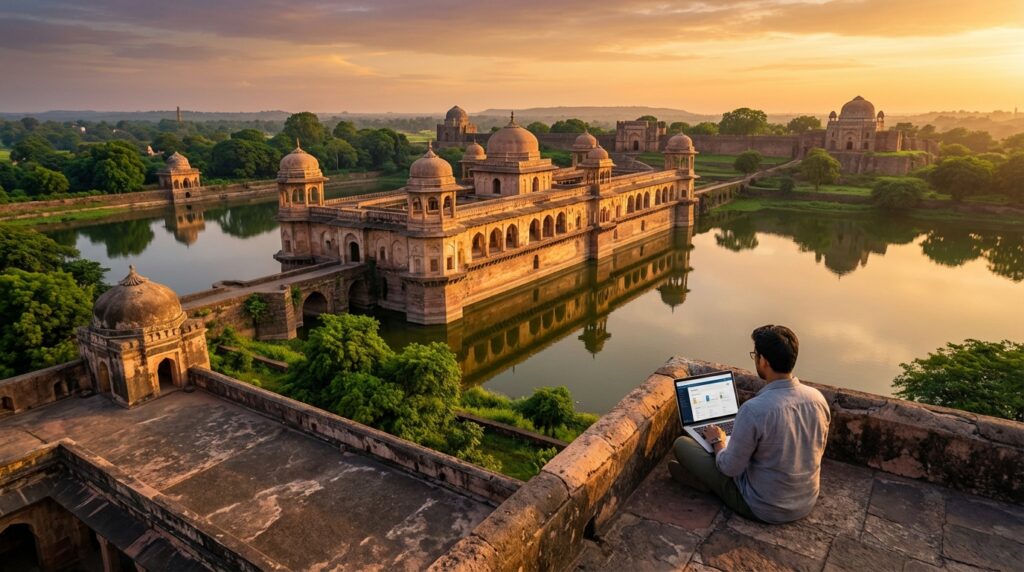
As remote work reshapes the professional landscape in 2026, digital nomads and remote professionals are seeking destinations that blend productivity with inspiration. While mainstream workation hubs like Goa and Udaipur dominate conversations, a hidden gem in Madhya Pradesh is emerging as the year’s most compelling offbeat workspace: Mandu, the ancient city of Afghan architecture and untold stories.
The Remote Work Revolution: India’s 2026 Landscape
India’s remote work ecosystem has undergone a dramatic transformation. According to the India Skills Report 2026, the country’s overall employability rate has risen to 56.35 percent, up from 54.81 percent in 2025. More significantly, India now holds 16 percent of the world’s artificial intelligence talent, positioning itself as a global hub for digital professionals.
43%
Professional jobs in India offering full remote options in 2026
12.7%
Indian office employees working fully remote
28.2%
Hybrid workers in India’s workforce
22%
Higher earnings for remote workers vs. office-based counterparts
The trend toward workations has matured beyond the initial pandemic-era experimentation. Remote workers in 2026 are choosing mid-term stays of one to three months in single locations, prioritizing sustainability over constant movement. This shift creates the perfect environment for discovering hidden gems like Mandu.
Mandu: Where History Meets Modern Productivity
Perched at an elevation of 633 meters in the Malwa region of western Madhya Pradesh, Mandu is a fortified city with a rich history spanning from the 6th century. This ruined city, once the capital of the Malwa Sultanate, boasts over 82 kilometers of fort perimeter, making it one of India’s largest forts.
What makes Mandu extraordinary for remote workers is its unique combination of architectural grandeur, natural beauty, and relative isolation. Unlike overcrowded tourist destinations, Mandu offers the tranquility necessary for deep focus work while providing enough cultural stimulation to prevent the monotony that often plagues remote workers.
Mandu’s Key Attractions for Remote Professionals
95%Historical Architecture
80%Natural Beauty
70%Peaceful Environment
85%Cultural Richness
65%Low Tourist Density
Infrastructure Reality Check: Can Mandu Support Remote Work?
The primary concern for any workation destination is connectivity. While Mandu itself is a small historic town, it benefits from Madhya Pradesh’s expanding digital infrastructure. The nearest major city, Indore, located approximately 99 kilometers away, has emerged as a thriving coworking hub with over ten established spaces offering high-speed internet, dedicated workstations, and collaborative environments.
Infrastructure Element
Availability in Mandu Region
Distance from Mandu
Coworking Spaces
Multiple options in Indore
99 km
High-Speed Broadband
JIO Fiber, Airtel, RailWire available
Available in town
Nearest Airport
Devi Ahilya Bai Holkar Airport, Indore
99 km
Railway Station
Ratlam Junction
124 km
Accommodation Options
Government guesthouses, private hotels, heritage stays
Within Mandu
Healthcare Facilities
Basic facilities in Mandu, advanced in Indore
0-99 km
For remote workers willing to invest in portable connectivity solutions such as 4G/5G hotspots, Mandu offers reliable mobile internet coverage through major providers. The MP Tourism Development Corporation’s Malwa Resort provides comfortable accommodation with modern amenities, making it an ideal base for extended stays.
The Cost Advantage: Budget Breakdown
One of Mandu’s most compelling advantages is its affordability compared to popular workation destinations. In an era where remote workers earn 22 percent more on average, strategic location choices can dramatically increase savings and quality of life.
Monthly Cost Comparison: Mandu vs. Popular Workation Hubs
Expense Category
Mandu (INR)
Goa (INR)
Udaipur (INR)
Accommodation
12,000 – 20,000
25,000 – 50,000
20,000 – 40,000
Food & Dining
6,000 – 10,000
15,000 – 25,000
12,000 – 20,000
Internet & Utilities
1,500 – 2,500
2,000 – 3,000
2,000 – 3,000
Local Transportation
2,000 – 3,000
5,000 – 8,000
4,000 – 6,000
Total Monthly Cost
21,500 – 35,500
47,000 – 86,000
38,000 – 69,000
Budget-conscious remote workers can save between 40 to 60 percent monthly by choosing Mandu over mainstream alternatives while enjoying a superior quality of life and cultural immersion.
The Productivity Paradox: Why Isolation Enhances Focus
Research on remote work trends in 2026 reveals a counterintuitive insight: extreme mobility decreases productivity. The constant movement between cities every few weeks creates decision fatigue and prevents the establishment of sustainable routines. Mandu’s relative isolation from major metropolitan areas becomes an advantage rather than a limitation.
The town’s architectural wonders provide natural breaks from screen time. A morning walk to Jahaz Mahal, the ship-like palace floating over twin lakes, offers mental rejuvenation without the crowds found at tourist hotspots. The Baz Bahadur Palace and Rani Roopmati Pavilion provide panoramic views ideal for afternoon contemplation and problem-solving.
Cultural Immersion Without Tourist Overload
Unlike destinations suffering from over-tourism, Mandu maintains authentic local culture. Remote workers can experience traditional Malwa cuisine, including the famous Dal Paniya cooked in tandoors, and witness the city’s unique African baobab trees, locally known as Khorasani Imli, gifted by Egyptian Caliphs in the 14th century.
The annual Mandu Festival showcases regional heritage through cultural programs, heritage walks, adventure sports including zip-lining and rock climbing, and yoga sessions, all without the commercialization plaguing similar events in popular destinations.
Best Practices for a Mandu Workation
To maximize the benefits of a Mandu workation, remote professionals should consider the following strategy:
Optimal Duration: Plan for 1-3 month stays to establish routines and deeply experience the location. This aligns with 2026’s trend toward mid-term stays over hyper-mobility.
Connectivity Setup: Arrange multiple internet backups including fiber broadband, 4G/5G hotspots from different providers, and offline work capabilities for occasional connectivity issues.
Accommodation Selection: Book heritage properties or government tourism accommodations that offer modern amenities within historic settings.
Work Schedule Design: Leverage the town’s quiet mornings for deep work, exploring monuments during less intense afternoon hours, and returning to evening tasks with renewed mental clarity.
Community Building: Connect with local professionals in nearby Indore through coworking spaces for occasional collaboration and networking.
The Climate Advantage
Timing is critical for any workation. Mandu’s climate follows distinct seasonal patterns that remote workers should consider:
Season
Months
Temperature Range
Workation Suitability
Winter
October – March
10°C – 25°C
Excellent – Pleasant weather, ideal for work and exploration
Summer
April – June
25°C – 40°C
Moderate – Lower hotel prices, fewer tourists, but hot afternoons
Monsoon
July – September
20°C – 30°C
Good – Lush landscapes, romantic ambiance, occasional connectivity disruptions
The winter months offer the optimal balance of pleasant weather and peak productivity conditions, making this period ideal for remote professionals seeking extended stays.
Sustainability and Long-Term Impact
One emerging trend in 2026 workations is the focus on sustainability and positive local impact. Unlike destinations experiencing environmental strain from tourism, Mandu can benefit from thoughtful remote worker engagement. Extended stays contribute to local economies without overwhelming infrastructure, and the lower tourist density means remote workers become community members rather than transient visitors.
This aligns with the broader shift identified in recent research: workations in 2026 are treated as infrastructure rather than experiences, emphasizing sustainable, repeatable patterns over Instagram-worthy moments.
Who Should Choose Mandu?
Mandu is particularly suited for:
Writers and creative professionals seeking inspiration from historical narratives and architectural beauty
Software developers and AI engineers who need deep focus periods and can work asynchronously with global teams
Digital marketers and content creators looking for unique visual content and cultural stories
Entrepreneurs and consultants who value cost efficiency and mental space for strategic thinking
Professionals in time-zone compatible roles where physical presence is unnecessary but internet connectivity is essential
The Verdict: Mandu’s Workation Potential
As remote work stabilizes into sustainable patterns in 2026, success lies not in chasing trending destinations but in finding locations that support long-term productivity, cultural enrichment, and economic efficiency. Mandu delivers on all three fronts while remaining largely undiscovered by the workation crowd.
With India’s remote work readiness climbing to third place among developing nations and 43 percent of professional jobs now offering full remote options, the infrastructure supporting remote professionals continues expanding into tier-two and tier-three cities. Mandu, positioned between these categories, benefits from improved connectivity while maintaining the charm that attracted sultans and poets centuries ago.
For remote professionals willing to trade beach sunsets for palatial sunrises and crowded cafes for monument-dotted landscapes, Mandu represents 2026’s most compelling offbeat workspace. It is not merely a destination but a workspace philosophy: prioritizing depth over breadth, sustainability over spectacle, and meaningful work over performative productivity.
In an era where 80 percent of software engineers work remotely at least part-time and hybrid arrangements become the norm, the question is no longer whether remote work will persist but where it will thrive. The answer, increasingly, lies in hidden gems like Mandu where history whispers productivity secrets that modern coworking spaces can only echo.
Meta description: Discover why Mandu, Madhya Pradesh is emerging as 2026’s best offbeat workation hub. Explore cost comparisons, infrastructure analysis, and productivity benefits.
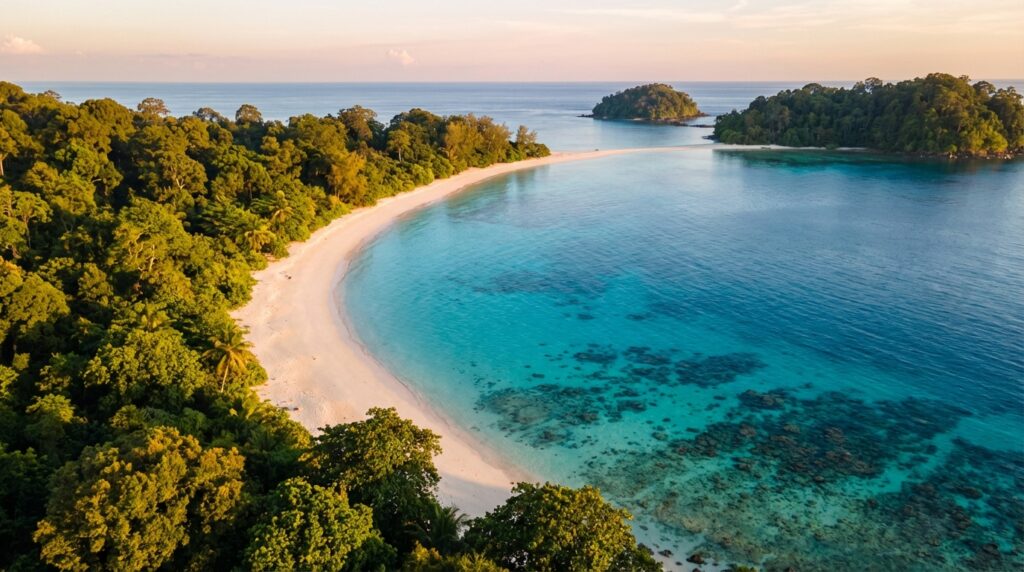
Andaman Islands Beyond Havelock: An Offbeat 2026 Guide to Neil and Diglipur
While Havelock Island continues to dominate Andaman tourism headlines, savvy travelers in 2026 are discovering that the archipelago’s most authentic experiences lie elsewhere. Neil Island and Diglipur represent the Andamans as they existed before mass tourism transformed the landscape, quieter beaches, more genuine local interactions, and natural wonders that haven’t been packaged for Instagram consumption. This comprehensive guide explores why these lesser-known destinations deserve a prominent place in your Andaman itinerary.
Neil Island
Shaheed Dweep
The vegetable bowl of Andamans offers pristine beaches, natural coral formations, and authentic island life just 40 kilometers from Port Blair.
Distance from Port Blair40 km
Ferry Duration90 minutes
Island Area18.9 km²
Population~3,000
Diglipur
North Andaman
The northernmost settlement offers mud volcanoes, turtle nesting beaches, and access to pristine Ross and Smith Islands connected by a natural sandbar.
Distance from Port Blair325 km
Travel Duration10-12 hours
Highest Peak732m (Saddle Peak)
Population~43,000
Neil Island: The Andamans’ Best-Kept Secret
Officially renamed Shaheed Dweep in 2018 to honor India’s freedom fighters, Neil Island remains refreshingly uncommercial despite its proximity to Port Blair. The island’s small size just 18.9 square kilometers, makes it easily explorable by bicycle or scooter, with most visitors covering the entire island in a single day. However, the unhurried pace of island life encourages longer stays, and those who spend three to four days here discover a rhythm that epitomizes the Andamans at their most peaceful.
Neil’s economy traditionally centered on agriculture, earning it the nickname “vegetable bowl of the Andamans.” This agricultural heritage remains visible across the island, with banana plantations, papaya groves, and rice paddies creating a patchwork of green between beaches. Unlike Havelock, where tourism has fundamentally reshaped the local economy, Neil retains its agricultural character even as visitor numbers gradually increase.
Neil Island’s Beaches: Natural Perfection
Neil’s beaches represent some of the finest shorelines in the Andaman archipelago, each offering distinct characteristics that appeal to different types of travelers.
Bharatpur Beach serves as Neil’s most developed and accessible beach, located just 500 meters from the jetty. The shallow, calm waters extending 50 to 100 meters from shore create ideal conditions for non-swimmers and families with children. The beach gained fame for its extensive coral formations visible at low tide, though these have experienced degradation in recent years due to tourism pressure and climate change impacts. Despite this, Bharatpur remains excellent for snorkeling, with glass-bottom boat tours operating throughout the day.
Laxmanpur Beach divides into two sections separated by a rocky outcrop. Laxmanpur I, accessible via a short walk from the main road, features powdery white sand and excellent swimming conditions. However, Laxmanpur II steals the show, particularly during low tide when the sea recedes up to 500 meters, revealing an otherworldly landscape of coral formations, natural rock pools, and marine life trapped in tidal pools. This beach is also Neil’s premier sunset destination, with the western orientation providing unobstructed views of the sun descending into the Andaman Sea.
Sitapur Beach, located on the eastern coast, offers Neil’s most secluded and pristine experience. The beach sees relatively few visitors due to its distance from the main settlement and lack of development. Strong currents make swimming inadvisable, but sunrise watchers consider it the island’s finest dawn viewing point. The beach’s natural state completely undeveloped with dense forest extending almost to the high-tide line provides a glimpse of how the Andamans appeared before tourism.
Neil Island Beach Comparison
Bharatpur
Accessibility: 9/10
Laxmanpur I & II
Sunset Views: 10/10
Sitapur
Seclusion: 10/10
Bharatpur
Snorkeling: 8/10
Diglipur: Adventure in North Andaman
Diglipur represents a completely different proposition from Neil Island. Located 325 kilometers north of Port Blair, reaching Diglipur requires either a grueling 10-12 hour overnight bus journey on the Andaman Trunk Road or a combination of shorter bus segments broken by overnight stays. This accessibility challenge keeps visitor numbers low, which is precisely Diglipur’s appeal for travelers seeking authentic wilderness experiences.
The region encompasses several distinct attractions spread across a wide area, requiring multiple days to explore properly. Most visitors base themselves in Diglipur town itself, which offers modest but adequate accommodation and serves as the logical hub for day trips to surrounding sites.
Ross and Smith Islands: The Twin Paradises
These twin islands connected by a seasonal sandbar represent Diglipur’s crown jewel. Accessible only by boat from Aerial Bay (about 12 kilometres from Diglipur town), the islands remain beautifully undeveloped, with just a handful of basic facilities. The sandbar connecting them appears during low tide between October and April, creating a remarkable natural phenomenon where visitors can literally walk between two islands through ankle-deep turquoise water.
The Department of Tourism strictly limits daily visitor numbers to preserve the islands’ pristine condition. Current regulations cap visits at approximately 200 people per day, with permits required and issued on a first-come, first-served basis. This protection has preserved some of the Andamans’ healthiest coral reefs, with snorkeling here offering visibility often exceeding 15 meters and encounters with sea turtles, reef sharks, and vast schools of tropical fish.
Saddle Peak National Park
At 732 meters, Saddle Peak claims the title of the highest point in the Andaman Islands. The trek to the summit challenges even experienced hikers, requiring 4-6 hours of ascent through dense tropical rainforest. The trail passes through multiple vegetation zones, from coastal mangroves through dipterocarp forest to mountain evergreen forest near the summit. Wildlife sightings frequently include Andaman imperial pigeons, Andaman treepies, and if fortunate, glimpses of the endemic Andaman wild pig. The panoramic views from the summit encompass the entire northern Andaman archipelago, making the demanding climb worthwhile. Trekkers require permits from the Forest Department and must hire mandatory local guides.
Seasonal Considerations and Best Times to Visit
The Andaman Islands experience a tropical climate with distinct wet and dry seasons, though conditions vary somewhat between Neil Island and Diglipur due to their geographic separation.
Season
Months
Neil Island
Diglipur
Considerations
Peak Season
December – February
Excellent
Excellent
Clear skies, calm seas, sandbar visible
Shoulder Season
October – November, March – April
Very Good
Good
Lower prices, fewer crowds, good weather
Monsoon
May – September
Challenging
Difficult
Heavy rain, rough seas, limited ferry service
December
24-30°C
Perfect
January
23-29°C
Perfect
February
24-30°C
Excellent
March
25-31°C
Very Good
April
26-32°C
Good
October
25-30°C
Good
November
24-30°C
Excellent
Activities Beyond the Beach
🤿
Snorkeling
Pristine coral reefs with 200+ fish species
🚴
Cycling
Explore Neil’s 18.9 km² at your own pace
🥾
Trekking
Saddle Peak – 732m summit challenge
🐢
Turtle Watching
Nesting season Dec-Feb at Kalipur Beach
🌋
Mud Volcanoes
Rare geological formations near Diglipur
🏝️
Island Hopping
Ross & Smith sandbar connection
Sample Itinerary: One Week in Neil and Diglipur
Day 1: Arrival in Neil Island
Morning ferry from Port Blair (90 minutes). Check into accommodation, rent bicycle or scooter. Afternoon visit to Bharatpur Beach for snorkeling and coral viewing. Evening exploration of Neil Island market and local eateries.
Day 2: Neil Beach Circuit
Early morning visit to Sitapur Beach for sunrise. Return to accommodation for breakfast. Late morning exploration of Laxmanpur Beach during low tide to observe natural bridge and coral formations. Afternoon return to Laxmanpur Beach for sunset viewing.
Day 3: Travel to Diglipur
Early morning ferry to Port Blair, then immediate connection on overnight bus to Diglipur (or break journey with overnight stay in Port Blair). The journey is long but necessary.
Day 4: Ross and Smith Islands
Early morning boat departure from Aerial Bay to Ross and Smith Islands. Full day exploring the twin islands, walking the sandbar at low tide, snorkeling in protected waters. Return to Diglipur by late afternoon.
Day 5: Saddle Peak Trek
Very early start (5:00 AM) for Saddle Peak National Park trek. Full day expedition with local guide, reaching summit by mid-morning, descent by mid-afternoon. Rest evening at accommodation.
Day 6: Kalipur Beach and Mud Volcanoes
Morning visit to Kalipur Beach (turtle nesting site if visiting December-February). Afternoon exploration of nearby mud volcanoes and limestone caves. Evening relaxation in Diglipur.
Day 7: Return to Port Blair
Overnight bus departure back to Port Blair, arriving following morning for onward connections or further Andaman exploration.
Practical Information for 2026 Travelers
Permits: Foreign nationals require a Restricted Area Permit (RAP) to visit the Andaman Islands, though this is typically issued on arrival at Port Blair airport or seaport. The permit allows access to most tourist areas including Neil Island and Diglipur for up to 30 days. Indian citizens require no special permits.
Connectivity: Mobile network coverage has improved significantly in recent years. BSNL provides the most reliable service across both Neil Island and Diglipur, while private carriers like Airtel and Jio offer coverage in main settlement areas but can be spotty in remote locations. Internet speeds remain slower than mainland India, and travelers should expect periodic connectivity issues.
Accommodation: Neil Island offers approximately 40-50 accommodation options ranging from basic guesthouses (starting around 800-1,200 rupees per night) to mid-range beach resorts (2,500-5,000 rupees). Diglipur has fewer options, mostly concentrated in the town center, with prices generally 20-30% lower than Neil Island. Advance booking during peak season (December-February) is essential.
Transportation: Ferry schedules between Port Blair, Neil Island, and Havelock operate multiple times daily, though schedules vary seasonally and can be disrupted by weather. Private operators like Makruzz and Green Ocean offer faster, more comfortable services than government ferries but at significantly higher prices. The Andaman Trunk Road connecting Port Blair to Diglipur remains the only overland route, with government buses operating overnight services.
Environmental Responsibility
Both Neil Island and Diglipur face increasing environmental pressures from tourism growth. Travelers should observe strict Leave No Trace principles, avoid touching or standing on coral formations, use reef-safe sunscreen, and support local businesses that demonstrate environmental commitment. The fragility of island ecosystems means that small actions by visitors have amplified impacts. Responsible tourism practices ensure these destinations remain pristine for future generations.
Why Visit Now?
The window for experiencing Neil Island and Diglipur in their current relatively undeveloped state may be limited. Tourism infrastructure in the Andamans is expanding rapidly, with the government announcing plans to develop several new beach resorts and improve road connectivity to remote areas. While these developments will make travel more convenient, they will inevitably alter the character of these destinations.
In 2026, Neil Island and Diglipur offer what Havelock provided a decade ago: authentic island experiences, meaningful interactions with local communities, and natural environments that haven’t been sanitized for tourism. The challenges of reaching these destinations, the long ferry rides, the overnight bus journeys, the limited accommodation options are precisely what keeps them special. For travellers willing to accept these inconveniences, the rewards are immense: some of India’s most beautiful beaches, largely to yourself, experiences that feel genuinely earned rather than purchased, and the satisfaction of having ventured beyond the well-trodden tourist circuit.
The Andaman Islands beyond Havelock represent travel at its most rewarding, slightly challenging, deeply authentic, and absolutely unforgettable. As more travellers discover Neil Island’s perfect beaches and Diglipur’s wilderness adventures, the window for experiencing them in their current state narrows. The time to visit is now.
Meta description: Explore Neil Island and Diglipur in 2026 – pristine beaches, Saddle Peak treks, Ross & Smith Islands sandbar, and authentic Andaman experiences beyond crowded Havelock.
The 2026 Guide to Meghalaya: Best Time to See the Living Root Bridges & Wettest Places on Earth
Nestled in the northeastern corner of India, Meghalaya stands as one of Earth’s most extraordinary natural laboratories. This cloud-wrapped state receives more rainfall than virtually anywhere else on the planet, creating landscapes so lush and mysterious that they seem plucked from fantasy. From living root bridges engineered by indigenous communities to valleys perpetually shrouded in mist, Meghalaya offers travelers an experience that combines raw natural power with profound cultural heritage.
11,872
mm Annual Rainfall (Mawsynram)
11,777
mm Annual Rainfall (Cherrapunji)
500+
Years Old (Oldest Root Bridges)
Understanding Meghalaya’s Climate Extremes
Meghalaya translates to “abode of clouds,” and the name proves remarkably accurate. The state’s unique geographical position creates a meteorological phenomenon that has earned two of its towns the distinction of being the wettest inhabited places on Earth. Mawsynram currently holds the world record with an average annual rainfall of 11,872 millimeters, narrowly surpassing neighboring Cherrapunji at 11,777 millimeters.
This extraordinary precipitation occurs primarily due to the orographic effect. Moisture-laden monsoon winds from the Bay of Bengal race northward across the Bangladeshi plains, encountering the steep Khasi Hills. As these winds are forced upward, they cool rapidly, causing massive condensation and unprecedented rainfall concentrated in a relatively small geographic area.
Monthly Rainfall Patterns in Meghalaya (mm)
85mm
January
120mm
February
250mm
March
450mm
April
980mm
May
2,850mm
June
2,650mm
July
1,850mm
August
750mm
September
280mm
October
95mm
November
60mm
December
The Marvel of Living Root Bridges
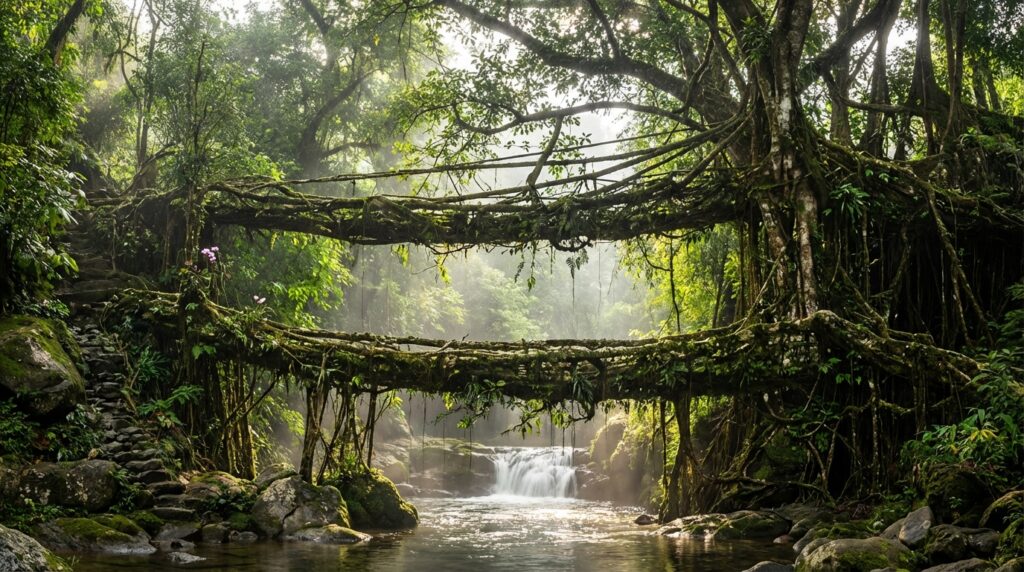
Perhaps no feature of Meghalaya captures the imagination quite like the living root bridges. These extraordinary structures represent a perfect synthesis of human ingenuity and natural processes. The indigenous Khasi and Jaintia tribes discovered centuries ago that the roots of the Ficus elastica tree, commonly known as the rubber fig tree, could be trained and shaped into functional bridges.
The process requires remarkable patience and foresight. Young, pliable roots are carefully guided across streams and rivers using hollowed-out betel nut tree trunks as directional supports. Over 15 to 20 years, these roots thicken and strengthen, eventually creating bridges capable of supporting the weight of 50 or more people simultaneously. Unlike conventional bridges that deteriorate over time, living root bridges actually grow stronger with age, with some specimens estimated to be over 500 years old.
The Double Decker Root Bridge
The most famous example is the Umshiang Double-Decker Root Bridge near Nongriat village. This two-tiered structure spans approximately 3 meters in length and represents one of the most complex examples of bioengineering in the world. Reaching it requires descending roughly 3,500 stone steps through dense jungle, but the sight of this living architecture makes the arduous trek worthwhile for thousands of visitors annually.
Optimal Travel Windows: When to Visit Meghalaya
Timing your visit to Meghalaya requires careful consideration of your priorities. The state experiences dramatically different conditions throughout the year, each offering distinct advantages and challenges.
Season
Months
Rainfall
Temperature
Best For
Winter (Dry)
October – February
Minimal (60-280mm/month)
10-24°C
Trekking, photography, root bridge visits
Pre-Monsoon
March – May
Moderate (250-980mm/month)
15-25°C
Waterfalls at peak flow, fewer crowds
Monsoon
June – September
Extreme (750-2,850mm/month)
18-25°C
Experiencing world’s heaviest rainfall
Best Time for Living Root Bridges: October to March
For most travelers, the period from October through March represents the ideal window for visiting Meghalaya’s living root bridges. During these months, rainfall drops to manageable levels, trails become significantly safer, and visibility improves dramatically. The post-monsoon period from October to November offers particularly stunning conditions, as the landscape remains lush and green from months of rain, while the weather becomes comfortably dry.
November and December are especially popular, with daytime temperatures ranging between 15-20°C and virtually guaranteed clear skies. This is when the living root bridges are most accessible, and the surrounding forests display their full magnificence without the obscuring veil of constant mist and rain. Photography enthusiasts particularly prize these months, as the combination of vibrant greenery and excellent lighting creates spectacular opportunities.
Visitor Experience Rating by Month (1-10 Scale)
January
9.0
February
9.0
March
8.5
April
7.5
May
6.0
June
4.0
July
3.5
August
4.0
September
5.5
October
9.5
November
10.0
December
9.5
Experiencing the Monsoon: June to September
While the dry season attracts the majority of visitors, there’s something profoundly compelling about experiencing Meghalaya during the monsoon. This is when the state truly lives up to its reputation as Earth’s wettest region. From June through September, the landscape transforms into a primordial wonderland of cascading waterfalls, swollen rivers, and clouds so thick they seem tangible.
Visiting during monsoon requires significant preparation and realistic expectations. Roads become treacherous, with landslides occurring frequently. Many trekking routes to root bridges become impassable or extremely dangerous. However, for those willing to accept these limitations, the monsoon offers rewards unavailable any other time of year. Waterfalls that trickle during winter become thundering torrents. The famous Nohkalikai Falls, India’s tallest plunge waterfall at 340 meters, reaches its most spectacular during peak monsoon months.
Essential Practical Considerations for 2026
Planning a trip to Meghalaya requires attention to several practical factors. The state’s tourism infrastructure has improved significantly in recent years, but it remains relatively undeveloped compared to mainstream Indian destinations, which is part of its charm.
Permits and Documentation: Foreign nationals require a Protected Area Permit to visit Meghalaya, though this is typically issued on arrival for most countries. Indian citizens need no special permits. Always carry multiple copies of identification documents, as mobile connectivity can be unreliable in remote areas.
Physical Preparation: Many of Meghalaya’s most remarkable sites, including the Double-Decker Root Bridge, require substantial physical exertion. The descent to Nongriat involves navigating approximately 3,500 stone steps, and what goes down must come back up. Visitors should assess their fitness level honestly before attempting these treks.
Accommodation: Shillong, the state capital, offers the widest range of accommodation options, from budget homestays to comfortable hotels. For root bridge treks, villages like Tyrna and Nongriat offer basic homestays that provide authentic cultural experiences alongside convenient access to trailheads.
Beyond the Bridges: Other Meghalayan Wonders
While living root bridges rightfully claim the spotlight, Meghalaya offers numerous other compelling attractions. Dawki, near the Bangladesh border, features the Umngot River, renowned for water so crystalline that boats appear to float in mid-air. The limestone caves of the Jaintia Hills, including Krem Liat Prah (one of the longest caves in India at over 30 kilometers), attract serious spelunkers from around the world.
Mawlynnong, dubbed “Asia’s cleanest village,” demonstrates the remarkable community organization of Khasi society. Every household maintains scrupulous cleanliness, with bamboo dustbins placed throughout the village and a complete absence of litter. The village’s Sky View platform, built entirely from bamboo, offers panoramic views across the Bangladesh plains.
Conclusion: Timing Your Meghalaya Adventure
Meghalaya represents one of Earth’s most extraordinary destinations, where human ingenuity has worked in harmony with extreme natural conditions to create something truly unique. For most travelers seeking to explore the living root bridges and experience the full breadth of what the state offers, the months from October through February provide optimal conditions. November and December stand out as particularly ideal, offering the best balance of accessibility, weather, and visual splendor.
However, adventurous souls who wish to witness the raw power of Earth’s wettest place should consider the monsoon months, accepting the challenges and limitations in exchange for an experience few others will have. Regardless of when you visit, Meghalaya promises encounters with landscapes and cultures that exist nowhere else on Earth, making any effort to reach this cloud-wrapped realm abundantly worthwhile.
Meta description: Discover the best time to visit Meghalaya’s living root bridges and wettest places on Earth. Complete 2026 guide with rainfall data, seasonal charts, and travel tips.
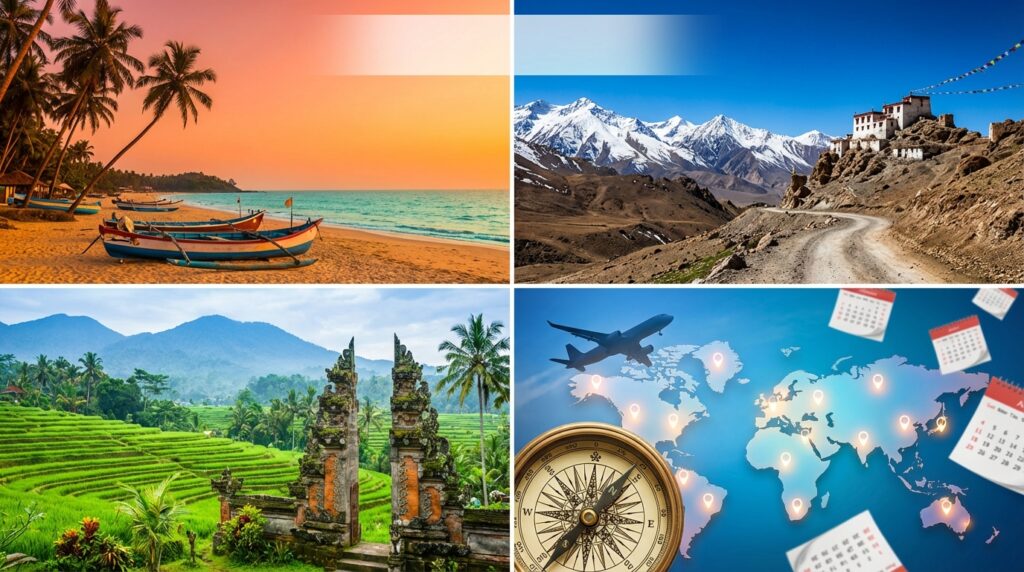
The 2026 Travel Calendar: Best Time to Visit Goa, Ladakh, Bali, and More
Planning your 2026 travel adventures requires strategic timing to maximize experiences while minimizing costs and crowds. Whether you’re dreaming of Goa’s pristine beaches, Ladakh’s mountain monasteries, or Bali’s cultural richness, understanding seasonal patterns can transform your journey from ordinary to extraordinary. This comprehensive guide breaks down the optimal travel windows for the world’s most sought-after destinations, backed by climate data, tourism statistics, and insider insights.
Understanding Travel Seasons: A Data-Driven Approach
Travel seasons directly impact your experience through three critical factors: weather conditions, tourist density, and pricing. Peak seasons offer the best weather but come with inflated prices and crowded attractions. Shoulder seasons provide the sweet spot of decent weather, moderate crowds, and reasonable rates. Off-peak periods deliver budget-friendly options but may include challenging weather or reduced services.
2026 Travel Season Calendar Overview
Peak Season
Shoulder Season
Off-Peak Season
Avoid Travel
Goa: India’s Beach Paradise
Goa’s tropical climate creates distinct travel windows. The peak season from November through February attracts 8.2 million visitors annually, with December alone accounting for 22% of annual tourism. Temperature averages hover between 20-32°C during these months, with humidity levels at a comfortable 65-70%.
Jan-Feb
Mar-May
Jun-Sep
Oct-Dec
Month
Avg Temp (°C)
Rainfall (mm)
Tourist Index
Hotel Rates
January
25-32
0.3
Very High
Premium
March
27-33
1.2
Moderate
Medium
July
24-29
868
Very Low
Budget
November
24-32
31
High
High
Best Time to Visit: November to February for beach activities, water sports, and nightlife. October offers early-season discounts with improving weather.
Ladakh: The Himalayan Wonderland
Ladakh’s extreme altitude creates a compressed travel season. Roads open from May through September, with peak tourism concentrated in July-August when 73% of annual visitors arrive. Temperatures range from 10-25°C during summer months, dropping to -20°C in winter. The region receives minimal rainfall at just 115mm annually, but winter snowfall makes most areas inaccessible.
Jan-Apr
May-Jun
Jul-Aug
Sep
Oct-Dec
Month
Road Access
Avg Temp (°C)
Oxygen Level
Crowd Level
May
Opening
10-20
70%
Low
July
Full Access
15-25
70%
Very High
September
Full Access
8-20
70%
Moderate
January
Closed
-15 to -5
65%
Minimal
Best Time to Visit: June for wildflowers and fewer crowds, or September for harvest festivals and clear skies. Avoid July-August peak season unless festivals are priority.
Bali: Indonesia’s Island Gem
Bali’s equatorial position creates two primary seasons: dry season from April to October and wet season from November to March. The island welcomes 6.3 million international visitors annually, with July-August representing peak tourism at 18% above average. Temperatures remain consistent at 26-31°C year-round, but rainfall varies dramatically from 60mm in August to 345mm in January.
Jan-Mar
Apr-Jun
Jul-Sep
Oct-Dec
Period
Weather
Avg Rainfall (mm)
Surf Conditions
Value Rating
April-May
Dry & Warm
90
Good (West Coast)
Excellent
July-August
Dry & Busy
45
Best (East Coast)
Fair
September-October
Transitional
85
Variable
Very Good
January-February
Wet Season
315
Poor
Budget
Best Time to Visit: April-May or September-October for ideal weather with smaller crowds. Cultural ceremonies peak in March and September.
Additional Premium Destinations for 2026
Santorini, Greece
Peak season runs May-September with July-August experiencing 40% above normal capacity. Shoulder months of April and October offer 30% lower prices with pleasant 18-24°C temperatures. Winter sees 65% of businesses closed.
Patagonia, Argentina/Chile
Southern hemisphere seasons reverse northern patterns. November-March provides optimal trekking conditions with 16-hour daylight. December-February peaks with 85% annual visitors concentrated in these months. Wind speeds average 40-50 km/h year-round.
Kerala, India
Monsoon season from June-September brings 3,000mm of rainfall but creates lush landscapes and 50% discounts. October-March offers dry weather with November-January peak season. Ayurveda treatments are optimal during monsoon months due to humidity benefits.
Strategic Booking Timeline for 2026
Data from global travel platforms reveals optimal booking windows maximize savings and availability. International flights booked 3-6 months advance save an average of 23% compared to last-minute bookings. Accommodation follows similar patterns with 4-8 week advance bookings securing 18% better rates.
Destination Type
Ideal Booking Window
Average Savings
Peak Booking Period
Beach Destinations
3-4 months prior
22%
January-February
Mountain Regions
4-6 months prior
28%
March-April
Cultural Cities
6-8 weeks prior
15%
Year-round
Adventure Travel
5-7 months prior
31%
February-March
Climate Change Considerations for 2026 Travel
Recent climate data indicates shifting seasonal patterns affecting traditional travel windows. Monsoon seasons in Southeast Asia show 12% increased variability, while European summers extend 2-3 weeks longer than historical averages. Winter sports destinations face 18% reduced snow coverage compared to decade averages. Smart travelers monitor real-time weather data and maintain flexible booking options when possible.
Budget Optimization Strategies
Maximizing travel value requires strategic timing beyond simple shoulder season selection. Midweek flights average 17% cheaper than weekend departures. Booking separate one-way tickets saves 8-12% on international routes. Hotel rates drop 25-35% during shoulder seasons while service quality remains consistent. Package deals during off-peak periods deliver 30-40% overall savings.
Key Takeaways for 2026 Travel Planning
Shoulder seasons offer the optimal balance of weather, crowds, and value across most destinations
Book international flights 3-6 months advance for maximum savings
Consider climate pattern shifts when planning traditional seasonal destinations
Flexibility in travel dates can unlock 20-40% cost savings
Research destination-specific festivals and events to enhance cultural experiences
Monitor currency fluctuations for international destinations to time bookings advantageously
Final Planning Recommendations
Successful 2026 travel planning balances personal preferences with data-driven insights. Whether prioritizing weather perfection, budget constraints, or crowd avoidance, understanding seasonal patterns empowers informed decisions. Goa shines November through February, Ladakh opens its mountain majesty June through September, and Bali welcomes visitors year-round with April-May and September-October sweet spots. Create backup plans for weather variability, book accommodations early for peak periods, and embrace shoulder seasons for authentic experiences without tourist saturation. The perfect travel window exists for every destination with proper research and strategic timing.
Remember that popular destinations evolve constantly with infrastructure improvements, emerging attractions, and changing tourism patterns. Monitor official tourism boards, check recent traveler reviews, and verify current entry requirements before finalizing 2026 travel plans. With careful planning using this data-driven calendar, your travels will deliver exceptional experiences while maximizing value and minimizing common tourist frustrations.
Discover the best time to visit Goa, Ladakh, Bali and more in 2026. Data-driven travel calendar with climate stats, booking tips, and seasonal insights.
7 Best Weekend Getaways Near Bangalore for a Short Trip
Bangalore, the bustling technology hub of India, is surrounded by some of the most enchanting weekend destinations that offer the perfect escape from urban chaos. Whether you’re seeking misty hill stations, historical landmarks, or serene waterfalls, the options within a radius of 60 to 275 kilometers from Bangalore are abundant and diverse. With travel times ranging from just 2 to 6 hours, these destinations are ideal for those looking to maximize their short breaks without spending excessive time on the road.
According to recent tourism data, over 2.5 million travelers from Bangalore embark on weekend trips annually, with hill stations accounting for approximately 45 percent of all bookings, followed by heritage sites at 30 percent and wildlife sanctuaries at 25 percent. This guide explores seven carefully selected destinations that combine accessibility, natural beauty, and unique experiences to help you plan the perfect weekend getaway.
Distance and Travel Time Comparison
Nandi Hills
60 km
Mysore
145 km
Kabini
220 km
Chikmagalur
245 km
Coorg
264 km
Ooty
274 km
Wayanad
278 km
1. Nandi Hills: The Sunrise Paradise
Located just 60 kilometers from Bangalore, Nandi Hills stands as the closest weekend escape for city dwellers. This ancient hill fortress, once the summer retreat of Tipu Sultan, rises to an elevation of 1,478 meters and offers spectacular sunrise views that draw thousands of visitors every weekend.
Quick Facts:
Distance from Bangalore: 60 km
Travel Time: 2 hours
Best Time to Visit: September to February
Ideal Duration: 1 day
The hill station features several attractions including Tipu’s Drop, a 600-meter cliff with breathtaking views, and the ancient Yoga Nandeeshwara Temple dating back to the 9th century. Adventure enthusiasts can explore biking trails and trekking routes that wind through the hills.
Visitor statistics show that Nandi Hills receives approximately 15,000 visitors during weekends, making it one of the most frequented spots near Bangalore. The opening hours are strictly from 6 AM to 6 PM, and an entry fee of 20 rupees per person applies for Indian nationals.
2. Mysore: The Cultural Capital
Situated 145 kilometers from Bangalore, Mysore represents the perfect blend of heritage, culture, and royal grandeur. The city, known as the cultural capital of Karnataka, houses the magnificent Mysore Palace which attracts over 6 million visitors annually, making it one of India’s most visited monuments after the Taj Mahal.
Quick Facts:
Distance from Bangalore: 145 km
Travel Time: 2.5 to 3 hours
Best Time to Visit: September to March
Ideal Duration: 2 days
The illuminated Mysore Palace, featuring 97,000 light bulbs that glow every Sunday and during festivals, creates a mesmerizing spectacle. Brindavan Gardens, located 21 kilometers from the city center, showcases synchronized musical fountains and spans across 60 acres of meticulously maintained landscape.
Mysore’s culinary scene is equally impressive, with local delicacies like Mysore Pak (a traditional sweet made from gram flour and ghee), Mysore Masala Dosa, and authentic filter coffee that have earned geographical indication tags. The city also serves as an excellent base for exploring nearby attractions including Chamundi Hills and the ancient town of Srirangapatna.
3. Coorg: The Scotland of India
Coorg, officially known as Kodagu, lies 264 to 275 kilometers from Bangalore depending on the route chosen. This misty hill station earned its nickname as the Scotland of India due to its rolling hills, sprawling coffee plantations, and pleasant climate year-round.
Quick Facts:
Distance from Bangalore: 264-275 km
Travel Time: 5.5 to 6 hours
Best Time to Visit: October to March
Ideal Duration: 2 to 3 days
Karnataka produces approximately 70 percent of India’s coffee, with Coorg being the largest contributor. Visitors can tour working coffee estates, witness the entire coffee-making process from bean to cup, and purchase freshly roasted beans directly from plantations.
Abbey Falls, plummeting from a height of 70 feet amidst dense forests, represents one of Coorg’s most photographed attractions. Raja’s Seat, a seasonal garden perched on a hill, offers panoramic sunset views and features a musical fountain that operates in the evenings. Adventure seekers can trek to Tadiandamol Peak, standing at 5,724 feet as the highest peak in Coorg.
4. Chikmagalur: Coffee Land Paradise
Positioned 245 kilometers from Bangalore, Chikmagalur is renowned as the birthplace of coffee cultivation in India. Legend states that Baba Budan, a Sufi saint, smuggled seven coffee beans from Yemen in the 17th century and planted them in these hills, establishing the foundation of India’s coffee industry.
Quick Facts:
Distance from Bangalore: 245 km
Travel Time: 5 hours
Best Time to Visit: September to March
Ideal Duration: 2 to 3 days
Mullayanagiri, the highest peak in Karnataka at 6,330 feet, offers challenging treks and stunning sunrise views. The Baba Budangiri range, spanning across 10 square miles, features ancient caves and provides trekking opportunities for various skill levels.
Hebbe Falls and Jhari Falls showcase the region’s natural beauty, while the Bhadra Wildlife Sanctuary houses elephants, tigers, leopards, and over 250 species of birds. The sanctuary covers an area of 492 square kilometers and offers jeep safaris and coracle rides on the Bhadra River.
5. Kabini: Wildlife Enthusiast’s Dream
Located 220 kilometers from Bangalore near Nagarhole National Park, Kabini represents premium wildlife tourism in South India. The Kabini River, a tributary of the Cauvery, creates a reservoir that attracts large herds of elephants, especially during summer months when water becomes scarce in the forest.
Quick Facts:
Distance from Bangalore: 220 km
Travel Time: 4.5 hours
Best Time to Visit: October to May
Ideal Duration: 2 days
Nagarhole National Park spans 643 square kilometers and hosts a remarkable density of wildlife including tigers, leopards, wild dogs, sloth bears, and over 270 species of birds. Safari statistics indicate successful tiger sightings occur in approximately 40 percent of jungle drives during peak season.
Unique experiences include coracle rides on the Kabini backwaters, specialized night safaris for spotting nocturnal animals, and boat safaris that offer opportunities to observe wildlife from a different perspective. The region combines authentic jungle experiences with luxury resort amenities, making it suitable for families and adventure seekers alike.
6. Ooty: The Queen of Hill Stations
Situated 274 kilometers from Bangalore, Ooty (officially Udhagamandalam) ranks among South India’s most celebrated hill stations. Perched at an elevation of 7,200 feet in the Nilgiri Hills, Ooty maintains pleasant temperatures throughout the year, with averages ranging from 15 to 20 degrees Celsius.
Quick Facts:
Distance from Bangalore: 274 km
Travel Time: 6 hours
Best Time to Visit: October to June
Ideal Duration: 2 to 3 days
The Nilgiri Mountain Railway, recognized as a UNESCO World Heritage Site since 2005, operates vintage toy trains that climb through 16 tunnels and cross over 250 bridges during the journey from Mettupalayam to Ooty. This engineering marvel covers 46 kilometers and takes approximately 5 hours, offering spectacular views of tea estates and eucalyptus forests.
The Government Botanical Gardens, established in 1848, spread across 55 acres and house over 650 species of plants. Ooty Lake, covering 65 acres, provides boating facilities and serves as the centerpiece of the town. Doddabetta Peak, standing at 8,650 feet, represents the highest point in the Nilgiris and features a telescope house for panoramic views.
7. Wayanad: Kerala’s Emerald Wonderland
Positioned 278 kilometers from Bangalore, Wayanad represents Kerala’s pristine wilderness in the Western Ghats. This biodiversity hotspot showcases dense forests, sprawling spice plantations, and prehistoric caves, creating a unique blend of natural and historical attractions.
Quick Facts:
Distance from Bangalore: 278 km
Travel Time: 6 hours
Best Time to Visit: October to May
Ideal Duration: 2 to 3 days
Edakkal Caves house prehistoric carvings dating back 6,000 years, making them one of the earliest known records of human civilization in South India. The trek to these caves involves a 1-kilometer uphill climb but rewards visitors with ancient pictorial writings and stunning valley views.
Wayanad Wildlife Sanctuary covers 344 square kilometers and forms part of the Nilgiri Biosphere Reserve. The sanctuary hosts significant populations of elephants (estimated at 700 to 900 individuals), tigers, leopards, and the endangered lion-tailed macaque. Chembra Peak, rising to 6,900 feet, features a heart-shaped lake at 5,800 feet that remains a major trekking attraction.
Banasura Sagar Dam, India’s largest earthen dam, stretches across 1,275 meters and creates a reservoir spanning 350 hectares. The location offers speed boating, kayaking, and scenic views of the surrounding Banasura hills.
Destination
Distance (km)
Travel Time
Primary Attraction
Budget Range (2 days)
Nandi Hills
60
2 hours
Sunrise Views & Trekking
₹3,000 – ₹5,000
Mysore
145
2.5 – 3 hours
Heritage & Culture
₹5,000 – ₹8,000
Kabini
220
4.5 hours
Wildlife Safari
₹8,000 – ₹15,000
Chikmagalur
245
5 hours
Coffee Plantations & Trekking
₹6,000 – ₹10,000
Coorg
264 – 275
5.5 – 6 hours
Coffee Estates & Waterfalls
₹7,000 – ₹12,000
Ooty
274
6 hours
Hill Station & Toy Train
₹6,000 – ₹11,000
Wayanad
278
6 hours
Wildlife & Prehistoric Caves
₹7,000 – ₹13,000
Best Time to Visit and Travel Tips
The optimal period for weekend getaways from Bangalore generally falls between October and March when the weather remains pleasant across most destinations. Hill stations like Ooty and Wayanad experience temperatures between 15 to 25 degrees Celsius during this period, while Mysore and Kabini maintain comfortable conditions for sightseeing and outdoor activities.
Monsoon season from June to September transforms hill stations into lush green paradises but also brings challenges including heavy rainfall, potential road closures, and limited visibility for scenic views. However, enthusiasts of monsoon tourism often prefer this season for experiencing waterfalls at their fullest glory and enjoying significantly lower tourist crowds.
For road trips, departing early morning between 5 AM and 6 AM helps avoid traffic congestion on major highways, especially during weekends. The Bangalore-Mysore highway experiences peak traffic between 8 AM and 11 AM on Saturdays and Sundays. Advance booking of accommodations becomes crucial during long weekends, festival periods, and peak tourist season when occupancy rates often exceed 90 percent.
Seasonal Visitor Distribution
Season
Visitor Percentage
Weather Conditions
Crowd Level
Winter (Oct-Feb)
48%
Pleasant, 15-25°C
High
Summer (Mar-May)
32%
Warm, 20-32°C
Moderate
Monsoon (Jun-Sep)
20%
Heavy Rainfall
Low
Transportation Options and Costs
Multiple transportation modes connect Bangalore to these weekend destinations. Private vehicles offer maximum flexibility and comfort, with fuel costs ranging from 800 to 1,500 rupees for round trips depending on the destination distance and vehicle type. Self-drive car rentals typically cost between 2,000 to 3,500 rupees per day including fuel.
Karnataka State Road Transport Corporation operates regular bus services to all major destinations with varying comfort levels. Non-air-conditioned buses charge approximately 300 to 650 rupees per person, while air-conditioned Volvo buses range from 500 to 900 rupees. Premium sleeper buses for longer routes like Ooty and Wayanad cost between 800 to 1,200 rupees.
Train connectivity exists primarily for Mysore, with multiple daily services covering the 145-kilometer distance in 2.5 to 3 hours. The Shatabdi Express completes the journey in just 2 hours, while regular passenger trains take up to 3.5 hours. Ticket prices range from 50 rupees for general class to 500 rupees for air-conditioned chair cars.
Organized tour packages provide hassle-free alternatives with costs varying from 3,500 to 8,000 rupees per person for two-day trips including transportation, accommodation, and selected meals. These packages eliminate planning stress and often include guided tours and entry fees to major attractions.
Conclusion
Bangalore’s strategic location in South India provides access to diverse weekend getaway options that cater to different preferences and budgets. From the quick sunrise escape to Nandi Hills just 60 kilometers away to the elaborate wilderness experience at Wayanad 278 kilometers distant, each destination offers unique experiences and memories.
Statistical analysis reveals that travelers typically spend between 5,000 to 12,000 rupees per person for two-day weekend trips when accounting for transportation, accommodation, food, and activities. Early planning, flexible travel dates, and advance bookings can reduce costs by 20 to 30 percent while ensuring availability at preferred properties.
Whether seeking adventure, relaxation, cultural immersion, or wildlife encounters, these seven destinations collectively showcase the remarkable diversity available within a six-hour radius of Bangalore. The combination of good road connectivity, varied accommodation options, and well-developed tourism infrastructure makes weekend travel both convenient and rewarding for Bangalore residents and visitors alike.
10 Best Places to Visit Between Mumbai and Pune for a Road Trip
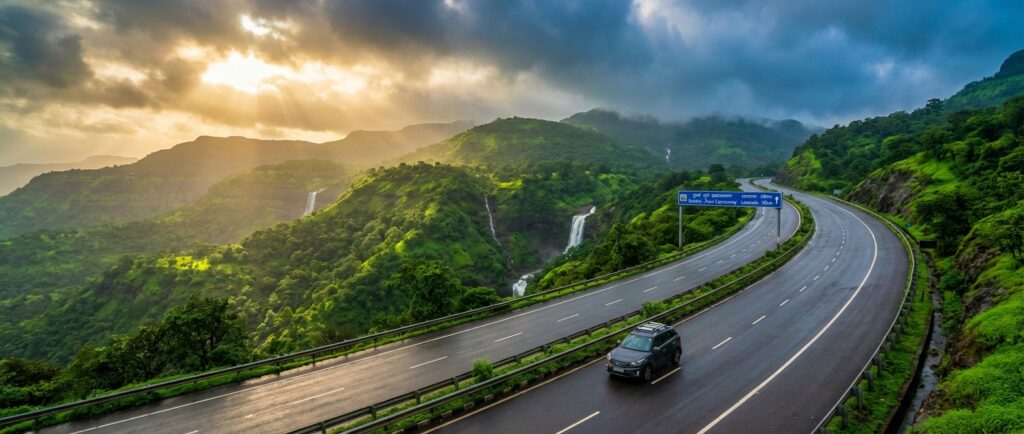
The Mumbai-Pune corridor represents one of India’s most scenic and well-traveled routes, connecting two of Maharashtra’s most vibrant cities. Spanning approximately 150 kilometers via the expressway, this route transforms into an unforgettable journey when you explore the hidden gems nestled in the Western Ghats. Whether you’re seeking ancient history, natural beauty, or adventure activities, the Mumbai-Pune highway offers diverse attractions that cater to every traveler’s taste.
150
Kilometers via Expressway
3
Hours Average Drive Time
10+
Major Tourist Attractions
622m
Elevation at Hill Stations
Quick Overview: Distance & Travel Time from Mumbai
Destination
Distance from Mumbai
Travel Time
Best Season
Ideal Duration
Lonavala
83-96 km
1.5-2 hours
June-September
1-2 days
Khandala
93 km
2 hours
July-September
1 day
Imagica Theme Park
76 km
1.5 hours
October-March
1 day
Karla Caves
60 km
1.5 hours
October-February
2-3 hours
Bhaja Caves
65 km
1.5 hours
October-February
2-3 hours
Pawna Lake
105 km
2 hours
October-February
1-2 days
Kamshet
102 km
2 hours
October-May
1 day
Lohagad Fort
70 km
2 hours
October-March
4-5 hours
Rajmachi Fort
82 km
2 hours + trek
June-September
1-2 days
Lavasa
185 km (from Mumbai)
4 hours
September-May
1-2 days
1. Lonavala – The Hill Station Paradise
Located at an elevation of 622 meters above sea level, Lonavala stands as one of Maharashtra’s most cherished hill stations. Approximately 96 kilometers from Mumbai and just 64 kilometers from Pune, this picturesque town serves as the perfect midway retreat. The journey along the Mumbai-Pune Expressway treats visitors to spectacular views of the Western Ghats, tunnels carved through mountains, and lush valleys during the monsoon season.
Lonavala’s fame extends beyond its natural beauty. The town is renowned for producing the traditional candy known as chikki, a hard candy made from jaggery and groundnuts that has become synonymous with the destination. Visitors can explore numerous attractions including Bhushi Dam, where water cascades down stepped levels creating natural pools, and Tiger’s Leap, a rocky outcrop offering panoramic valley views from a cliff with a sheer drop exceeding 650 meters.
The establishment of this hill station dates back to 1871 when Lord Elphinstone, the Governor of Bombay Presidency, recognized its potential. Today, it attracts thousands of visitors year-round, with peak tourism occurring during the monsoon months when waterfalls come alive and the landscape transforms into a lush green paradise.
Situated just 4.6 kilometers from Lonavala, Khandala functions as its twin hill station, positioned at 625 meters elevation at one end of the Bhor Ghat. This strategic location provides breathtaking views of both the Deccan Plateau and the Konkan coast. The town gained widespread recognition after being featured in popular Bollywood films, cementing its place in Indian popular culture.
Duke’s Nose, located 12 kilometers from Lonavala, represents one of Khandala’s most iconic landmarks. Locally known as Naagphani (Cobra’s Hood), this distinctive cliff formation resembles the nose of the Duke of Wellington. The site attracts hikers and adventure enthusiasts who come to experience the challenging trek and the rewarding panoramic views from the summit.
During the monsoon season, Khandala transforms into a wonderland with multiple viewpoints offering spectacular vistas. Lion’s Point provides 180-degree views of surrounding hills and Tungarli Lake, while Rajmachi Point offers stunning perspectives of the historic Rajmachi Fort nestled in the valley below.
Key Attractions: Duke’s Nose, Rajmachi Point, Amrutanjan Point, Sunset Point, Ryewood Park
3. Karla Caves – Ancient Buddhist Heritage
The Karla Caves stand as a testament to ancient Buddhist architecture, dating back to the 3rd century BC, making them among the oldest cave complexes in India. Located approximately 60 kilometers from Mumbai near Lonavala, these rock-cut caves showcase the architectural brilliance of the Hinayana Buddhist sect that once thrived in this region.
The main chaitya (prayer hall) at Karla is considered one of the largest and most impressive of its kind in India. The cave features intricate carvings, massive pillars, and a sophisticated design that demonstrates advanced engineering knowledge. The facade includes elaborate sculptures of elephants, horses, and human figures that have weathered centuries but still retain their artistic magnificence.
Visitors can explore the spacious interior where ancient monks once meditated and conducted religious ceremonies. The natural acoustics within the cave create an atmosphere of tranquility, allowing modern visitors to connect with the spiritual heritage of this historic site.
Historical Significance: 3rd Century BC origin, Buddhist architectural marvel, UNESCO Heritage Site candidate
4. Bhaja Caves – Rock-Cut Monastery Complex
Complementing the Karla Caves, the Bhaja Caves represent another remarkable example of ancient Buddhist rock-cut architecture. These 22 caves, carved around the same period, showcase a simpler yet equally impressive architectural style. Located approximately 65 kilometers from Mumbai, the caves are accessible via a short trek that adds an element of adventure to the cultural experience.
The Bhaja complex includes viharas (monasteries) and a chaitya griha featuring a distinctive horseshoe-shaped entrance. The caves contain some of India’s earliest examples of rock-cut architecture, with carvings that depict various aspects of Buddhist life and mythology. Unlike Karla, the Bhaja Caves maintain a more austere character, reflecting the early ascetic traditions of Buddhism.
During the monsoon season, the area surrounding the caves comes alive with waterfalls and streams, creating a serene environment perfect for contemplation. The combination of historical significance and natural beauty makes this destination particularly appealing to history enthusiasts and nature lovers alike.
Key Features: 22 rock-cut caves, Ancient Buddhist monastery, Stupas and prayer halls, Monsoon waterfalls nearby
5. Imagica Theme Park – Entertainment Hub
Adlabs Imagica represents India’s premier theme park destination, sprawling across 132 acres and featuring more than 65 attractions. Located on the Mumbai-Pune Expressway approximately 76 kilometers from Mumbai, this world-class entertainment complex transforms a road trip into an adventure-filled day for families and thrill-seekers.
The park divides into three distinct zones: Theme Park with roller coasters and adventure rides, Water Park offering aquatic attractions, and Snow Park providing a unique winter experience in India’s tropical climate. Popular attractions include Nitro, India’s first spinning roller coaster, and various live shows that entertain visitors throughout the day.
Imagica has established itself as a must-visit destination since its opening, attracting millions of visitors annually. The park maintains international standards in safety and entertainment, making it comparable to theme parks worldwide while incorporating uniquely Indian themes and experiences.
Statistics: 132 acres, 65+ attractions, 3 zones (Theme, Water, Snow), Suitable for all ages
6. Pawna Lake – Camping Paradise
Pawna Lake, a man-made reservoir created by the Pawna Dam on the Pawna River, has emerged as Maharashtra’s premier camping destination. Located approximately 105 kilometers from Mumbai, this serene water body offers panoramic views of the Sahyadri mountain range and serves as an ideal escape from urban chaos.
The lake’s popularity among adventure enthusiasts has led to the establishment of numerous camping sites along its shores. Visitors can experience overnight camping with bonfires, stargazing sessions, and water activities. The area around Pawna Lake also provides access to several historic forts including Tikona, Tung, and Lohagad, allowing camping enthusiasts to combine outdoor recreation with historical exploration.
During the monsoon and post-monsoon seasons, the lake reaches full capacity, creating a mesmerizing reflection of surrounding hills and cloudy skies. The tranquil atmosphere, combined with opportunities for photography and outdoor activities, makes Pawna Lake an increasingly popular weekend getaway destination.
Activities: Lakeside camping, Bonfire nights, Water sports, Photography, Fort trekking nearby
7. Kamshet – Paragliding Capital
Kamshet has earned its reputation as the paragliding paradise of India, attracting adventure sports enthusiasts from across the globe. Located 102 kilometers from Mumbai along the Mumbai-Pune Expressway, this small town benefits from ideal wind conditions and thermal currents that make it perfect for paragliding throughout the year.
The area offers multiple take-off points at various elevations, with Shelar providing low-altitude thermal paragliding at 2,200 feet, while Kondeshwar Cliff enables flights from higher altitudes. Professional paragliding schools operate in Kamshet, offering tandem flights for beginners and training courses for those seeking certification. The experience of soaring over green hills, paddy fields, and sunflower meadows creates unforgettable memories.
Beyond paragliding, Kamshet serves as a gateway to several ancient Buddhist caves including Bedsa Caves and provides access to Pawna Lake. The scenic beauty of rolling hills and agricultural landscapes makes even the drive to Kamshet a rewarding experience.
Adventure Stats: Year-round paragliding, Multiple take-off points, Professional training available, Elevation range: 2,200-3,000 feet
8. Lohagad Fort – Trekker’s Delight
Lohagad Fort, meaning “Iron Fort,” stands proudly atop the Sahyadri ranges at an elevation significant enough to offer commanding views of the surrounding region. Located approximately 70 kilometers from Mumbai, this historic fortification played a crucial role in Maratha military strategy and witnessed numerous battles throughout history.
The trek to Lohagad spans approximately 5 kilometers from Lohagad Wadi village, making it ideal for beginners and experienced trekkers alike. The well-defined trail passes through lush vegetation, ancient gateways, and stone-paved pathways that showcase medieval engineering. The fort complex includes four main gates, numerous bastions, and a unique scorpion-tail shaped fortification known as the Vinchukata.
Historical records indicate that Chatrapati Shivaji Maharaj captured this fort, and it later became an important military base for the Maratha Empire. The fort also holds significance in more recent history, as Chhatrapati Shivaji’s treasure was supposedly kept here before being transferred to Raigad. Today, it attracts history enthusiasts and nature lovers who come to experience both cultural heritage and natural beauty.
Trek Details: 5 km trek distance, Suitable for beginners, 4 main gates, Historic Maratha fort, Monsoon trekking popular
9. Rajmachi Fort – Historic Twin Fortresses
Rajmachi Fort actually comprises two distinct fortifications: Shrivardhan Fort and Manaranjan Fort, both perched strategically in the Sahyadri mountains. Located approximately 82 kilometers from Mumbai, Rajmachi holds immense historical importance as it was captured by Chatrapati Shivaji Maharaj in 1657 before falling to British control in 1818.
The trek to Rajmachi can be undertaken via two different routes: a 15-kilometer trail from Lonavala or an alternate path from Kondiwade Village (13 kilometers). Both routes offer spectacular views of valleys, waterfalls during monsoon, and diverse flora and fauna. The fort area includes a small village where locals provide basic accommodation, making overnight stays possible for those wanting to experience sunrise from the ramparts.
From various viewpoints on the fort, trekkers can observe Duke’s Nose, the Konkan plains, and multiple waterfalls that cascade during the rainy season. The combination of moderate trekking difficulty, historical significance, and natural beauty makes Rajmachi one of the most popular weekend trekking destinations near Mumbai.
Historical Timeline: Captured by Shivaji (1657), British occupation (1818), Two forts: Shrivardhan & Manaranjan, Trek distance: 13-15 km
10. Lavasa – India’s First Planned Hill City
Lavasa represents a unique concept in Indian urban planning as the country’s first privately planned hill city, developed between Mumbai and Pune. Though approximately 185 kilometers from Mumbai (about 65 kilometers from Pune), Lavasa deserves inclusion for its distinctive character and modern amenities set against a backdrop of natural beauty.
The city’s architecture draws inspiration from the Italian town of Portofino, featuring colorful Mediterranean-style buildings arranged around a picturesque lakefront. Visitors can enjoy water sports at Lakeshore Watersports including jet skiing, pedal boating, and kayaking. The lakeside promenade offers opportunities for relaxation while admiring the unique urban landscape integrated into the natural hillside.
Lavasa includes multiple zones dedicated to different purposes including residential areas, commercial districts, and hospitality sectors. The planned infrastructure, combined with the scenic Dasve Dam reservoir, creates an atmosphere markedly different from traditional hill stations. While the city continues to develop, its current offerings include fine dining restaurants, nature trails, and recreational facilities that cater to modern travelers seeking a blend of urban comfort and natural surroundings.
Unique Features: India’s first planned hill city, Italian-inspired architecture, Lakeside promenade, Water sports facility, Modern amenities
Travel Route Comparison Chart
Distance from Mumbai (in Kilometers)
Karla Caves
60 km
Bhaja Caves
65 km
Lohagad Fort
70 km
Imagica Park
76 km
Rajmachi Fort
82 km
Lonavala
96 km
Kamshet
102 km
Pawna Lake
105 km
Pune
150 km
Lavasa
185 km
Activity-Based Destination Recommendations
Activity Type
Recommended Destinations
Difficulty Level
Equipment Required
Trekking
Lohagad, Rajmachi, Duke’s Nose
Easy to Moderate
Trekking shoes, water bottle
Paragliding
Kamshet
Beginner-friendly
Provided by operators
Historical Exploration
Karla Caves, Bhaja Caves, Rajmachi
Easy
Comfortable walking shoes
Family Entertainment
Imagica, Lonavala, Lavasa
Easy
None
Camping
Pawna Lake, Rajmachi
Easy to Moderate
Camping gear (or rental)
Water Activities
Bhushi Dam, Pawna Lake, Lavasa
Easy
Swimming gear
Photography
Khandala, Tiger’s Leap, Kune Falls
Easy
Camera/smartphone
Nature Walks
Lonavala, Khandala, Lavasa
Easy
Comfortable shoes
Best Time to Visit: Monthly Weather Guide
Season-wise Tourist Preference (%)
Monsoon (Jun-Sep)
45%
Winter (Oct-Feb)
35%
Summer (Mar-May)
20%
Note: Monsoon season (June-September) attracts the highest number of tourists due to lush greenery and active waterfalls. Winter offers pleasant weather for outdoor activities, while summer sees moderate tourist activity.
Budget Planning Guide
Expense Category
Budget Range (₹)
Mid-Range (₹)
Premium (₹)
Fuel (Round Trip from Mumbai)
1,500-2,000
2,000-2,500
2,500-3,000
Toll Charges (Both Ways)
500-800
500-800
500-800
Food & Beverages (Per Person)
400-600
800-1,200
1,500-2,500
Accommodation (Per Night)
1,000-2,000
3,000-5,000
7,000-15,000
Entry Fees & Activities
200-500
500-1,500
2,000-5,000
Total Per Person (Day Trip)
1,500-2,500
2,500-4,000
5,000-8,000
Total Per Person (2D/1N)
3,000-5,000
6,000-9,000
12,000-20,000
Essential Road Trip Tips
Vehicle Maintenance: Ensure your vehicle undergoes a complete check-up before the journey. The Mumbai-Pune Expressway is well-maintained, but having properly inflated tires, functioning brakes, and adequate engine oil is crucial for safety.
Two-Wheeler Restriction: Note that two-wheelers are not permitted on the Mumbai-Pune Expressway. Motorcyclists must use the Old Mumbai-Pune Highway, which offers scenic views but takes longer.
Monsoon Precautions: During monsoon season (June-September), certain stretches may experience waterlogging or minor landslides. Check weather forecasts and road conditions before traveling. Drive slowly through ghat sections where visibility may be reduced.
Toll Preparation: Multiple toll booths operate along the route. Carry sufficient cash or ensure your FASTag is active and has adequate balance for smooth passage.
Food Stops: The Food Mall on the expressway serves as an excellent midway stop offering various food options including the famous vada pav. However, explore local restaurants in Lonavala and other destinations for authentic Maharashtrian cuisine.
Photography Opportunities: Several designated viewpoints along the expressway allow safe stops for photography. Avoid stopping on the main road, which is dangerous and illegal.
Cave Exploration Timing: Karla and Bhaja Caves have specific visiting hours. Plan to reach early morning to avoid crowds and experience the serene atmosphere these ancient sites offer.
Booking Accommodations: During peak season (monsoons and major holidays), book hotels and resorts in advance. Lonavala and Khandala experience high demand, and last-minute bookings may be limited or expensive.
Trekking Preparation: For fort treks like Lohagad and Rajmachi, start early morning to avoid midday heat. Carry adequate water, wear appropriate footwear, and inform someone about your trekking plans.
Local Purchases: Buy Lonavala’s famous chikki from authentic shops rather than roadside vendors to ensure quality. Cooper’s and Maganlal are well-established brands.
Conclusion
The Mumbai-Pune corridor transcends being merely a connecting route between two major cities; it represents a treasure trove of diverse experiences that cater to every type of traveler. From the ancient Buddhist caves dating back to the 3rd century BC to modern entertainment complexes like Imagica, from serene lakeside camping at Pawna to adrenaline-pumping paragliding in Kamshet, this route offers an impressive variety of attractions within a compact geographic area.
The infrastructure along this route has evolved significantly, with the Mumbai-Pune Expressway reducing travel time to approximately 3 hours while offering spectacular views of the Western Ghats. The combination of excellent road connectivity, diverse attractions, and proximity to major urban centers makes these destinations ideal for both quick day trips and extended weekend getaways.
Whether you’re a history enthusiast drawn to the architectural marvels of Karla and Bhaja Caves, an adventure seeker looking for trekking and paragliding opportunities, a family planning a fun-filled day at theme parks, or a nature lover seeking tranquil lakeside camping experiences, the Mumbai-Pune route delivers memorable experiences. The key to maximizing your road trip lies in proper planning, considering seasonal variations, and allowing flexibility to explore spontaneous discoveries along the way.
As you embark on your journey between these two dynamic cities, remember that the true essence of a road trip lies not just in reaching destinations but in savoring the journey itself. The winding roads through the Western Ghats, the monsoon-fed waterfalls, the historical fortifications standing sentinel over valleys, and the warm hospitality of local communities all contribute to creating memories that last long after the trip concludes. Pack your bags, fuel up your vehicle, and set out to discover the magnificent diversity that awaits between Mumbai and Pune.
Meta description: Discover the 10 best places between Mumbai and Pune including Lonavala, Karla Caves, Imagica, and Pawna Lake. Complete guide with distances, timings, and travel tips.
The Loneliness of the Long-Distance Nomad: How to Build a Real Community While Traveling Solo
📍 Digital Nomad Life | ⏱️ 8 min read | 📅 February 2026
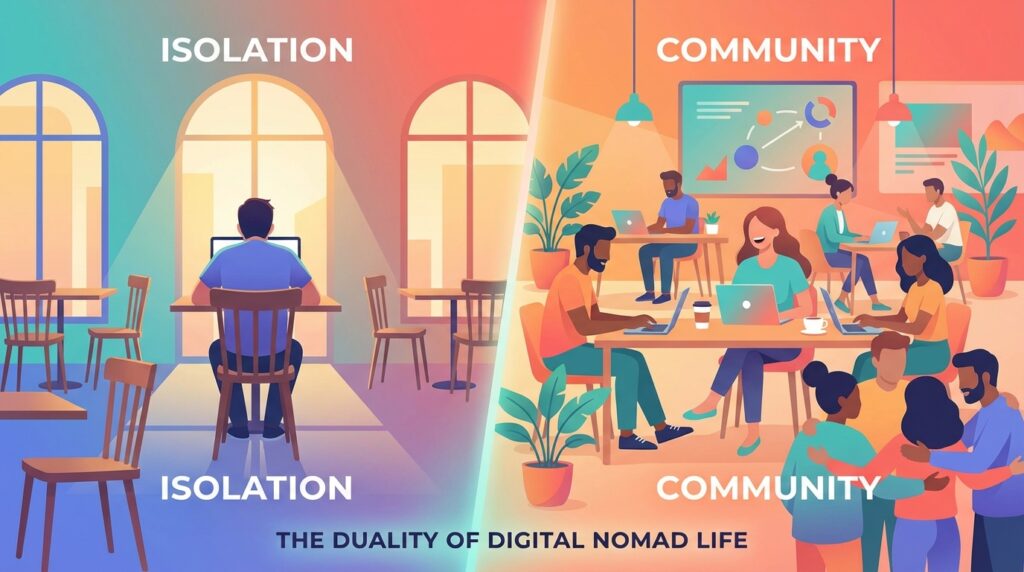
The digital nomad lifestyle promises freedom, adventure, and the world as your office. But behind the Instagram-worthy sunset photos and exotic cafe workspaces lies a reality few talk about: profound loneliness. A 2023 study by MBO Partners found that 53% of remote workers reported feeling isolated, with solo travelers experiencing even higher rates of disconnection.
53%Remote workers feel isolated
15Cigarettes worth of health risk
The paradox is striking. You’re surrounded by people in bustling markets, crowded hostels, and vibrant coworking spaces, yet you can feel utterly alone. This isn’t just an emotional inconvenience, chronic loneliness has been linked to health risks equivalent to smoking 15 cigarettes daily, according to research published in the Journal of the American Heart Association.
But here’s the good news: building genuine community while traveling solo is not only possible, it’s becoming easier as more nomads face this challenge head-on. This guide will show you how to transform temporary connections into meaningful relationships, no matter how frequently you change time zones.
Understanding the Nomad Loneliness Cycle
Before we solve the problem, we need to understand it. The loneliness cycle for traveling nomads typically follows a predictable pattern that differs significantly from stationary loneliness.
Phase
Duration
Emotional State
Social Behavior
Arrival Excitement
Days 1-5
Energized, curious
Highly social, open to connections
Settling Discomfort
Days 6-14
Anxious, overwhelmed
Selective, seeking familiar faces
Routine Depression
Days 15-30
Isolated, disconnected
Withdrawn, work-focused
Integration or Departure
Day 30+
Acceptance or avoidance
Community-embedded or planning exit
Understanding this cycle helps you anticipate emotional dips and take proactive steps during vulnerable phases. The key is recognizing that day 15-30 slump isn’t personal failure, it’s a documented psychological response to repeated social resets.
Strategic Community-Building Tactics That Actually Work
Traditional friendship advice doesn’t translate well to nomadic life. You can’t join a weekly book club or commit to Sunday dinners when you’re moving cities every month. Instead, successful nomads use these evidence-based strategies:
1. The Coworking Space Anchor Method
Coworking spaces aren’t just about WiFi and desk space, they’re community infrastructure. Research from Deskmag’s Global Coworking Survey shows that 84% of coworking members feel more engaged and motivated, primarily due to social connections.
💡 The Strategy: Choose one primary coworking space per location and commit to showing up at consistent times. Regular presence creates familiarity. Within two weeks, you’ll recognize faces. By week three, you’ll have coffee buddies. By week four, you’ll have genuine connections.
Top nomad-friendly coworking networks include Selina, WeWork, and local spaces found through Coworker directory. Budget approximately $150-300 monthly for membership, consider it an investment in mental health, not just workspace.
2. The Slow Travel Formula
Here’s a revealing statistic: nomads who stay in locations for 60-90 days report 67% higher satisfaction with their social connections compared to those moving every 2-3 weeks, according to a 2024 survey by Nomad List.
The Optimal Stay Duration Formula:
Week 1-2: Tourist phase, surface connections
Week 3-4: Local rhythm established, recurring faces
Week 9-12: Genuine community membership, difficult goodbyes
Slower travel doesn’t mean less adventure, it means depth over breadth. You’ll discover hidden neighbourhoods, build recurring routines, and have time for friendships to evolve beyond “Where are you from?” conversations.
3. Activity-Based Community Integration
Shared activities create bonds faster than conversation alone. Nomads who join regular group activities report feeling connected 3.2 times faster than those relying solely on coworking or hostel socializing.
High-impact activities for community building:
Language exchanges: Sites like Conversation Exchange and Tandem connect you with locals eager to practice English while teaching you their language. These relationships often extend beyond lessons into genuine friendships.
Fitness classes: Yoga, CrossFit, running clubs, and martial arts create consistent touchpoints with the same people. The endorphin boost doesn’t hurt either.
Volunteer opportunities: Organizations like Workaway and WWOOF connect travelers with local projects. Contributing to community initiatives accelerates acceptance.
Skill workshops: Cooking classes, photography walks, or coding bootcamps attract like-minded individuals while you learn something valuable.
4. Digital Community as a Supplement (Not Replacement)
Online nomad communities serve a crucial function, but they can’t replace in-person connection. The balance matters. A 2023 Buffer survey found that remote workers who engaged with both online and offline communities reported 41% lower loneliness scores than those relying on digital-only connections.
Effective digital community use:
Join location-specific Facebook groups and Slack channels before arriving to arrange meetups
Use apps like Meetup and Bumble BFF specifically to facilitate in-person connections
Participate in nomad-focused platforms like Nomad List forums to find people in your current city
Maintain regular video calls with close friends and family to preserve existing relationships
⚡ The Rule: Digital communities should drive offline interaction, not replace it.
The Data on Quality Over Quantity
How many friends do you actually need? Research from Robin Dunbar’s work on social connections suggests humans maintain approximately 5 intimate bonds, 15 close friendships, 50 casual friends, and 150 meaningful contacts.
For nomads, these numbers compress. You don’t need dozens of superficial connections, you need a handful of people who genuinely care about your wellbeing in each location, plus a core group of fellow nomads you reconnect with across different cities.
Nomad Social Circle Model
Creating Rituals and Routines
Humans are creatures of habit, and rituals create a sense of home regardless of location. Establishing personal and social rituals combats the rootlessness of constant travel.
Personal rituals anchor your day: morning coffee at the same café, evening walks in a specific park, Sunday market visits. Social rituals build community: weekly coworking lunches, Thursday language exchanges, monthly nomad dinners.
These predictable touchpoints provide stability in an otherwise fluid lifestyle. They also signal commitment to others when people know they’ll see you every Thursday, relationships deepen naturally.
The Reverse Networking Approach
Traditional networking focuses on what others can do for you. Reverse networking asks what you can contribute to others. This mindset shift is transformative for building genuine community.
Practical applications:
Offer your professional skills to local organizations or fellow nomads
Host events rather than just attending them, organize a potluck, skill share, or coworking meetup
Make introductions between people who should know each other
Share valuable local knowledge you’ve discovered with newcomers
When you become a community builder rather than just a community seeker, connections form organically around the value you create.
Dealing with Goodbye Fatigue
Perhaps the hardest part of nomadic community building is the constant cycle of goodbyes. A 2024 study in the Journal of Social and Personal Relationships found that frequent goodbyes can lead to emotional numbing and relationship avoidance.
Healthy coping strategies include reframing goodbyes as “see you laters” in the nomad circuit, maintaining digital connections with people you genuinely click with, and allowing yourself to grieve endings rather than minimizing their significance.
Some nomads find comfort in the concept of having “homes” in multiple cities not physical residences, but networks of people they return to cyclically. This transforms linear travel into a circular pattern where relationships can deepen over repeated visits.
Measuring Your Social Health
How do you know if your community-building efforts are working? Track these indicators:
Indicator
Healthy Range
Warning Signs
Meaningful conversations per week
5-10
Less than 3
People who know your name
10-15 per location
Less than 5 after 3 weeks
Social activities per week
3-5
Less than 2
Days feeling isolated
1-2 per week
More than 4 per week
If you’re consistently in the warning zone, it’s time to actively adjust your strategies rather than hoping things will improve organically.
The Bottom Line: Community is a Skill, Not Luck
🎯 Key Takeaway: Building community while traveling solo isn’t about being naturally extroverted or getting lucky with cool hostel mates. It’s a learnable skill set involving strategic location selection, consistent presence, genuine contribution, and intentional relationship investment.
The loneliness of the long-distance nomad is real, but it’s not inevitable. With the right approach, you can experience genuine belonging in every city while maintaining the freedom that drew you to this lifestyle in the first place. The key is treating community building with the same intentionality you apply to finding accommodation or planning your work schedule as an essential component of sustainable nomadic life, not an optional bonus.
Start small. Choose one strategy from this article and implement it in your next location. Show up consistently. Contribute genuinely. The connections will follow.
Best Solo Travel Destinations in India for Women (2026 Guide)
India has emerged as one of the most exciting destinations for solo female travelers in 2026, with a remarkable 67 percent increase in women traveling alone compared to 2020. With improved safety infrastructure, women-friendly accommodations, and a growing community of solo female travelers, exploring India independently has never been more accessible or rewarding.
Why 2026 is the Best Year for Women to Travel Solo in India
The landscape of solo female travel in India has transformed dramatically. According to recent tourism data, approximately 23 percent of all travelers in India are now women traveling alone, up from just 14 percent in 2019. The Indian government has implemented several initiatives including dedicated women-only tourist police helplines, safety apps, and enhanced security measures at popular tourist destinations.
67%
Increase in Solo Female Travelers Since 2020
23%
Of All Travelers Are Women Traveling Alone
1800+
Women-Friendly Certified Accommodations
Top 10 Solo Travel Destinations for Women in India
Safety Ratings by Destination (Scale: 1-10)
Pondicherry
9.0
Udaipur
8.8
Goa
8.6
Rishikesh
8.5
Jaipur
8.2
1. Pondicherry – The French Riviera of India
Pondicherry consistently ranks as the safest destination for solo female travelers in India. This former French colony offers a unique blend of Indian and European culture, with its charming cafes, colonial architecture, and serene beaches. The compact size of the town makes it easy to navigate on foot or by bicycle, and the local population is exceptionally welcoming to solo travelers.
Budget: Daily expenses range from 1500 to 3000 rupees, including accommodation, meals, and local transportation. Best Time to Visit: October to March offers pleasant weather with temperatures between 20 to 30 degrees Celsius.
2. Udaipur – The City of Lakes
Known as one of India’s most romantic cities, Udaipur is equally perfect for solo female travelers. The city boasts low crime rates and a tourist-friendly infrastructure. With its majestic palaces, tranquil lakes, and vibrant markets, Udaipur offers a safe and enriching experience. Many hotels and guesthouses offer women-only floors and enhanced security features.
Budget: Expect to spend 2000 to 4000 rupees daily. Best Time to Visit: September to March provides ideal sightseeing weather.
3. Goa – Beaches and Beyond
Goa has long been a favorite among solo travelers, with particular areas like Palolem, Agonda, and Arambol being especially popular among women traveling alone. The state has a relaxed atmosphere, excellent public transport, and a thriving community of digital nomads and long-term travelers. Safety initiatives include beach patrolling and dedicated tourist police.
Budget: Daily costs vary from 1800 to 3500 rupees depending on accommodation choices. Best Time to Visit: November to February for optimal beach weather.
4. Rishikesh – Yoga Capital of the World
This spiritual town in the Himalayan foothills attracts thousands of solo female travelers annually. Rishikesh offers a safe, alcohol-free environment with numerous yoga ashrams, adventure activities like white-water rafting, and stunning natural beauty. The town has a strong spiritual community and well-established tourist infrastructure.
Budget: Budget-friendly at 1200 to 2500 rupees per day. Best Time to Visit: February to May and September to November.
5. Jaipur – The Pink City
Jaipur combines historical grandeur with modern amenities. The city has implemented women-safety measures including GPS-enabled tourist buses and dedicated women helpdesks at major tourist attractions. The well-connected metro system makes independent exploration convenient and safe.
Budget: Plan for 2000 to 3500 rupees daily. Best Time to Visit: October to March avoids extreme heat.
Comprehensive Destination Comparison
Destination
Safety Score
Budget (per day)
Best For
Peak Season
Pondicherry
9.0/10
₹1500-3000
Beach lovers, culture enthusiasts
Oct-Mar
Udaipur
8.8/10
₹2000-4000
History buffs, photographers
Sep-Mar
Goa
8.6/10
₹1800-3500
Beach activities, nightlife
Nov-Feb
Rishikesh
8.5/10
₹1200-2500
Yoga, adventure sports
Feb-May, Sep-Nov
Jaipur
8.2/10
₹2000-3500
Architecture, shopping
Oct-Mar
Hampi
8.0/10
₹1000-2200
History, backpackers
Oct-Feb
McLeod Ganj
8.4/10
₹1500-2800
Tibetan culture, mountains
Mar-Jun, Sep-Nov
Alleppey
8.3/10
₹2500-5000
Backwaters, houseboats
Nov-Feb
Additional Top Destinations Worth Exploring
6. Hampi – Ancient Ruins and Boulder Landscapes
This UNESCO World Heritage Site offers a unique backpacker-friendly atmosphere. Hampi is known for its incredibly safe environment, affordable accommodation, and a community of like-minded travelers. The ancient ruins spread across 26 square kilometers provide endless exploration opportunities.
7. McLeod Ganj – Little Lhasa in India
Home to the Tibetan government-in-exile and the Dalai Lama, McLeod Ganj offers a peaceful, safe environment. The town attracts many solo female travelers interested in Buddhism, meditation, and Himalayan trekking. The local community is extremely welcoming and safety-conscious.
8. Alleppey – Backwater Bliss
Famous for its houseboat experiences, Alleppey in Kerala provides a unique travel experience. Kerala’s high literacy rate of 94 percent and progressive social attitudes make it one of India’s safest states. Women-only houseboat tours are increasingly available.
Essential Safety Tips for Solo Female Travelers
Stay Connected and Informed
Download the Indian government’s official safety app that provides emergency contact numbers for each state
Share your itinerary with family or friends and check in regularly
Keep local emergency numbers saved: National Women’s Helpline (1091), Police (100)
Purchase a local SIM card immediately upon arrival for reliable connectivity
Dress and Behavior Considerations
Dress modestly, especially in smaller towns and religious sites – covering shoulders and knees is recommended
Carry a scarf or shawl that can serve multiple purposes including temple visits and sun protection
Be assertive but polite when declining unwanted attention or services
Avoid walking alone late at night; use reputable taxi services or ride-sharing apps
Accommodation Recommendations
Choosing the right accommodation is crucial for solo female travelers. In 2026, over 1800 properties across India have received women-friendly certifications, which include criteria such as well-lit premises, 24-hour security, CCTV coverage, and female staff availability. Hostels specifically catering to solo travelers have increased by 45 percent since 2022, with many offering women-only dorms and social events that facilitate connections with other travelers.
Popular booking platforms now feature verified reviews from solo female travelers and allow filtering by women-friendly amenities. Budget travelers can find safe dormitory beds for 400 to 800 rupees per night, while mid-range private rooms range from 1500 to 3000 rupees. Many properties offer free breakfast, luggage storage, and travel assistance.
Transportation Tips
India’s transportation network has become significantly more accessible and safe for women. The Indian Railways now operates women-only compartments in metro cities and offers premium services like Vande Bharat Express trains with enhanced security. Metro systems in cities like Delhi, Bangalore, and Mumbai feature women-only coaches during peak hours.
Ride-sharing applications have introduced women-driver options and real-time trip sharing features. For intercity travel, AC sleeper buses and trains are recommended over general class for comfort and security. Several states have launched women-only tourist buses that connect major attractions.
Connecting with Other Travelers
The solo travel community in India has grown exponentially. Numerous online communities and local meetup groups organize events, group tours, and shared experiences. Apps connecting solo female travelers have seen user growth of over 80 percent in the past two years. Many hostels organize group activities including cooking classes, city walks, and weekend treks.
Joining a yoga retreat, volunteering program, or short course is an excellent way to meet other travelers while gaining deeper cultural insights. These activities provide structured safe environments while allowing independence and flexibility.
Final Thoughts
Solo female travel in India in 2026 represents an incredible opportunity for adventure, self-discovery, and cultural immersion. With improved infrastructure, growing awareness about women’s safety, and an increasingly supportive travel ecosystem, Indian destinations are more welcoming than ever before. Whether you are drawn to the beaches of Goa, the spiritual energy of Rishikesh, or the royal heritage of Udaipur, India offers diverse experiences that cater to every interest and budget.
Remember that while India is generally safe for solo female travelers who take sensible precautions, staying aware, trusting your instincts, and connecting with the vibrant traveler community will enhance your experience. Start planning your Indian adventure today and join the thousands of women discovering the magic of solo travel in this incredible country.
Meta description: Discover the best solo travel destinations in India for women in 2026. Safety ratings, budgets, and expert tips for Pondicherry, Goa, Udaipur, and more.
The Ultimate 2026 Guide to Bali on a Budget: How to Experience the Island Without the Crowds
Bali has long captured the hearts of travelers worldwide, but the island’s popularity has brought significant challenges. Recent tourism data shows that Bali welcomed over 6 million international visitors in 2024, with popular areas like Seminyak and Canggu experiencing severe overcrowding during peak seasons. However, 2026 presents unique opportunities for budget-conscious travelers who want to experience authentic Bali while avoiding tourist congestion.
The secret to experiencing Bali affordably without crowds lies in strategic timing, location selection, and understanding local pricing structures. With the Indonesian Rupiah currently trading at approximately 15,800 IDR to 1 USD, your money stretches remarkably far when you know where to look. This comprehensive guide reveals exactly how to maximize your Bali experience while minimizing both costs and tourist encounters.
Understanding Bali’s Tourism Patterns in 2026
Timing your visit correctly can reduce your expenses by up to 40% while virtually guaranteeing crowd-free experiences. Analysis of tourism data reveals distinct patterns that savvy travelers can exploit. The traditional high season from July to August sees accommodation prices spike by 60-80% in popular areas, while shoulder seasons offer identical weather conditions at fraction of the cost.
Bali Seasonal Tourism Patterns & Pricing (2026)
Month
Tourist Crowd Level (%)
Price Premium (%)
Recommendation
January
75%
65%
High Season – Avoid
February
70%
60%
High Season – Avoid
March
65%
55%
Decreasing crowds
April
50%
40%
BEST – Great value!
May
45%
38%
BEST – Lowest crowds!
June
55%
45%
BEST – Good balance
July
95%
80%
Peak Season – AVOID
August
100%
85%
Peak Season – AVOID
September
60%
48%
BEST – Great value!
October
55%
42%
BEST – Excellent choice
November
70%
58%
Increasing crowds
December
80%
68%
High Season – Expensive
The optimal budget travel windows for 2026 are April to early June and September to October. During these periods, you’ll encounter 50-70% fewer tourists in major attractions while enjoying stable weather with only occasional rain showers. Daily rainfall during shoulder seasons averages just 3-5 hours, typically occurring in late afternoon, leaving your mornings and early afternoons perfect for exploration.
Money-Saving Insight: Booking accommodations during the first week of September can save you between $30-$80 per night compared to August rates, while the weather remains virtually identical. This single timing adjustment can reduce your accommodation budget by over $400 for a two-week trip.
Budget Breakdown: What Bali Actually Costs in 2026
Understanding realistic daily budgets helps you plan effectively. Based on current pricing data and inflation projections, here’s what different budget levels afford you in Bali during 2026:
Budget Level
Daily Cost (USD)
Accommodation
Food & Drink
Activities
Ultra Budget
$25-35
Hostel dorm or homestay
Local warungs only
Free beaches, hiking
Comfortable Budget
$40-60
Private room with AC
Mix of local and tourist spots
1-2 paid activities
Mid-Range Comfort
$70-100
Nice hotel with pool
Quality restaurants
Tours and experiences
Splurge Budget
$120-180
Boutique resort
Fine dining options
Premium experiences
The comfortable budget range of $40-60 daily offers the sweet spot for most travelers, providing genuine comfort without overspending. At this level, you can afford private accommodations with air conditioning and pool access, enjoy diverse dining options including both authentic local cuisine and occasional western meals, rent a scooter for transportation freedom, and participate in several paid activities weekly.
Hidden Bali: Crowd-Free Destinations with Authentic Experiences
While over 85% of tourists concentrate in the southern corridor from Seminyak to Uluwatu, Bali’s true magic reveals itself in lesser-known regions. These areas offer dramatically lower prices, authentic cultural experiences, and landscapes that rival or exceed the famous spots without the Instagram crowds.
East Bali remains one of the island’s best-kept secrets. Towns like Amed and Sidemen see fewer than 5,000 international visitors monthly compared to Ubud’s 300,000. Here, accommodation costs 40-60% less, with beachfront bungalows available for $15-25 per night. The diving and snorkeling at Amed rivals anything in Southeast Asia, with drop-offs just meters from shore teeming with marine life. Daily diving costs average $35 for two dives compared to $60-80 in tourist areas.
West Bali, particularly the Pemuteran and Munduk regions, offers stunning mountain scenery and pristine coastal areas. Munduk’s waterfall circuit provides access to over a dozen waterfalls with entrance fees under $1 each. The area’s coffee plantations welcome visitors for free tours and tastings, a stark contrast to Ubud’s crowded and commercialized coffee experiences. Accommodation in Munduk averages $20-30 nightly for comfortable guesthouses with spectacular views.
Cost Comparison: Tourist Areas vs Hidden Gems
Average Accommodation Cost (USD/night)
Seminyak: $75
Canggu: $65
Ubud: $50
Sanur: $45
Amed: $22
Sidemen: $18
Munduk: $25
Pemuteran: $28
Average Meal Cost (USD)
Seminyak: $15
Canggu: $13
Ubud: $10
Sanur: $9
Amed: $4
Sidemen: $3.50
Munduk: $4
Pemuteran: $4.50
■ Tourist Areas | ■ Mid-Range | ■ Budget Gems
North Bali centered around Lovina offers black sand beaches, dolphin watching, and hot springs at fraction of southern Bali costs. The region maintains traditional Balinese character with minimal development pressure. Beachfront hotels cost $25-40 nightly, and meals at local restaurants rarely exceed $3-4. The nearby Banjar hot springs entrance fee remains just $2, providing hours of relaxation in natural sulfur pools surrounded by tropical gardens.
Accommodation Strategies That Cut Costs by 50-70%
Smart accommodation choices represent the largest potential savings area for budget travelers. The difference between tourist-focused and local-oriented accommodation in identical locations can reach 300%. Understanding where locals rent and how to access these options unlocks massive savings.
Homestays or “guesthouses” run by Balinese families offer the best value proposition. These typically cost $10-18 nightly for clean, comfortable private rooms with breakfast included. Unlike hotels, homestays provide cultural immersion with hosts often sharing meals, offering cooking lessons, or inviting guests to ceremonies. Search using Indonesian terms on local platforms or simply walking neighborhoods and looking for “kamar kos” signs for long-term monthly rates as low as $120-180.
Insider Strategy: Contact accommodations directly via WhatsApp or phone after finding them online. Many offer 10-25% discounts for direct bookings avoiding platform commissions. For stays exceeding one week, negotiate directly with owners for monthly rates even if staying shorter periods. Owners often prefer guaranteed occupancy over nightly rate maximization.
Location matters tremendously. Staying 1-2 kilometers from beach or tourist centers reduces costs by 40-60% while remaining easily accessible by scooter. In Canggu, accommodation two kilometers inland costs $20-30 versus $60-100 beachfront for comparable quality. The five-minute scooter ride provides identical beach access while tripling your accommodation budget’s purchasing power.
For longer stays exceeding three weeks, consider house-sitting opportunities. Platforms connect travelers with homeowners needing property management during their absence. These arrangements provide free accommodation in exchange for basic caretaking duties like watering plants and feeding pets. Bali hosts over 200 active house-sitting opportunities monthly, ranging from simple village homes to luxury villas.
Eating Like Locals: The $2-4 Daily Food Budget Reality
Food expenses separate budget travelers from those overspending on identical meals. The tourist-local price divide in Bali dining reaches extreme levels, with identical dishes costing 500-800% more in tourist areas. Learning where and how locals eat transforms your food budget from $30-40 daily to $10-15 without sacrificing quality or variety.
Warungs, small family-owned restaurants, serve authentic Indonesian cuisine at remarkable prices. A complete meal including rice, protein, vegetables, and sambal costs $1.50-3.00. These establishments concentrate in residential neighborhoods away from tourist zones. Nasi campur, Bali’s mixed rice dish offering protein and vegetable variety, costs $2-2.50 and provides substantial portions easily satisfying lunch or dinner requirements.
Meal Type
Tourist Area Price
Local Warung Price
Monthly Savings
Breakfast
$6-10
$1.50-3
$135-210
Lunch
$8-15
$2-4
$180-330
Dinner
$10-18
$2.50-5
$225-390
Coffee/Drinks
$4-6
$0.50-1.50
$105-135
Total Monthly
$840-1,470
$195-405
$645-1,065
Traditional markets offer incredible value for self-catering. Morning market visits before 9am provide fresh tropical fruits, vegetables, and proteins at wholesale prices. Mangoes, papayas, and dragon fruit cost $0.30-0.80 per kilogram. Fresh fish caught that morning sells for $2-4 per kilogram. Markets exist in every town with the largest offering greatest variety and lowest prices.
Street food reaches even lower price points while offering delicious options. Bakso soup, martabak, and various satay cost $0.75-1.50 per serving. Evening food carts appear in residential areas around 6pm serving locals returning from work. These mobile vendors offer rotating menus based on daily availability and represent the absolute cheapest quality eating options.
Transportation: Mastering Bali’s Roads on $5 Daily
Transportation costs spiral quickly with tourist-oriented services while local alternatives cost fraction of amounts. Taxi and ride-sharing apps charge $15-30 for journeys that cost $2-3 using local transport methods. Understanding transportation options and negotiating effectively saves hundreds monthly.
Scooter rental provides the greatest freedom and value for extended stays. Monthly rentals through local shops cost $50-70 compared to $5-8 daily rates for short-term tourists. Fuel efficiency averages 40-50 kilometers per liter with gasoline costing approximately $0.80 per liter. Daily transportation costs including rental and fuel total $3-4 even with extensive daily travel.
Safety Note: International driving permits cost $20-30 and provide legal riding permission plus collision insurance eligibility. Indonesian police conduct regular license checks with fines reaching $35 for violations. This permit investment pays for itself preventing single fine while enabling insurance coverage.
Public bemos, Bali’s minibus system, cost $0.30-0.75 per journey but require understanding local routes and schedules. These primarily serve Balinese residents with limited tourist area coverage. However, for travel between towns and accessing local areas, bemos provide authentic experience at minimal cost. Drivers appreciate passengers attempting Indonesian language greetings and payment phrases.
For longer distances, consider shared shuttle services connecting major towns. These cost $5-8 per person versus $40-60 for private transport, making inter-regional travel affordable. Companies operate scheduled daily services between tourist hubs with booking available through guesthouses or online platforms.
Free and Low-Cost Activities Worth Experiencing
Bali offers countless experiences requiring minimal or zero expenditure. While tourist attractions charge $10-30 entrance fees, equally impressive alternatives remain free or cost under $2. Strategic activity selection maintains rich travel experiences while preserving budget integrity.
Beach access remains free throughout Bali with hundreds of kilometers of coastline available. Lesser-known beaches like Green Bowl, Bias Tugel, and Nyang Nyang offer stunning beauty without crowds or costs. These require short hikes or drives away from main tourist beaches but reward with near-private tropical paradise experiences.
Activity Costs: Tourist vs Budget Options
Activity
Tourist Price
Budget Price
Savings
Beach Day
$0
$0
FREE
Temple Visit
$5
$1
Save $4 (80%)
Waterfall Hike
$10
$1
Save $9 (90%)
Rice Terrace Walk
$2
$0
FREE alternative
Local Market Visit
$0
$0
FREE
Cooking Class
$35
$15
Save $20 (57%)
Diving (2 dives)
$75
$35
Save $40 (53%)
Spa Treatment
$40
$12
Save $28 (70%)
Surf Lesson
$30
$18
Save $12 (40%)
Yoga Class
$15
$8
Save $7 (47%)
Temple ceremonies occur daily across Bali’s thousands of temples. Visitors respecting dress codes and behavior expectations can observe these genuine religious practices free. Asking permission from temple priests or guides demonstrates respect and usually results in warm welcomes. Major ceremony days following the Balinese calendar provide particularly spectacular experiences with elaborate offerings and traditional performances.
Rice terrace walks cost nothing except time and energy. While Tegallalang charges $2 entrance and teems with tourists, countless equally beautiful terraces exist throughout central and eastern Bali without fees or crowds. The walks between Sidemen and Iseh traverse spectacular landscapes through working rice paddies where farmers welcome respectful observers.
Waterfalls throughout Bali charge minimal entrance fees of $0.50-2.00 when charged at all. Many remain completely free requiring only directions from locals. The multi-tier falls near Munduk, Sekumpul area’s several waterfalls, and numerous unnamed cascades in East Bali provide refreshing swimming spots and photo opportunities rivaling famous paid attractions.
Practical Money-Saving Tips for Daily Life
Small daily decisions compound into substantial savings over weeks or months. Understanding Indonesian business culture and local pricing norms prevents overpaying while maintaining respectful interactions. These practical strategies optimize every transaction without appearing cheap or disrespectful.
ATM selection significantly impacts currency exchange costs. Indonesian bank ATMs charge lower fees than international bank machines. Maximum withdrawal limits vary between $125-300 per transaction with fees of $3-6. Withdrawing maximum amounts less frequently minimizes total fees. Notify your bank about travel preventing card blocks while confirming international withdrawal fee structures.
Negotiation remains expected and appropriate in many contexts including markets, long-term accommodation, and transportation services. However, negotiation requires cultural sensitivity avoiding aggressive or disrespectful behavior. Starting at 60-70% of asking price for market goods and 70-80% for services generally leads to fair agreements. For accommodations exceeding one week, 15-25% discounts from posted rates represent reasonable requests.
Local SIM cards cost $3-5 providing 10-20GB data sufficient for navigation, communication, and basic browsing for 30 days. Tourist-oriented SIM packages at airports charge triple these amounts for identical service. Purchase SIM cards from convenience stores or mobile shops in towns using passport identification. Data enables access to local deals, communication with accommodation hosts, and navigation reducing reliance on expensive tourist services.
Avoiding tourist surcharges requires awareness and confidence. Two-tier pricing affects various services from parking to attractions. Polite questioning of prices that seem inflated combined with willingness to walk away often results in local rates. Learning basic Indonesian numbers helps confirm prices and demonstrates cultural engagement often encouraging fair treatment.
Planning Your Crowd-Free Bali Itinerary
Successful budget travel requires intentional planning balancing flexibility with strategic booking. Creating rough frameworks around accommodation bases while maintaining daily flexibility maximizes both cost efficiency and authentic experiences. This approach allows capitalizing on local recommendations and spontaneous opportunities while securing necessary reservations.
Base yourself in 2-3 locations for weekly increments rather than moving every few days. This reduces transportation costs while enabling relationship building with local communities and deeper area exploration. Ideal bases include one central mountain area like Sidemen or Munduk, one coastal area like Amed or Pemuteran, and optionally one accessible location like Sanur for inter-regional transportation connections.
Pre-book only initial accommodation for 3-5 nights before arrival. This provides arrival security while maintaining flexibility after initial area assessment. Once comfortable navigating local systems, book subsequent stays shorter-term or directly with properties offering better rates than online platforms. Many excellent accommodations lack online presence relying entirely on walk-in guests and word-of-mouth recommendations.
Final Budget Reality Check: A realistic comfortable budget for Bali in 2026 totals approximately $1,400-1,800 monthly including accommodation, food, transportation, activities, and miscellaneous expenses. This provides private accommodation, diverse dining, scooter transportation, regular activities, and contingency funds. Ultra-budget travelers can reduce this to $900-1,100 monthly while maintaining good standards through careful choices and local integration.
Conclusion: Your Affordable Bali Adventure Awaits
Bali in 2026 remains one of Southeast Asia’s most accessible destinations for budget travelers willing to look beyond tourist infrastructure. The island’s authentic culture, stunning natural beauty, and genuine warmth exist abundantly outside overcrowded tourist zones at fraction of costs. By timing visits strategically, selecting lesser-known areas, eating where locals eat, and embracing local transportation, you can experience Bali deeply and authentically for $40-60 daily.
The key to success lies in approaching Bali as residents rather than tourists. Learn basic Indonesian phrases, respect cultural norms, engage genuinely with local communities, and prioritize experiences over luxury. This mindset shift not only reduces costs but enriches your travel experience immeasurably, creating memories and connections impossible to achieve in tourist bubbles.
Start planning your crowd-free, budget-friendly Bali adventure today. Research lesser-known areas, connect with budget travel communities online, and prepare for adventure beyond guidebook recommendations. The real Bali awaits those willing to explore beyond the crowds, and your wallet will thank you for the journey.
Meta description: Discover how to explore Bali on $40-60 daily in 2026. Find crowd-free destinations, budget accommodations, local food spots, and insider tips for authentic experiences.
Vietnam vs. Thailand: Which is Actually Cheaper for an Indian Digital Nomad in 2026?
If you are an Indian digital nomad weighing your options between Vietnam and Thailand in 2026, you are not alone. Both Southeast Asian countries have emerged as top destinations for remote workers, offering stunning landscapes, vibrant cultures, and wallet-friendly lifestyles. But when it comes to the bottom line, which country actually saves you more rupees?
This comprehensive analysis breaks down the real costs, visa situations, lifestyle factors, and hidden expenses to help you make an informed decision. We have crunched the numbers, analyzed current exchange rates, and compared everything from street food to coworking spaces.
Exchange Rates: Understanding Your Rupee’s Power
Current Exchange Rates (February 2026):
1 Indian Rupee = 285 Vietnamese Dong (VND)
1 Indian Rupee = 0.35 Thai Baht (THB)
This means: ₹10,000 = 2,850,000 VND or 3,500 THB
Understanding these exchange rates is crucial for budgeting. Vietnamese dong appears large in numbers but actually offers competitive value. The Thai baht is stronger but Thailand has more established infrastructure for digital nomads, which can offset some costs.
Monthly Cost Breakdown: The Real Numbers
Budget Tier Comparison (All amounts in INR and USD)
Expense Category
Vietnam (Da Nang)
Thailand (Chiang Mai)
Winner
Rent (1BR Apartment)
₹25,000-35,000 ($300-420)
₹28,000-42,000 ($335-500)
Vietnam
Street Food Meal
₹80-120 ($1-1.50)
₹125-170 ($1.50-2)
Vietnam
Restaurant Meal
₹250-500 ($3-6)
₹335-670 ($4-8)
Vietnam
Coworking Space
₹6,700-10,000 ($80-120)
₹8,400-12,500 ($100-150)
Vietnam
Local Beer
₹50-85 ($0.60-1)
₹85-125 ($1-1.50)
Vietnam
Scooter Rental
₹5,000-6,700 ($60-80)
₹7,500-8,400 ($90-100)
Vietnam
Monthly Groceries
₹8,400-13,400 ($100-160)
₹10,000-16,700 ($120-200)
Vietnam
Gym Membership
₹1,670-2,500 ($20-30)
₹2,500-4,200 ($30-50)
Vietnam
Total Monthly Living Costs
Budget Lifestyle (Minimal Expenses)
Vietnam: ₹58,000-67,000 ($700-800)
Thailand: ₹75,000-92,000 ($900-1,100)
Comfortable Lifestyle (Moderate Spending)
Vietnam: ₹84,000-1,09,000 ($1,000-1,300)
Thailand: ₹1,00,000-1,50,000 ($1,200-1,800)
Upgraded Lifestyle (Luxury)
Vietnam: ₹1,25,000-1,67,000 ($1,500-2,000)
Thailand: ₹1,50,000-2,50,000 ($1,800-3,000)
Key Insight: Vietnam is consistently 15-25% cheaper than Thailand across all expense categories. For an Indian digital nomad living comfortably, you can save approximately ₹16,000-41,000 ($200-500) per month by choosing Vietnam over Thailand.
Detailed Cost Analysis by Category
Accommodation
Vietnam (Da Nang): Modern one-bedroom apartments near the beach cost ₹25,000-35,000. Studios in the city center start at ₹20,000.
Thailand (Chiang Mai): Comparable apartments range from ₹28,000-42,000. Bangkok is significantly more expensive at ₹50,000-75,000.
Savings: ₹3,000-7,000/month in Vietnam
Food & Dining
Vietnam: Pho for ₹80-120, Bun Cha for ₹100-120. Restaurant meals ₹250-500. Monthly food budget: ₹12,500-20,000.
Thailand: Pad Thai for ₹125-170, restaurant meals ₹335-670. Monthly food budget: ₹16,700-25,000.
Thailand: Scooter rental ₹7,500-8,400/month. Tuk-tuks and taxis cost more. Bangkok has excellent public transport.
Savings: ₹2,500-3,300/month in Vietnam
Coworking & Internet
Vietnam: Coworking spaces ₹6,700-10,000/month. High-speed home internet ₹1,250-2,000/month. Cafes charge ₹80-170.
Thailand: Coworking ₹8,400-12,500/month. Home internet ₹1,670-3,300/month. More established coworking scene.
Savings: ₹1,700-2,500/month in Vietnam
Visa Situations for Indian Nationals
Vietnam Visa Options (2026)
E-Visa (90 days): Available to all Indian citizens, costs approximately ₹2,100 ($25), multiple entries allowed, easily renewable
Tourist Visa Extensions: Can be extended multiple times without leaving the country
Proposed Golden Visa: 5-10 year residence permit announced but not yet implemented as of February 2026
Legal Gray Area: No official digital nomad visa, but working remotely for foreign clients is tacitly accepted
Tax Residency: Triggered after 183 days in a calendar year
Thailand Visa Options (2026)
Destination Thailand Visa (DTV): 5-year multiple entry visa, costs ₹23,500 (10,000 THB or $280 USD), allows 180-day stays with one 180-day extension per entry
Requirements: ₹41,70,000 (500,000 THB or $13,600 USD) in bank savings, proof of remote work income
Visa-Free Entry: Indians get 30-60 days visa-free (recently extended)
Long-Term Resident Visa (LTR): For high earners making $80,000+ annually
Tax Residency: Triggered after 180 days
Visa Winner: Thailand – The DTV visa is revolutionary for digital nomads, offering 5 years of validity with minimal hassle. However, the ₹41,70,000 savings requirement is a significant barrier. Vietnam’s 90-day e-visa is easier to obtain but requires more frequent renewals.
Quality of Life Comparison
Vietnam Advantages
15-25% cheaper overall living costs
Less touristy, more authentic experiences
Better value for beachfront living
Cleaner air in coastal cities like Da Nang
Incredible coffee culture (Vietnamese coffee is world-renowned)
Fresh seafood at unbeatable prices
Growing but not overcrowded nomad scene
Easier visa process (no large deposit required)
Vietnam Challenges
Lower English proficiency outside expat areas
Less established coworking infrastructure
Fewer direct international flights
Banking can be difficult without long-term visa
Healthcare quality lower than Thailand
Smaller expat community
No official digital nomad visa yet
Visa runs more frequent (every 90 days)
Thailand Advantages
Excellent DTV visa (5 years validity)
World-class coworking scene
Large, established digital nomad community
Better English proficiency
Superior healthcare infrastructure
More international flight connections
Reliable high-speed internet everywhere
Diverse cities (Bangkok, Chiang Mai, Phuket, Koh Samui)
Well-developed tourism infrastructure
Thailand Challenges
More expensive (15-25% higher costs)
Overcrowded nomad scene in popular cities
Air pollution issues (especially Chiang Mai Feb-April)
More touristy, less authentic in popular areas
DTV requires ₹41,70,000 in savings proof
Becoming more expensive each year
Alcohol significantly more expensive
Traffic congestion in Bangkok
City-Specific Comparison
Best Cities for Digital Nomads
Aspect
Da Nang, Vietnam
Chiang Mai, Thailand
Monthly Cost
₹84,000-1,09,000 ($1,000-1,300)
₹1,00,000-1,50,000 ($1,200-1,800)
Internet Speed
100-200 Mbps (reliable)
100-300 Mbps (excellent)
Coworking Spaces
Growing (10+ options)
Excellent (50+ options)
Beach Access
5-10 minutes
N/A (mountains)
Air Quality
Generally good
Poor (Feb-April burning season)
Nomad Community
Growing (moderate)
Very established (large)
Airport Connections
Limited international
Better regional connections
Other Notable Cities
Hanoi, Vietnam
Monthly Cost: ₹62,500-84,000 ($750-1,000)
Capital city with rich culture, cooler weather, four seasons, excellent street food, and vibrant Old Quarter. Lower English proficiency but growing expat scene in Tay Ho district.
Ho Chi Minh City, Vietnam
Monthly Cost: ₹84,000-1,25,000 ($1,000-1,500)
Vietnam’s business hub, more expensive but better infrastructure, largest nomad community in Vietnam, excellent food scene, hot and humid year-round.
Bangkok, Thailand
Monthly Cost: ₹1,50,000-2,50,000 ($1,800-3,000)
Most expensive but best infrastructure, international hub, excellent healthcare, diverse neighborhoods, great coworking, extensive public transport, intense heat and pollution.
Koh Phangan, Thailand
Monthly Cost: ₹1,17,000-1,67,000 ($1,400-2,000)
Beach paradise with growing nomad scene, reliable internet improving, perfect for beach lovers, monthly full moon parties, more expensive than mainland cities.
Hidden Costs and Considerations
Visa Run Expenses
Vietnam: Need to exit every 90 days on e-visa. Typical visa run to Cambodia or Thailand costs ₹8,400-16,700 ($100-200) including transport, visa fees, and accommodation. Annual visa run cost: approximately ₹33,600-67,000 ($400-800).
Thailand: DTV visa holders need to exit every 180 days. Visa runs are less frequent but still required. Typical cost: ₹8,400-20,000 ($100-240). Annual cost: ₹16,800-40,000 ($200-480).
Thailand: Doctor consultation ₹835-2,500 ($10-30), dental cleaning ₹2,500-5,000 ($30-60). Better healthcare but higher costs. Insurance: ₹4,200-8,400/month ($50-100).
Banking and Money Transfer
Vietnam: Difficult to open local bank account on tourist visa. ATM fees ₹75-185 per withdrawal. Use Wise or Revolut for best rates.
Thailand: Easier to open bank accounts with proper visa. ATM fees similar. More ATMs accept international cards.
Annual Cost Projection
Lifestyle Level
Vietnam (Annual)
Thailand (Annual)
Annual Savings in Vietnam
Budget
₹7,00,000-8,00,000 ($8,400-9,600)
₹9,00,000-11,00,000 ($10,800-13,200)
₹2,00,000-3,00,000 ($2,400-3,600)
Comfortable
₹10,00,000-13,00,000 ($12,000-15,600)
₹12,00,000-18,00,000 ($14,400-21,600)
₹2,00,000-5,00,000 ($2,400-6,000)
Upgraded
₹15,00,000-20,00,000 ($18,000-24,000)
₹18,00,000-30,00,000 ($21,600-36,000)
₹3,00,000-10,00,000 ($3,600-12,000)
Important Note: These projections include visa runs, travel insurance, occasional trips, and emergency funds. Actual costs vary based on personal lifestyle, work requirements, and travel frequency.
Best Locations on Map
Below is an interactive map showing the top digital nomad cities in Vietnam and Thailand:
Note: Monthly costs shown are for comfortable lifestyle ranges including rent, food, transport, and coworking.
Internet and Connectivity
Connectivity Aspect
Vietnam
Thailand
Average Home Internet Speed
100-200 Mbps
100-300 Mbps
Home Internet Cost
₹1,250-2,000/month
₹1,670-3,300/month
Mobile Data (20GB)
₹420-835
₹670-1,250
Cafe WiFi Quality
Good (most cafes)
Excellent (everywhere)
5G Coverage
Growing in major cities
Widespread in cities
Both countries offer reliable internet suitable for video calls, streaming, and remote work. Thailand has a slight edge in overall connectivity infrastructure, but Vietnam is rapidly catching up, especially in cities like Da Nang and Ho Chi Minh City.
Food Scene Comparison
Daily Food Budget Comparison
Vietnam – Daily Food Options:
Breakfast (Banh Mi or Pho): ₹80-120
Lunch (Com Binh Dan): ₹130-250
Dinner (Local Restaurant): ₹250-500
Coffee (Ca Phe): ₹40-85
Snacks/Street Food: ₹85-170
Daily Total: ₹585-1,125
Thailand – Daily Food Options:
Breakfast (Jok or Thai tea): ₹125-210
Lunch (Pad Thai or Rice Plate): ₹210-335
Dinner (Restaurant): ₹335-670
Coffee (Latte): ₹85-170
Snacks/Street Food: ₹125-250
Daily Total: ₹880-1,635
Food Savings: Eating local food in Vietnam saves you approximately ₹300-500 per day compared to Thailand. That’s ₹9,000-15,000 per month just on food!
Social and Networking Opportunities
Vietnam (Da Nang/Hanoi)
Smaller, more intimate nomad community
Vietnam Nomad Fest (annual event in Da Nang)
Growing coworking community events
Easier to stand out and build genuine connections
Less saturated market for digital services
Facebook groups active for expats
Lower English proficiency can limit local interactions
Thailand (Chiang Mai/Bangkok)
Huge, well-established digital nomad scene
Weekly meetups, workshops, and networking events
Coworking spaces host regular community activities
Easier to find collaborators and clients
Strong English-speaking community
More competitive but more opportunities
Can feel overwhelming or cliquish at times
Travel and Exploration
Regional Travel Costs from Each Country
Destination
From Vietnam
From Thailand
Weekend in Cambodia
₹8,400-12,500
₹6,700-10,000
Weekend in Laos
₹6,700-10,000
₹5,000-8,400
Flight to Bali
₹12,500-20,000
₹8,400-16,700
Flight to Singapore
₹10,000-16,700
₹6,700-12,500
Domestic Beach Weekend
₹5,000-8,400
₹6,700-12,500
Thailand generally offers better and cheaper regional flight connections due to Bangkok being a major hub. However, Vietnam offers incredible domestic travel options at lower prices.
The Verdict: Which Country is Actually Cheaper?
Clear Winner on Price: Vietnam
Vietnam is unequivocally 15-25% cheaper than Thailand across almost every expense category. An Indian digital nomad can save ₹2,00,000-5,00,000 ($2,400-6,000) annually by choosing Vietnam over Thailand while maintaining a comparable quality of life.
But Consider These Factors:
Choose Vietnam if:
Budget is your primary concern
You prefer less touristy, more authentic experiences
You want beachfront living at lower costs
You’re comfortable with smaller expat community
You can handle visa runs every 90 days
You don’t mind working around language barriers
You value cleaner air and less pollution
Choose Thailand if:
You can afford the DTV visa deposit (₹41,70,000)
You want long-term visa stability (5 years)
You prioritize established infrastructure and amenities
You want a large, active digital nomad community
Healthcare quality is a major concern
You prefer better English proficiency
You want more coworking and networking options
Easy regional travel is important
The Smart Middle Ground
Many seasoned digital nomads split their time between both countries. Spend 3-6 months in Vietnam enjoying lower costs and authentic culture, then 3-6 months in Thailand for better infrastructure and community events. This approach gives you the best of both worlds while managing visa requirements naturally.
Final Numbers
Annual Cost for Comfortable Lifestyle:
Vietnam: ₹10,00,000-13,00,000 ($12,000-15,600)
Thailand: ₹12,00,000-18,00,000 ($14,400-21,600)
Annual Savings in Vietnam: ₹2,00,000-5,00,000 ($2,400-6,000)
Practical Tips for Indian Digital Nomads
For Vietnam:
Get your e-visa before arrival through the official government website
Use Wise or Revolut for money transfers to avoid high ATM fees
Learn basic Vietnamese phrases – it makes a huge difference
Join Facebook groups like “Digital Nomads in Vietnam” before arriving
Stock up on Indian spices – they’re hard to find and expensive
Rent in advance through local Facebook groups for better deals
Invest in a good VPN for accessing content
Plan visa runs to neighboring countries in advance
For Thailand:
If you qualify, apply for DTV visa – it’s worth the effort
Start savings early to meet the ₹41,70,000 requirement
Join nomad communities on Facebook and Slack before arriving
Book coworking space day passes initially before committing monthly
Use Grab for transport – cheaper and more reliable than taxis
Avoid Chiang Mai during burning season (February-April)
Indian restaurants are everywhere but expensive – cook at home to save
Get comprehensive health insurance – you’ll use healthcare more here
Monthly Budget Templates
Vietnam – Comfortable Lifestyle Budget
Rent (1BR near beach): ₹30,000
Food (mix local/Western): ₹18,000
Coworking space: ₹8,400
Scooter rental: ₹6,000
Phone/Internet: ₹2,000
Gym membership: ₹2,000
Entertainment/Social: ₹12,000
Health insurance: ₹5,000
Utilities: ₹3,000
Miscellaneous: ₹5,000
Total: ₹91,400 ($1,095)
Thailand – Comfortable Lifestyle Budget
Rent (1BR near city): ₹35,000
Food (mix local/Western): ₹22,000
Coworking space: ₹10,000
Scooter rental: ₹8,000
Phone/Internet: ₹2,500
Gym membership: ₹3,500
Entertainment/Social: ₹15,000
Health insurance: ₹6,500
Utilities: ₹4,000
Miscellaneous: ₹7,000
Total: ₹1,13,500 ($1,360)
Bottom Line: Vietnam offers better value for money, saving you approximately ₹22,000 ($265) per month. Over a year, that’s ₹2,64,000 ($3,180) – enough for several trips home to India or exploring other Asian destinations.
Conclusion
For Indian digital nomads in 2026, Vietnam emerges as the clear winner purely on cost considerations. You can maintain a comfortable lifestyle while saving ₹2,00,000-5,00,000 annually compared to Thailand. The beaches are just as beautiful, the food is incredible (and cheaper), and the authentic cultural experience is unmatched.
However, Thailand offers superior infrastructure, a revolutionary long-term visa option, better healthcare, and a more established digital nomad ecosystem. If you can afford the DTV visa deposit and prefer convenience over cost savings, Thailand remains an excellent choice.
The ideal strategy? Start with Vietnam to save money and experience authentic Southeast Asian culture. If your income grows and you qualify for the DTV, move to Thailand for long-term stability and community. Many successful digital nomads rotate between both countries, enjoying the unique advantages each offers.
Whichever you choose, both Vietnam and Thailand offer Indian digital nomads incredible opportunities to live, work, and thrive in Southeast Asia – all while spending far less than you would in major Indian metros like Mumbai, Bangalore, or Delhi.
Meta description: Comprehensive 2026 comparison of Vietnam vs Thailand costs for Indian digital nomads. Real numbers, visa details, and budget breakdowns to help you choose wisely.