
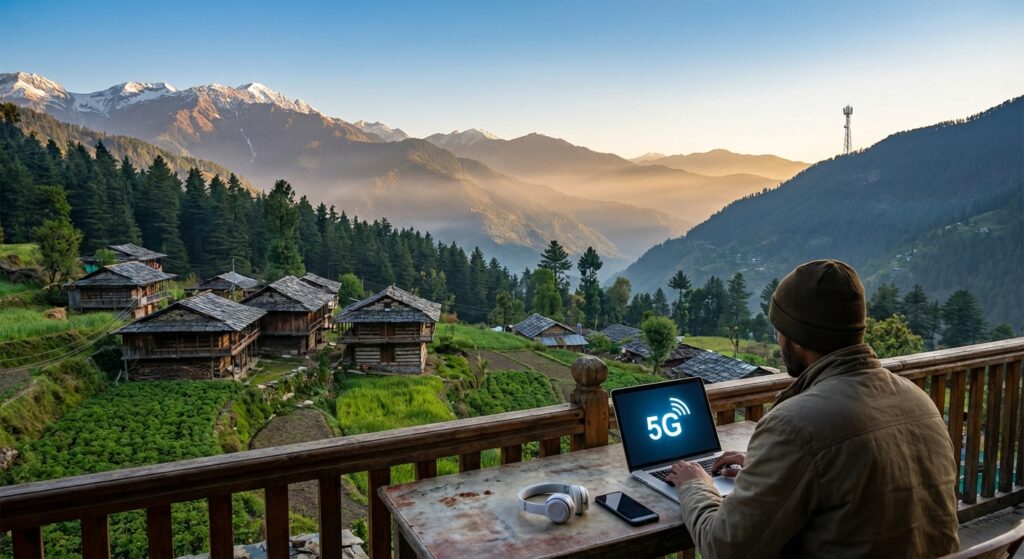
Here’s the modern professional’s paradox: you need to disappear, but you can’t actually disappear. You crave mountain silence and zero notifications, yet your calendar is blocked with Zoom calls through next Thursday. You want to trade your standing desk for a Himalayan sunrise, but WiFi isn’t optional – it’s survival.
Welcome to the era of the “internet-fast village” – remote enough to feel like you’ve vanished, connected enough that your boss has no idea you’re responding to emails from a terrace overlooking rice paddies instead of your cramped Mumbai apartment.
The good news? India’s 5G revolution has quietly transformed some of the country’s most remote villages into accidental coworking paradises. While burnout-fueled urbanites still associate “village life” with disconnection, a new infrastructure reality is emerging: you can now get faster internet speeds in a Himalayan hamlet than in your city high-rise.
The Connectivity Map: India’s 5G Rural Revolution by 2026
India’s 5G expansion has been nothing short of explosive. As of early 2026, the country has achieved near-universal 5G coverage, with services now available across every state and union territory, reaching an impressive 99.6% of all districts. Over 469,000 5G Base Transceiver Stations have been deployed nationwide, with a significant percentage dedicated to non-urban areas.
What makes this rollout particularly revolutionary is India’s strategic use of Fixed Wireless Access technology, which beams high-speed internet wirelessly from cell towers to receivers, bypassing the need for expensive fiber-optic cable installation. Rural areas now receive stable connectivity speeds typically ranging from 50-100 Mbps – more than adequate for video conferencing, cloud-based work, and streaming.
| Metric | Statistics |
|---|---|
| Districts with 5G Coverage | 99.6% |
| Villages with 5G Signal Detection | 77.8% |
| Villages with 4G Coverage | 88.9% |
| Total 5G Base Stations Installed | 469,000+ |
| Total 5G Subscribers | 400+ Million |
| Typical Rural 5G Speed (FWA) | 50-100 Mbps |
The government’s Digital India initiative, combined with private sector investments from telecom giants like Jio, Airtel, Vi, and BSNL, has created a unique moment in connectivity history. India skipped the “fiber-to-the-home” phase for many villages, jumping directly to 5G Fixed Wireless Access – making remote workations not just possible, but practical.
The 7 Secret Villages: Where Detox Meets Download Speed
1. Yakten, Sikkim – India’s Official Digital Nomad Village
The Vibe (The Detox Part)
Perched in Sikkim’s Pakyong district just a short drive from Gangtok, Yakten offers breathtaking Himalayan views, pristine air, and a pace of life that operates on mountain time. This isn’t a tourist trap – it’s a structured community designed specifically for remote workers who want to combine productivity with peace. The village is surrounded by forests and rolling hills, with cultural exchange programs that connect you with local traditions rather than Instagram aesthetics.
The Tech (The 5G Part)
Yakten was officially declared India’s first digital nomad village through a joint initiative by the Pakyong district administration and NGO Sarvahitey. The village is equipped with dual internet lines ensuring reliable connectivity, modern coworking spaces with panoramic mountain views, and eco-friendly accommodations utilizing solar power. Jio and Airtel provide consistent 4G/5G coverage as backup for when you need mobile hotspot support.
Where to Stay
Long-term housing options include eco-lodges with community kitchens, cafés for connecting with fellow nomads, and sustainable homestays ranging from ₹20,000-35,000 per month. Best visited March-June and September-November. Nearest airport: Bagdogra (accessible by scenic road routes).
2. Spiti Valley, Himachal Pradesh – High-Altitude Solitude with Surprising Connectivity
The Vibe (The Detox Part)
At over 12,000 feet, Spiti Valley embodies the “cold desert” aesthetic – stark, lunar landscapes punctuated by ancient monasteries and villages that seem untouched by time. This is where you go to experience genuine isolation, where the loudest sound is wind through barren mountains. The Nako Lake area offers traditional mud houses, sacred pathways, and a spirituality that has nothing to do with wellness branding.
The Tech (The 5G Part)
While Spiti was historically known for zero connectivity, the 2026 5G expansion has reached even these high-altitude villages. Main villages like Kaza and Nako now have Jio and Airtel 4G/5G coverage, with speeds adequate for video calls and cloud work. Many homestays have installed WiFi via local broadband providers. The key is managing expectations – connectivity is functional, not flawless, with occasional drops during extreme weather.
Where to Stay
Ecosphere Homestays offer zero-distraction environments with basic WiFi. Traditional guesthouses in Nako charge ₹1,500-3,000 per night. Permits required (₹50 in Reckong Peo, free in Shimla/Kaza). Best months: May-September when temperatures range 10-25°C. Accessible via cab from Reckong Peo or Manali through the Atal Tunnel.
3. Chitkul, Himachal Pradesh – The Last Village on the Indo-Tibetan Border
The Vibe (The Detox Part)
Located in the Kinnaur district, Chitkul holds the distinction of being the last inhabited village before the Indo-Tibetan border. This means dramatic mountain vistas, winding roads through pine forests, and a village untouched by mass tourism. The clean mountain air and majestic peaks create an environment where your biggest decision is whether to work from your balcony or the riverside.
The Tech (The 5G Part)
Thanks to the government’s push for border connectivity, Chitkul now receives surprisingly strong BSNL and Airtel coverage. The village falls under the enhanced connectivity zones due to its strategic border location. Download speeds hover around 40-70 Mbps – more than sufficient for remote work, video conferencing, and streaming.
Where to Stay
Basic guesthouses and homestays available for ₹1,000-2,500 per night. The Wanderer’s Nest and Chitkul Camps offer longer stays. Best visited April-October before heavy snowfall closes roads. Accessible via Shimla-Rampur-Sangla route (240km from Shimla).
4. Ziro Valley, Arunachal Pradesh – Rice Fields, Tribal Culture, and Reliable WiFi
The Vibe (The Detox Part)
Ziro Valley is where indigenous Apatani tribal culture meets breathtaking rice terraces wrapped in mist. This UNESCO World Heritage Site offers pine forests that smell like rain, mountains that fade into soft blue layers, and a rhythm of life dictated by agricultural cycles rather than quarterly earnings reports. The valley hosts the famous Ziro Music Festival, but outside festival season, it’s profoundly peaceful.
The Tech (The 5G Part)
Airtel and Jio 4G reaches main villages like Siiro and Old Ziro, with coverage that’s functional if not always perfect. Many homestays now offer WiFi via local broadband providers, adequate for moderate remote work needs. Power backup is limited, so plan your heavy work during daylight hours. It’s the perfect “digital detox zone with enough signal to stay connected, not distracted.”
Where to Stay
Homestays range ₹20,000-35,000 monthly with home-cooked meals included. Blue Pine Lodge and Siiro Homestays are popular among remote workers. Best visited March-October. Nearest airport: Lilabari (100km). Inner Line Permit required for Arunachal Pradesh (obtainable online).
5. Nako, Himachal Pradesh – Ancient Lake Village with Modern Internet
The Vibe (The Detox Part)
At 12,000 feet in the Kinnaur district, Nako sits beside a sacred lake surrounded by willow and poplar trees. This tiny village feels like stepping into another era, with ancient Buddhist monasteries, traditional Kinnauri architecture, and a slower pace dictated by harsh mountain winters. The Lipa Asrang Sanctuary nearby hosts Himalayan black bears and musk deer, blissfully unaware of human digital dramas.
The Tech (The 5G Part)
Nako benefits from Himachal’s aggressive rural connectivity push. BSNL’s 5G nationwide rollout has reached this high-altitude village, alongside Airtel 4G coverage. The local monastery now even has WiFi for visiting scholars. Speeds are modest but stable – ideal for email, document work, and the occasional video call when you need to prove you’re “working from the mountains.”
Where to Stay
Monastery guesthouses and traditional homestays available for ₹1,500-3,000 per night. May-September offers the best weather. Accessible via road from Reckong Peo (110km). Carry warm clothing even in summer – temperatures rarely exceed 20°C.
6. Chatpal, Jammu & Kashmir – Kashmir’s Hidden Valley
The Vibe (The Detox Part)
Just 90km from Srinagar, Chatpal remains blissfully unknown to most tourists. This untouched valley offers pure serenity: vibrant meadows, flowing streams, and mountain air so clean it feels medicinal. Far from the crowds of Gulmarg or Pahalgam, Chatpal provides the Kashmir experience without the commercialization. It’s where you reconnect with the concept of “silence” beyond the absence of notifications.
The Tech (The 5G Part)
Following the restoration of 4G services across J&K in 2020 and subsequent 5G expansion, Chatpal now receives solid Jio and Airtel coverage. The Kashmir region has seen major telecom infrastructure investment for both connectivity and security purposes, meaning even remote valleys like Chatpal now have speeds comparable to tier-2 cities (40-80 Mbps).
Where to Stay
Traditional Kashmiri guesthouses and homestays available for ₹2,000-4,000 per night. The Chatpal Retreat offers longer workation packages. Best visited May-October. Accessible via road from Srinagar (3-hour drive). Permit not required, but carry ID for security checkpoints.
7. Vanvadi, Maharashtra – Forest-Farm Near Mumbai
The Vibe (The Detox Part)
For those who can’t commit to Himalayan isolation, Vanvadi offers a remarkable alternative just 100km from Mumbai. This regenerated “forest-farm” at the edge of a remote village in the Western Ghats features over 90% tree cover, water bodies, and 120+ traditionally useful plant species. It’s more forest than farm, providing an unpolluted environment for learning about biodiversity and sustainable living while still being reachable for weekend returns to city life.
The Tech (The 5G Part)
Being within Maharashtra’s connectivity belt means Vanvadi enjoys excellent Jio and Airtel 5G coverage. As a property designed for workshops and educational programs, it’s equipped with reliable WiFi infrastructure. Speeds regularly exceed 100 Mbps – you’re trading Mumbai’s pollution for clean air, not sacrificing internet quality.
Where to Stay
Eco-lodges and dormitory-style accommodations available for workshops and longer stays (₹25,000-40,000 monthly for immersive programs). Participatory forest walks led by Adivasi elders are a highlight. Accessible year-round, though monsoon months (June-September) transform the landscape. Three-hour drive from Mumbai via Kasara.
| Village | State | Altitude | Monthly Cost | Connectivity | Best Season |
|---|---|---|---|---|---|
| Yakten | Sikkim | ~6,000 ft | ₹20,000-35,000 | Dual internet + 5G | Mar-Jun, Sep-Nov |
| Spiti Valley | Himachal Pradesh | 12,000+ ft | ₹45,000-75,000 | 4G/5G (occasional drops) | May-Sep |
| Chitkul | Himachal Pradesh | 11,300 ft | ₹30,000-50,000 | BSNL/Airtel 4G/5G | Apr-Oct |
| Ziro Valley | Arunachal Pradesh | 5,500 ft | ₹20,000-35,000 | Jio/Airtel 4G | Mar-Oct |
| Nako | Himachal Pradesh | 12,000 ft | ₹45,000-60,000 | BSNL 5G/Airtel 4G | May-Sep |
| Chatpal | J&K | 7,800 ft | ₹40,000-60,000 | Jio/Airtel 5G | May-Oct |
| Vanvadi | Maharashtra | 2,000 ft | ₹25,000-40,000 | Jio/Airtel 5G 100+ Mbps | Year-round |
Packing List for a Village Workation: The Essentials
Remote villages aren’t city apartments – infrastructure can be unpredictable, and you can’t Swiggy your way out of forgetting essentials. Here’s what seasoned village-hoppers never leave behind:
Power & Connectivity
- High-capacity power bank (20,000mAh minimum): Rural areas experience power cuts, sometimes for hours. A robust power bank keeps your laptop and phone alive through outages.
- Portable WiFi hotspot device: While 5G is reaching villages, having a backup Jio/Airtel MiFi device with a separate SIM provides redundancy when primary connections falter.
- Universal power adapter with surge protection: Village electrical systems can be unstable. Protect your expensive electronics.
- Solar charger: For extended stays in high-altitude areas where both electricity and sunlight are abundant but unreliable.
- Extension cord (10-15 feet): Village accommodations often have limited outlet placement. Don’t end up working from the floor because the socket is near the door.
Work Setup
- Noise-canceling headphones: Village life includes roosters, temple bells, and excited children. Quality ANC headphones create your portable office.
- Laptop stand: Working from a proper desk height prevents neck strain. Foldable stands travel well.
- External keyboard and mouse: If you’re staying more than a week, proper ergonomics matter. Your wrists will thank you.
- Blue light glasses: High-altitude sunlight is intense. Protect your eyes for those sunset work sessions.
- Notebook and pens: Internet drops are less frustrating when you can jot notes offline.
Health & Comfort
- First aid kit with altitude sickness medication: For villages above 8,000 feet, carry Diamox or its equivalent. Headaches at altitude are real.
- Water purification tablets/portable filter: While most homestays provide filtered water, having backup purification ensures you don’t lose work days to stomach issues.
- Thermal layers and rain gear: Mountain weather is unpredictable. Carry merino base layers and a good rain jacket even in summer.
- Sunscreen (SPF 50+) and moisturizer: High-altitude UV rays are brutal. Dry mountain air destroys skin moisture.
- Basic medicines: Pain relievers, anti-diarrheal medication, antihistamines, and any prescription medications. Village pharmacies are limited.
Food & Hydration
- Reusable water bottle (insulated): Stays hot in freezing mornings, cold during afternoon hikes.
- Instant coffee/tea packets: Not all homestays stock your preferred caffeine format. Emergency coffee is not optional.
- Protein bars and nuts: For days when you’re on deadline and the nearest meal is two hours away.
- Electrolyte powder: Altitude and exertion drain electrolytes faster. Prevents the dreaded altitude headache.
Documents & Miscellaneous
- Multiple ID proofs (physical + digital): Border areas and restricted zones require verification. Carry Aadhaar, PAN, passport copies.
- Permits (where required): Download Inner Line Permits for Arunachal Pradesh, restricted area permits for Sikkim/Himachal border areas before you lose internet access.
- Cash (₹10,000-20,000): Villages operate on cash. ATMs are rare and often non-functional.
- Portable door lock: Not all guesthouses have secure room locks. A small travel lock adds security.
- Headlamp/flashlight: Street lighting is minimal to non-existent. Essential for midnight bathroom trips.
- Ziploc bags: Protect electronics from unexpected rain, dust, and spills.
| Category | Must-Have (Essential) | Nice-to-Have (Optional) |
|---|---|---|
| Power | Power bank, backup SIM/hotspot, adapter | Solar charger, voltage stabilizer |
| Work Gear | Laptop, headphones, chargers | External monitor, mechanical keyboard |
| Health | First aid, altitude meds, sunscreen | Fitness tracker, yoga mat |
| Clothing | Thermal layers, rain jacket, trekking shoes | Fancy dinner outfit (you won’t need it) |
| Documents | IDs, permits, insurance, cash | Physical books, travel journal |
Conclusion: Choose Your Village, Reclaim Your Focus
The future of work isn’t returning to the office – it’s discovering that “the office” can be anywhere with stable WiFi and a view that doesn’t involve traffic. India’s 5G rural expansion has created an unprecedented opportunity: you can now access mountain solitude without sacrificing career momentum.
These seven villages represent more than just coordinates on a connectivity map. They’re proof that the old binary – digital life versus nature – is dissolving. You don’t have to choose between career ambition and mental peace, between productivity and presence. In 2026, you can have both, provided you’re willing to trade the urban grind for mountain silence punctuated by the occasional Zoom notification.
The data is clear: with 99.6% district coverage, 469,000 5G towers, and 400+ million subscribers, India has built the infrastructure for a new kind of escape. Not the “delete-your-email-and-find-yourself” fantasy sold by wellness retreats, but something more sustainable – a life where work happens in four focused hours against Himalayan backdrops, leaving afternoons free for actual living.
Your inbox will still be waiting. The difference is, when you open it, you’ll be breathing clean mountain air instead of recycled AC fumes. The Slack messages will still arrive. The difference is, you can mute them and walk to a monastery instead of a coffee shop chain.
Which Village Is Calling Your Name?
Drop a comment below and tell us: Which of these seven villages would you choose for your first month-long workation? Are you team Himalayan solitude (Spiti/Chitkul) or team accessible escape (Vanvadi/Yakten)? Have you already discovered your own internet-fast village? Share your experience – this list is just the beginning. India has thousands of connected villages waiting to be discovered by the next generation of location-independent professionals.
The mountains are no longer disconnected. They’re just differently connected. And that difference might be exactly what you need.
Leave a Reply